Imagine trying to study the foundations of an ancient city while it's still being built. The noise is deafening, the dust is everywhere, and the whole place is barely visible through the haze. That is almost exactly the challenge astronomers face when trying to understand how vast cities of hundreds of galaxies first came into being. A new discovery has just given them their best look yet.
Space News & Blog Articles
Tune into the SpaceZE News Network to stay updated on industry news from around the world.
The Stars That Lit Up the Early Milky Way
Imagine trying to reconstruct the history of a city by studying only its oldest surviving buildings. You can't watch it being built, you can't interview the architects, all you have are the structures themselves, their materials, their arrangement, the subtle clues locked into their very fabric. That is essentially what astronomers do when they study the formation of our Galaxy, and a new study has just given them their biggest collection of clues yet.
Would Earth Still Be Habitable Without Us?
Here's a thought experiment that keeps planetary scientists awake at night. Strip every living thing from our planet, every bacterium, every blade of grass, every creature that has ever drawn breath and ask a simple but profound question: would Earth still be a world capable of supporting life?
NASA Updates Artemis Program, Adding a Mission and Delaying Lunar Landing
Earlier today, NASA announced that it would be increasing the cadence of its missions to meet its objectives under the Artemis Program. It is also making changes to its mission architecture to include a standard vehicle configuration and undertake one surface landing every year after 2027. In real terms, this means that a lunar landing will not take place as part of Artemis III in 2027, but during Artemis IV, currently scheduled for 2028. Instead, Artemis III will involve a rendezvous in Low Earth Orbit (LEO) to test the systems and operations for the first lunar landing in over sixty years.
Jupiter Is Smaller and Flatter Than Previously Thought
Jupiter is the largest planet in the solar system and has proudly boasted about this since time immemorial, with its scientific confirmation occurring by Galileo Galilei in 1610. It was later found that Jupiter has a bulging equator caused by its rapid rotation, turbulent atmosphere, and complex interior mechanisms despite its massive size, and scientists have even measured its “waistline” down to a tenth of a kilometer. Now, imagine being the largest planet in the solar system and you’re told you’re not as big as you thought. Where probably most humans would be thrilled to find this out, how do you respond if you’re Jupiter?
February finale: SpaceX wraps up month with three Starlink launches this week
Two Falcon 9 launches from Florida and one from California deployed 83 Starlink satellites into low Earth orbit, wrapping up February 2026 for the SpaceX network.
Apollo moon rocks may have finally solved an old lunar mystery
A new analysis of Apollo moon samples reveals insight into the history of the lunar magnetic field.
The LOFAR Telescope Produces the Most Detailed Radio Map of the Universe Ever
Radio astronomy offers scientists a means of observing the "unseen" Universe, where a wide range of natural phenomena take place that optical telescopes cannot observe. This is the purpose behind the Low-Frequency Array (LOFAR), a massive radio telescope with stations all across Europe. It is the largest and most sensitive radio telescope in the world, operating at low frequencies (10–240 MHz). After ten years of surveying the sky, the LOFAR Collaboration has produced the most detailed radio map of the Universe ever made.
Nostrovia! We finally got our 1st look at Apple TV's 'Star City,' the Soviet 'For All Mankind' spinoff
See how the space race evolved from the other side in this new sci-fi series coming in May
The US Air Force's latest X-plane looks like a missile — that shoots other missiles
The U.S. military is developing a new experimental aircraft known as the X-68A and looks a lot like a cruise missile that is also capable of launching its own missiles.
Unique Facts about Pluto
Pluto, once considered the ninth planet, is now classified as a dwarf planet. It resides in the Kuiper Belt, a doughnut-shaped region of icy bodies beyond Neptune. Despite its reclassification, Pluto holds many unique and fascinating characteristics.
If Godzilla attacked, could we survive? We asked the experts
Let's say Godzilla exists and walks among us like in Monarch: Legacy of Monsters. Could humans actually stop him, or even survive? We spoke to the experts to find out.
NASA's Artemis 3 astronauts won't land on the moon after all. 'This is just not the right pathway forward.'
NASA is changing its plans to return astronauts to the moon, and redrawing the architecture for how the Artemis missions will look moving forward.
6 Million Years Ago Something Slammed Into Modern-Day Brazil
Giant mpacts on Earth's surface can be cataclysmic events with far-reaching consequences. They can excavate massive craters like the Vredefort Crater. There's also growing evidence that impacts powerful enough can create a massive underground hydrothermal system of cracks and chemistry that could be conducive to life.
NASA announces major overhaul of Artemis moon program: “We’ve got to get back to basics”
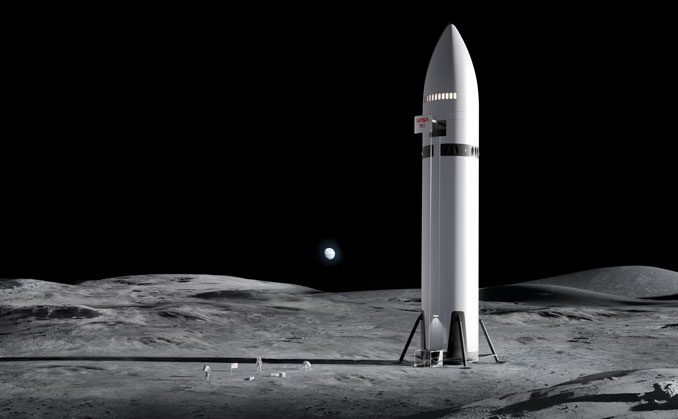
Artist concept of a SpaceX Starship lunar lander on the surface of the moon. Image: SpaceX.
New NASA Administrator Jared Isaacman announced a major overhaul of the agency’s Artemis moon program Friday, acknowledging that the agency’s plan to land astronauts on the moon in 2028 was not realistic without another preparatory mission first to lay the groundwork.
The total lunar eclipse tonight will be the last until New Year's Eve 2028
After this 'blood moon,' our natural satellite will not fully disappear into Earth's shadow again for nearly three years — until a rare trifecta of total lunar eclipses in 2028–29 ends the drought.
Lego Star Wars AT-AT 75440 review
One of 2026's must-have Lego Star Wars sets — the excellent mid-sized AT-AT model.
In-flight call with ESA astronaut Sophie Adenot
Video: 00:19:11
On 26 February, ESA astronaut Sophie Adenot conducted her first in-flight call with selected French media.
Artemis 2 moon rocket rolls back to the shop | Space photo of the day Feb. 27, 2026
NASA brought its mega moon rocket back into the shop for repairs on Feb. 25, 2026, just as the sun was setting over the Florida Space Coast.
Herhoter Galaxy star projector review
With a small form factor and a seriously low price, the Herhoter Galaxy star projector is a great buy for anyone wanting nebula projections on a budget.