Video: 00:07:42
2025 marks a landmark year for Europe’s ‘bridge between Earth and space’. The European Space Agency’s Estrack satellite tracking network turns 50.
Video: 00:07:42
2025 marks a landmark year for Europe’s ‘bridge between Earth and space’. The European Space Agency’s Estrack satellite tracking network turns 50.
NASA's Perseverance rover has found minerals that could have powered life on Mars — or simply shaped the Red Planet's environment in fascinating ways.
It's Harvest Moon week, when the Moon shines low and bright at nightfall for many days running. Along the way it passes edge-on Saturn.
Image: This Copernicus Sentinel-2 image captures an active lava lake on the Kilauea volcano on Hawaii’s Big Island.
Astronomers using JWST have captured the sharpest infrared view yet of the supermassive black hole jet in M87, offering new insights into its structure and physics.
China's Tianwen 2 spacecraft took a picture of itself, as well as the Earth, while en route to a mysterious asteroid that may tell us more about the moon's history.
ESA is making use of spacecraft originally dedicated to its Mars and Jupiter missions to track comet 3I/ATLAS as it continues its journey through our solar system
Spacecraft orbiting the Red Planet will aim a suite of instruments at Comet 3I/ATLAS to capture details about this enigmatic object.
Modeling something like geysers on a far-away moon seems like it should be easy. How much complexity could there possibly be when a geyser is simply a hole in some ice shooting superheated water through it? The answer is pretty complex, to be honest - enough that accurate models require a supercomputer to run on. Luckily, the supercomputing cluster at the University of Texas, known as the Texas Advanced Computing Center, gave some time to researcher modeling Enceladus’ ice plumes, and their recent paper in JGR Planets discusses the results, which show there might not be as much water and ice getting blown into orbit as originally thought.
Interest in icy moons has been growing steadily as they become more and more interesting to astrobiologists. Some take the majority of the attention, like Enceladus with its spectacular geysers. But there are interesting ones that might be hiding amongst even thicker ice shells in the Uranian system. A new paper published in Icarus from researchers at the Planetary Science Institute, Johns Hopkins University, and the University of North Dakota, looks at what Ariel, the fourth biggest moon in the Uranian system, might look like under its icy surface.
Enceladus’ ice continues to get more and more intriguing as researchers continue to unlock more secrets taken from a probe over ten years ago. When Cassini crashed into Saturn in 2017, it ended a 13 year sojourn that is still producing new research papers today. A recent one in Nature Astronomy from the researchers at the Freie Universität Berlin and the University of Stuttgart found hints of organic molecules discovered for the first time on the icy moon, some of which could serve as precursors to even more advanced biomolecules.
File photo of a SpaceX Falcon 9 rocket at pad 4E ready to launch a Starlink mission. Image: SpaceX
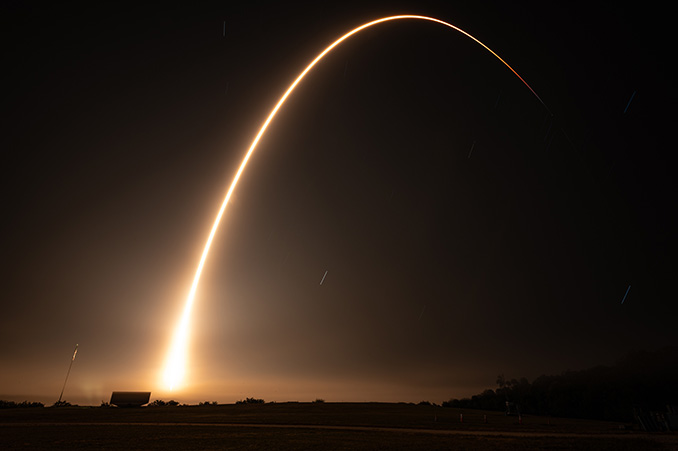
SpaceX is preparing to launch its 125th Falcon 9 rocket of 2025, which will carry a batch of Starlink V2 Mini satellites into low Earth orbit. The company’s first mission of the month will take flight from Vandenberg Space Force Base Friday morning.
Paying tribute to the 'Star Trek' creator's posthumous space adventure that still resonates with fans today.
How Ridley Scott's third sci-fi masterpiece proved there is life on Mars after all, by telling a deeply human, and oddly familiar story.
The first supermoon of 2025 rises on Oct. 6 close to the gas giant Saturn.
A new rainbow spectrum from the STELES instrument on Chile's SOAR Telescope captures Eta Carinae in unprecedented detail.
Video: 00:03:16
ESA’s Mars Express takes us on another mesmerising flight over curving channels carved by water, islands that have resisted erosion, and a maze of hilly terrain.
Auroras may be visible from Alaska to New York as geomagnetic storm conditions are predicted to continue tonight.
Astronomers used the Very Large Telescope to find exoplanet Cha 1107-7627 which is consuming gas and dust at an incredibly fast rate.
The discovery strengthens the case for a new mission to orbit and land on Enceladus and search for evidence of life.
An unstable group of asteroids orbiting near Venus could threaten Earth — but not for a few thousand years
All Rights Reserved. 2026. SpaceZE.com