
The planet Uranus is a weird place. Not only does it roll around the Sun on its side once every 84.3 Earth years, it also sports a spindly set of rings corralled in some places by strange little moons. Two of those rings, the μ (mu) and ν (nu) rings are incredibly faint, which makes them challenging to study.
Observations by Hubble Space Telescope (HST), the James Webb Space Telescope (JWST), combined with data from the Keck Observatory on Mauna Kea in Hawai'i, show that those two rings are two different colors. The observations that revealed the differences are reflectance spectra that measured the sunlight reflected from the ring's particles. “By decoding the light from these rings, we can trace both their particle size distribution and composition, which sheds light on their origins, offering new insight into how the Uranian system and planets like it formed and evolved,” said Imke de Pater, professor at the University of California, Berkeley, and lead author of a paper discussing the findings.
The μ ring looks blue in the spectra and is made largely of icy particles. It likes about 98,000 kilometers from Uranus's cloud tops. Interestingly, Saturn's E ring is also blue, and its particles come from the moon Enceladus. The Uranian μ ring and Saturn's E ring are the only two such rings known in the Solar System.
The ν ring, which appears red in the spectra and lies about 67,000 kilometers from Uranus's cloud tops is dusty and consists of 10–15% carbon-rich organics. The differences in composition between the two rings raise a lot of questions about the origins of their materials and the mechanism for their presence in the two rings.
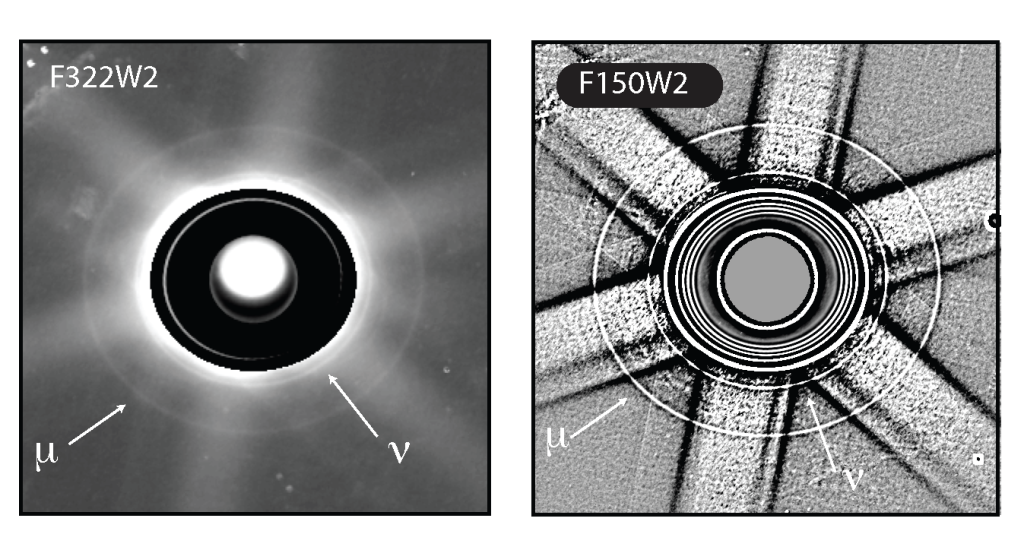 *Uranus outer ring system as imaged with JWST on February 2, 2025 in broadband filters centered at 3.2 mm (left) and 1.5 mm (right). Both μ and ν rings are indicated by arrows. Left: Image F322W2: to visualize the entire system, Uranus and its main ring system intensity is diminished by a factor of 100. Right: Image F150W2: In order to see the ings above the scattered light from Uranus and the main rings, this image has gone through a high-pass filter. Credit: NASA, ESA, Image processing: Imke de Pater, Matt Hedman*
How Could they Be So Different?
According to de Pater, the sources are very different. "The ν ring material is sourced from micrometeorite impacts on and collisions between unseen rocky bodies rich in organic materials, which must orbit between some of the known moons,” she said. “One interesting question is why the parent bodies sourcing these rings are so different in composition.”
The source of ice particles for the μ ring turns out to be the icy moon Mab. It was discovered in 2003 via HST observations and based on the most recent observations, appears to be mostly water ice. Since it orbits the same distance from Uranus as the μ ring, it likely renews the ring particles with tiny ice grains that get knocked off Mab's surface by small impacts.
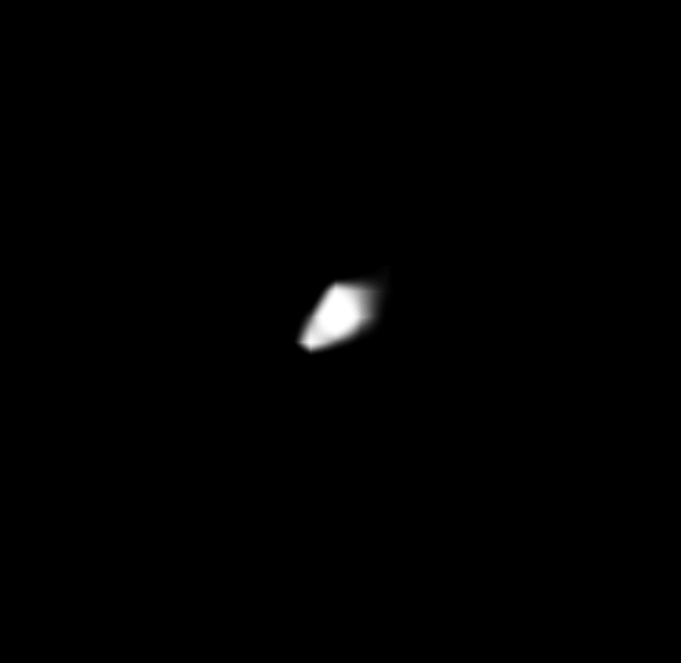 *Mab, a small moon orbiting Uranus and source of material for the μ ring. Courtesy NASA/ESA/STScI*
Why is Mab so different from Uranus's other inner moons? Those are mostly rocky bodies, and Mab's composition remains something of a mystery. The answers will come from further studies of the dynamical evolution of the outer Solar System over time. Flyby images would also help scientists understand more about the compositions of Mab and other moons circling Uranus.
The History of the Uranian Rings
Uranus's rings were the second set to be discovered in the Solar System, after Saturn's. They were first observed in 1977, and the Voyager 2 spacecraft later found two more rings, during its flyby in 1986. HST later found two outer rings in observations beginning in 2003. Unlike Saturn's collection, Uranus's rings are faint and narrow, some only a few kilometers wide. Some of the rings are optically dense (meaning they're thicker) while others are very thin.
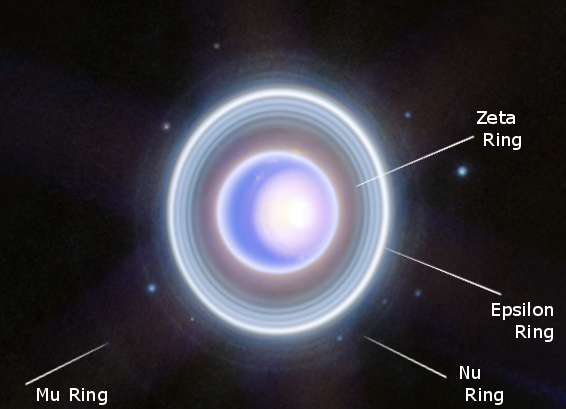 An annotated version of the Uranian moons. Public Domain.
The Uranus ring system is probably quite young. Some estimates put its age at around 500 to 600 million years old and it almost certainly originated from the collisions of several moons that once orbited the planet. Those collisions resulted in smaller chunks, which themselves collide to create smaller particles and dust. Eventually, that material collected into rings that get continually refreshed by other, smaller collisions with Mab and another so far unobserved object in the system. Planetary scientists are still working to understand the mechanism that keeps these rings so narrow. Shepherd moons may play a role, but that has yet to be proven since not every one of the narrow rings is bounded by a pair of small moons.
Scientists using Keck, JWST, and HST will continue to monitor changes in the Uranian rings, including the shifts in brightness, which could indicate renewed activity in the system. “We see hints that the µ ring’s brightness changes over time, and what could be causing those changes is still a mystery” added Matt Hedman, co-author and professor at the University of Idaho.
For More Information
New Study Uncovers Distinct Origins of Uranus’s Two Outer Rings
