
Space News & Blog Articles
Live coverage: SpaceX to launch final ViaSat-3 satellite on Falcon Heavy rocket
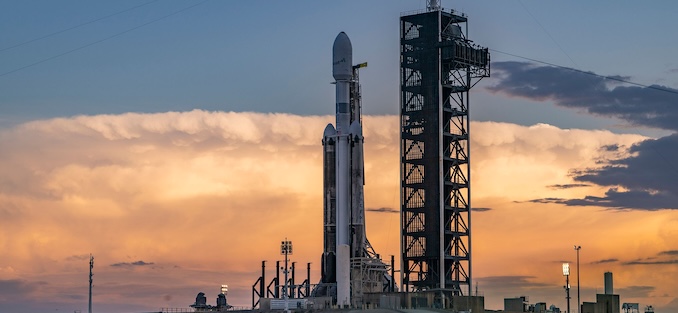 SpaceX’s Falcon Heavy rocket stands in the vertical launch position ahead of the flight of the ViaSat-3 Flight 3 mission for Viasat. Image: SpaceX
SpaceX is preparing to launch its first Falcon Heavy rocket in more than a year and a half. The Monday morning flight of the triple booster rocket from NASA’s Kennedy Space Center will feature the landing of the two side boosters at Cape Canaveral Space Force Station.
The mission will send the ViaSat-3 Flight 3 communications satellite to a geosynchronous transfer orbit. The six-metric-ton satellite is set to deploy from the rocket’s upper stage nearly five hours after leaving the pad.
“It’s kind of the end of an era. We’ve been working this program for over 10 years now. So that’s a good chunk of life that’s gone by over the course of the program,” said Dave Abrahamian, Viasat’s vice president of Satellite Systems.
“It’s a different world now than when we started the program. Back then, we had a handful of satellites in orbit. Since then, we’ve launched the two ViaSat-3s, we merged with Inmarsat, we’ve got the third one (ViaSat-3) ready to go now. So totally different world, different feeling, and its pretty cool to have been part of it all.”
Liftoff from Launch Complex 39A is scheduled for 10:21 a.m. EDT (1421 UTC), the opening of an 85-minute window. The Falcon Heavy rocket will fly on an easterly trajectory upon launch.
Spaceflight Now will have live coverage beginning about two hours prior to liftoff.
The 45th Weather Squadron forecast a 70 percent chance for favorable weather during Monday’s launch window. Meteorologists said they’re watching for violations of the cumulus cloud and the surface electric fields rules.
“A Carolina Low is expected to push a weak back door cold front through central Florida early Monday morning,” launch weather officers wrote in their forecast. “With the primary window opening around the time the sea breeze will develop, the position of that frontal boundary will determine if clouds are enhanced over the Spaceport.”
The three boosters SpaceX will fly on the mission are a combination of old, new, and brand new. The two side boosters, tail numbers 1072 and 1075, will be flying for a second and 22nd time respectively.
Those will separate from the center core, tail number B1098, and target landings at Landing Zone 2 (LZ-2) and Landing Zone 40 (LZ-40). The latter of the two is adjacent to Space Launch Complex 40 and is to the north of LZ-2.
SpaceX will not attempt to recover B1098 and it will be expended into the Atlantic Ocean, concluding its first and only flight.
 SpaceX’s design for the ViaSat-3 F3 mission patch. Graphic: SpaceX
Flying Falcon Heavy
The launch of the ViaSat-3 F3 mission marks the 12th flight of a Falcon Heavy rocket, which made its debut in 2018. Two of those missions carried ViaSat-3 satellites onboard.
Abrahamian noted that the time for on-orbit commissioning will be shorter than that of the Viasat-3 F2 satellite which flew on a United Launch Alliance Atlas 5 rocket. He said orbit raising to the operating position at the 158.55 degrees East position along the equator will take about two months.
“Falcon Heavy is a more powerful vehicle than Atlas 5 was, so they can put us in a more favorable transfer orbit for the electric propulsion,” Abrahamian said. “So they’re going to drop us off in an orbit, hopefully, that is just below [geostationary Earth orbit] apogee-wise, about 23,000 kilometers perigee-wise, and only about three degrees of inclination. So, it’s a very [electric propulsion]-friendly orbit.”
He said it will take at least a couple of months after that to go through the various deployment stages on the satellite and conduct checkouts before the satellite manufacturer, Boeing, hands the vehicle over to Viasat for operational use.
ViaSat-3 F2, which flew on Atlas 5 in November 2025, is still completing its on orbit checkout and is slated to begin operational service in the near future. We asked Abrahamian if he saw any challenges or key differences between the work to vertically integrate Viasat’s payload versus horizontal integration, since his company has done both.
“If you had asked me that before F2 happened and before all the weather challenges with stacking F2 I would have said no. But now, having been through that and doing this, there’s certainly much more flexibility in not having as many constraints on you when you’re doing horizontal integration,” Abrahamian said. “It presents its own set of challenges when you have to roll out to the pad, align very carefully, to pad infrastructure and then go vertical. So that’s a challenge that Atlas doesn’t have. Each system seems to work for each provider.”
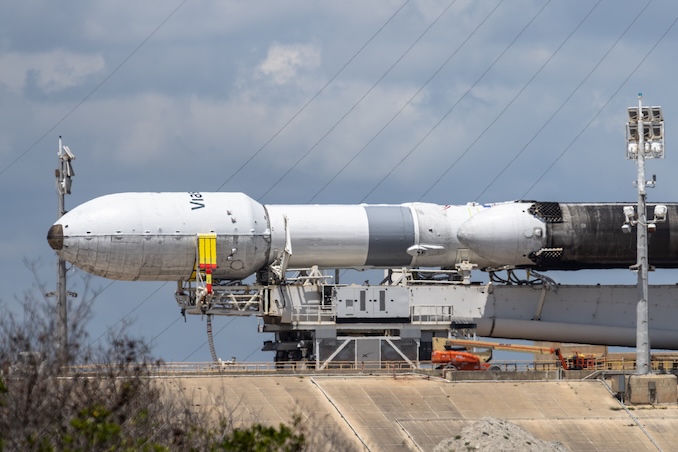 The SpaceX Falcon Heavy rocket supporting the ViaSat-3 F3 mission lies in the horizontal position at Launch Complex 39A at NASA’s Kennedy Space Center. Image: Adam Bernstein/Spaceflight Now
Adding capacity
This third and final satellite in the ViaSat-3 constellation will target its area of coverage over the Asia-Pacific region and is intended to add more than one Terabit per second (Tbps) of capacity to the overall Viasat network.
“We have a number of airline customers in the APAC region that are really anxious to get this capacity online so they can start serving their customers better,” Abrahamian said. “Two of the hallmarks of the ViaSat-3 constellation are a huge amount of just absolute capacity, but also the flexibility to put it wherever you need it, whenever you need it.
“So it’s not like a traditional satellite, like a ViaSat-1, or Ka sat, or most of the Inmarsat fleet, where you’ve got a single feed per beam, beam locations are fixed, spectrum allocations are fixed and you might overload one beam over here and another beam doesn’t have anybody in it and you can’t move that capacity.”
Abrahamian said the advantage of these newer satellites is their overall flexibility.
“ViaSat-3 because we’re using a phased array technology and our antennas onboard, we can form a beam wherever we need it,” he said. “We can allocate spectrum to it as we need it. We can put multiple beams in an area as needed. So we really don’t have the issue of trapped capacity here. So it’s a matter of following the demand wherever it is, within that spacecraft’s field of view.”
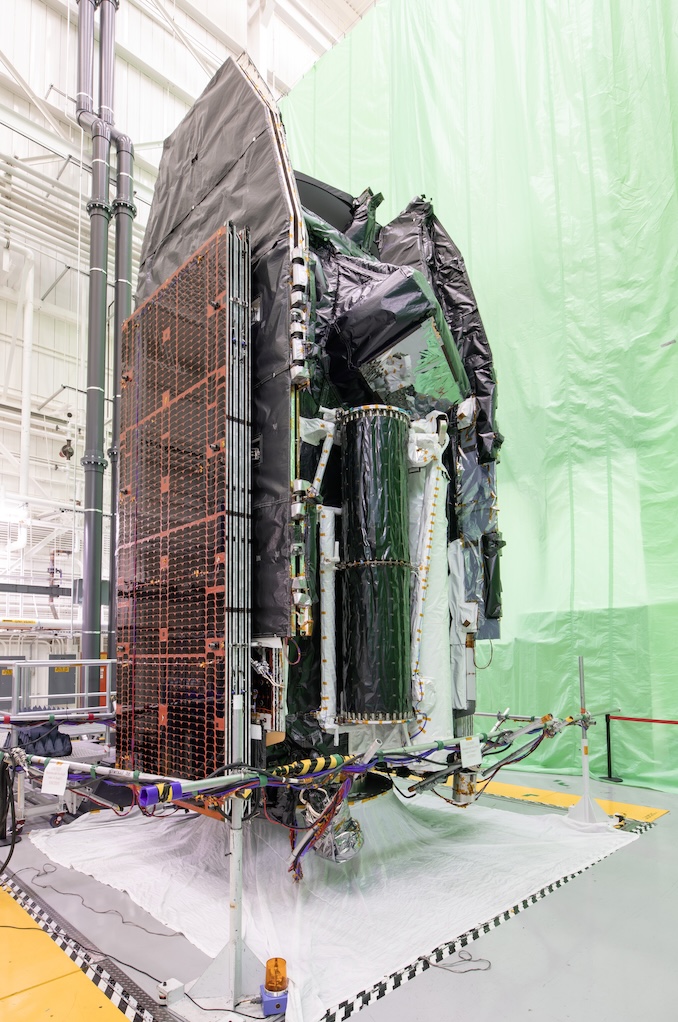 The ViaSat-3 Flight 3 satellite is seen inside Boeing’s test facilities in El Segundo, CA. Image: Boeing
When you subscribe to the SpaceZE News Feed, we will send you an e-mail when there are new updates on the site so you wouldn't miss them.
