
The chemical is known as thiepine, or 2,5-cyclohexadiene-1-thione (C₆H₆S), a ring-shaped sulfur-bearing hydrocarbon produced in biochemical reactions. When examining the molecular cloud G+0.693–0.027, a star-forming region about 27,000 light-years from Earth near the center of the Milky Way, astronomers from the Max Planck Institute for Extraterrestrial Physics (MPE) and the CSIC-INTA Centro de Astrobiología (CAB) detected this complex molecule in space for the first time. This detection represents the largest sulfur-bearing molecule ever detected beyond Earth, with significant implications for the study of the cosmic origins of life.
By combining astronomical observations with laboratory experiments, they confirmed the presence of this six-membered, 13-atom molecule in a region of space similar to the cloud of gas and dust (nebula) from which new star systems form. The team synthesized the molecule in the laboratory by subjecting liquid thiophenol (C₆H₅SH), a related hydrocarbon, to a 1,000-volt electrical discharge and then examined the results using a custom-built spectrometer. This enabled them to measure the precise radio-frequency emission of the resulting thiepine molecules.
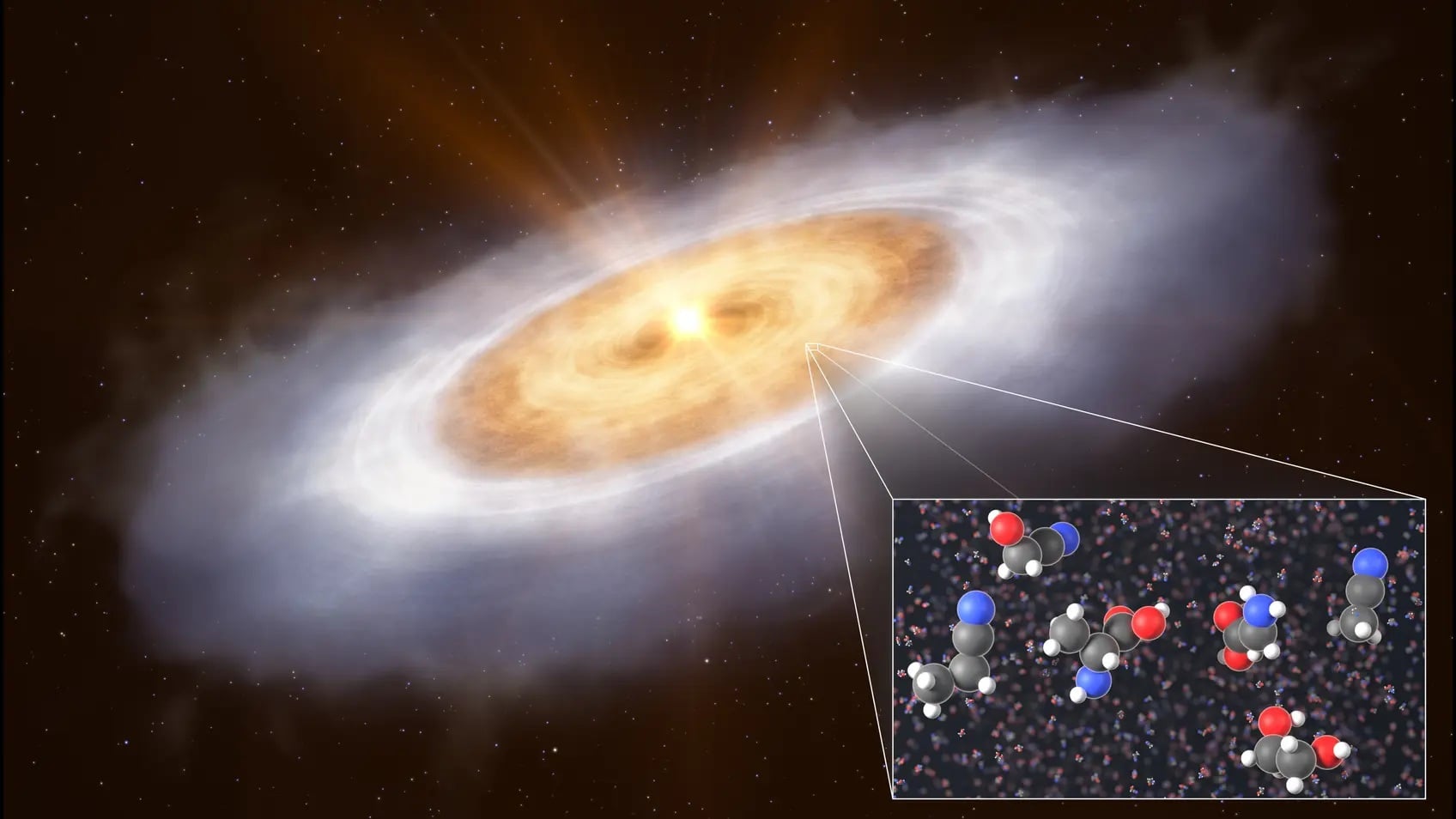 The chemical structure of complex organic molecules detected in a protoplanetary disc. © Credit: ESO/L. Calçada/T. Müller (MPIA/HdA)
They then compared this spectral signature to data obtained by CAB astronomers using the IRAM 30-meter and the Yebes 40-meter radio telescopes in Spain. Until now, astronomers had only detected small sulfur compounds of six atoms or fewer in interstellar space, which play an essential role in proteins and enzymes. Meanwhile, larger sulfur-bearing molecules like thiepine remained elusive, so the gap between the types of organics found in meteorites and the chemistry observed in space persisted. The newly discovered thiepine molecule is structurally related to molecules found in meteorite samples.
This demonstrates, for the first time, a connection between astrochemistry and life on Earth. "This is the first unambiguous detection of a complex, ring-shaped sulfur-containing molecule in interstellar space—and a crucial step toward understanding the chemical link between space and the building blocks of life”, said lead author Mitsunori Araki, a researcher at MPE. "Our results show that a 13-atom molecule structurally similar to those in comets already exists in a young, starless molecular cloud. This proves that the chemical groundwork for life begins long before stars form”, added co-author Valerio Lattanzi, a scientist at MPE.
The discovery suggests that many more complex sulfur-bearing molecules likely remain undetected in interstellar space. The results also bolster recent findings from Aarhus University and the Institute for Nuclear Research that showed how peptides, another crucial ingredient for life, can form in interstellar space spontaneously. These and other findings indicate that the origins of life reside in space, and are far more plentiful than previously thought!
Further Reading: Max Planck Institute for Extraterrestrial Physics, Nature Astronomy
