
The search for life-supporting worlds in the Solar System includes the Jovian moon Europa. Yes, it's an iceberg of a world, but underneath its frozen exterior lies a deep, salty ocean and a nickel-iron core. It's heated by tidal flexing, and that puts pressure on the interior ocean, sending water and salts to the surface. As things turn out, there's also evidence of ammonia-bearing compounds on the surface. All these things combine to provide a fascinating look at Europa's geology and potential as a haven for life.
Data from the Galileo spacecraft, which orbited in the Jupiter system from 1995 to 2003, contained clues to the presence of those ammonia compounds, but it took until now for them to be found. NASA/JPL scientist Al Emran took a closer look at measurements made by the Near-Infrared Mapping Spectrometer. He found faint ammonia absorption bands at 2.2 microns near cracks in the Europan surface. Those cracks are the main conduits for liquid water to rise from deep below, in a form of eruptive activity called cryovolcanism.
That water likely carried ammonia along with it, depositing it on the surface. The fact that ammonia can't survive long in space means that the ammonia Galileo's instrument detected was dredged up and deposited relatively recently in geologic terms. It also means that the presence of ammonia has changed the chemistry of the ocean. The presence of nitrogen (via the ammonia) has astrobiological implications.
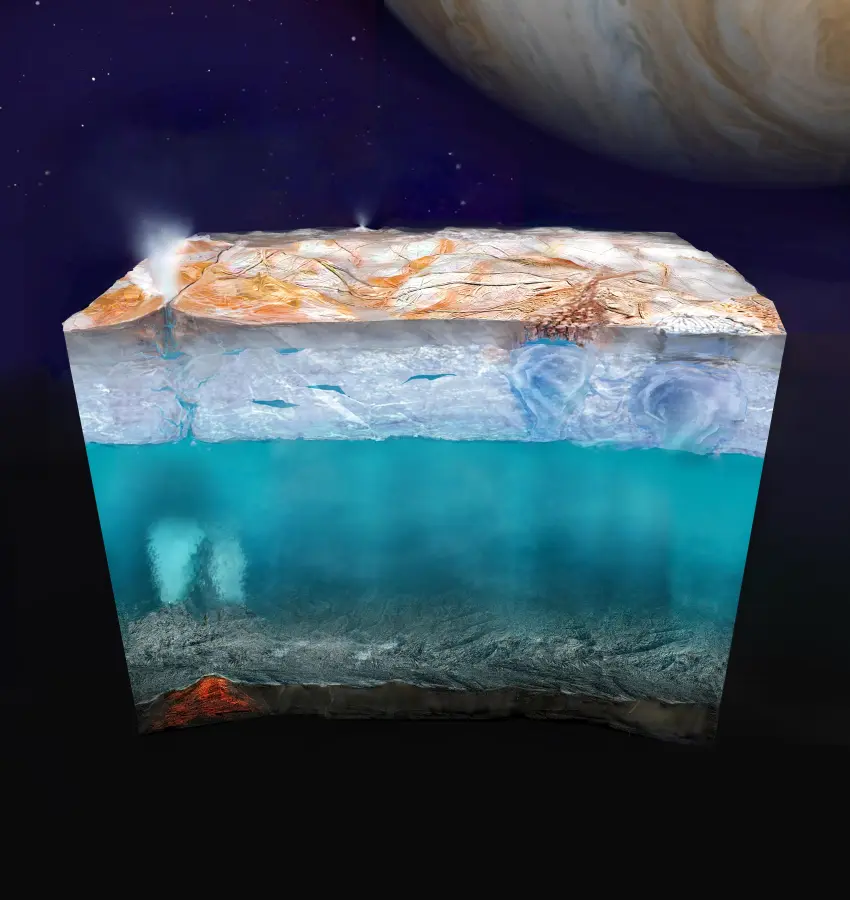 A cross-section of what scientists think lies under the icy Europan crust. There's a saltwater ocean that contains twice as much water as all of Earth's oceans, overlying a rocky core. Tidal flexing heats the interior and could help render this a suitable environment for life to develop. NASA/JPL-Caltech.
Ammonia, Cryovolcanism, and Life
The chemical formula for ammonia is NH3, a combo of nitrogen with hydrogen. Nitrogen is an important part of life and plays a role in the formation of amino acids, DNA, chlorophyll, and proteins. On Earth, specific types of bacteria convert atmospheric nitrogen gas (N2) into ammonia, which many living organisms need for growth. Now, the presence of ammonia and nitrogen doesn't automatically mean that life exists on Europa, but it does provide some evidence of a hospitable environment. In addition, it gives clues to the geological activity in and on this moon.
Europa isn't the only place where NH3-bearing compounds have been found in the Solar System. It's an important component on many icy bodies, inlcuding Pluto, Charon, Nyx, Hydra, the Uranian moons Ariel, Miranda, Umbriel, Oberon and Titania. Plumes rushing up from Enceladus's subsurface ocean also contain traces of it. Other places have shown possible existence of ammonia compounds. So, it's not a rare find. But, finding it has been difficult since the signals get buried in detections of other materials. Finding it on Europa confirms the ubiquitous presence of ammonia. Geologically, ammonia plays a role in changing a water ocean's characteristics. Among other things, this compound lowers water's freezing point quite a bit. As water ice does form on Europa's surface, the ammonia concentrations go up.
Europa is a Busy World
Observations of Europa's surface by JWST show the terrain is being modified by ongoing cryovolcanism within very recent times. Water brought to the surface and frozen into place will start to get driven away by energetic particle activity in a couple of weeks, leaving behind deposits of ammonia and other compounds. In the re-study of Galileo data, Emran's detection of a 2.2-micron absorption feature show the presence of NH3-hydrate (ammonia dissolved in water) and NH4-chloride (a water-soluble salt crystal). The presence of these and other compounds is giving off clues to extensive geological activity on Europa (occurring within well less than a million years).
Finding ammonia compounds on this moon gives a push to the science planned to be done with NASA's Europa Clipper. That mission launched on October 14, 2024 and will arrive at the Jupiter system in 2030. One of its main aims is to determine if Europa has any habitable conditions beneath its frozen surface. The fact that it has a liquid ocean and promising deposits of organic compounds will give the instruments on the Clipper an up-close and personal opportunity to look for the building blocks of life.
In addition to doing chemical analysis of the deep ocean, Europa Clipper will measure the thickness of the Europan surface, study how the ocean interacts with that shell, and get more information on the moon's geological makeup. In particular, project scientists want to understand the surface features and how they are sculpted. As the Clipper makes its way to Jupiter, continuing re-examinations of Galileo and other data should help Clipper scientists fine-tune the mission and its scientific objectives.
For More Information
NASA’s Galileo Mission Points to Ammonia at Europa, Recent Study Shows
Detection of an NH3 Absorption Band at 2.2 microns on Europa
