
Dark Matter (DM) remains one of the most daunting mysteries for astronomers, astrophysicists, and cosmologists. Six decades ago, the theory that the Universe was filled with mass that did not interact with normal matter in visible light became an accepted part of our cosmological models. And yet, all efforts to detect this mysterious matter in space or its constituent particles in a lab have produced null results. However, scientists have developed several promising methods that are helping them narrow the search for DM and measure its influence on the cosmos.
One method in particular is the search for "decaying dark matter" (DDM), a theoretical model where DM particles slowly decay over cosmic timescales into lighter or even massless particles. In theory, this process would produce unique signatures not seen in normal matter, such as X-rays, gamma rays, or neutrino signals. According to a new study by the international XRISM Collaboration, DDM could potentially be detected by searching for unidentified X-ray emission lines in the spectra of galaxy clusters.
The resulting data could reveal the nature of DM particles, their mass and interactions, and other vital information. To date, Weakly Interacting Massive Particles (WIMPs) are considered the leading candidate for DM. These hypothetical particles are massive but interact only with normal matter via gravity and the weak nuclear force. However, other candidates have emerged in recent decades, including axions and "sterile" neutrinos.
 *Galaxy cluster Abell 2319. Credit: XRISM/ESA*
Dr. Ming Sun, a professor in the College of Science at The University of Alabama in Huntsville (UAH) and the corresponding author on the project, explained in a UAH press release.
A sterile neutrino is a hypothetical type of neutrino that only interacts with other particles via gravity, unlike the three known ‘active’ neutrinos that also interact via the weak force. The existence of the sterile neutrino is well-motivated theoretically and can explain the very small but non-zero mass of regular neutrinos. Sterile neutrinos can decay into two photons with the same energy. Models can predict the decay rate of sterile neutrinos, which is then constrained from the data.
X-ray emission lines are unique in their ability to identify the presence of heavy elements (such as iron, silicon, and oxygen) that have been ejected from galaxy clusters. These appear as peaks in an X-ray spectrum when electrons drop from a higher to a lower energy shell in an atom, releasing X-rays in the process. The study of these unidentified lines allows astronomers to determine the abundances of certain elements in galaxy clusters, measure their gas temperatures and densities, and learn more about the complex physics governing these massive structures.
"Eighty-five percent of mass in galaxy clusters come from dark matter, and we can model the dark matter radial distribution well," Said Sun. "Thus, galaxy clusters are great targets for such a search as they are dark matter rich and we know the dark matter mass in clusters well."
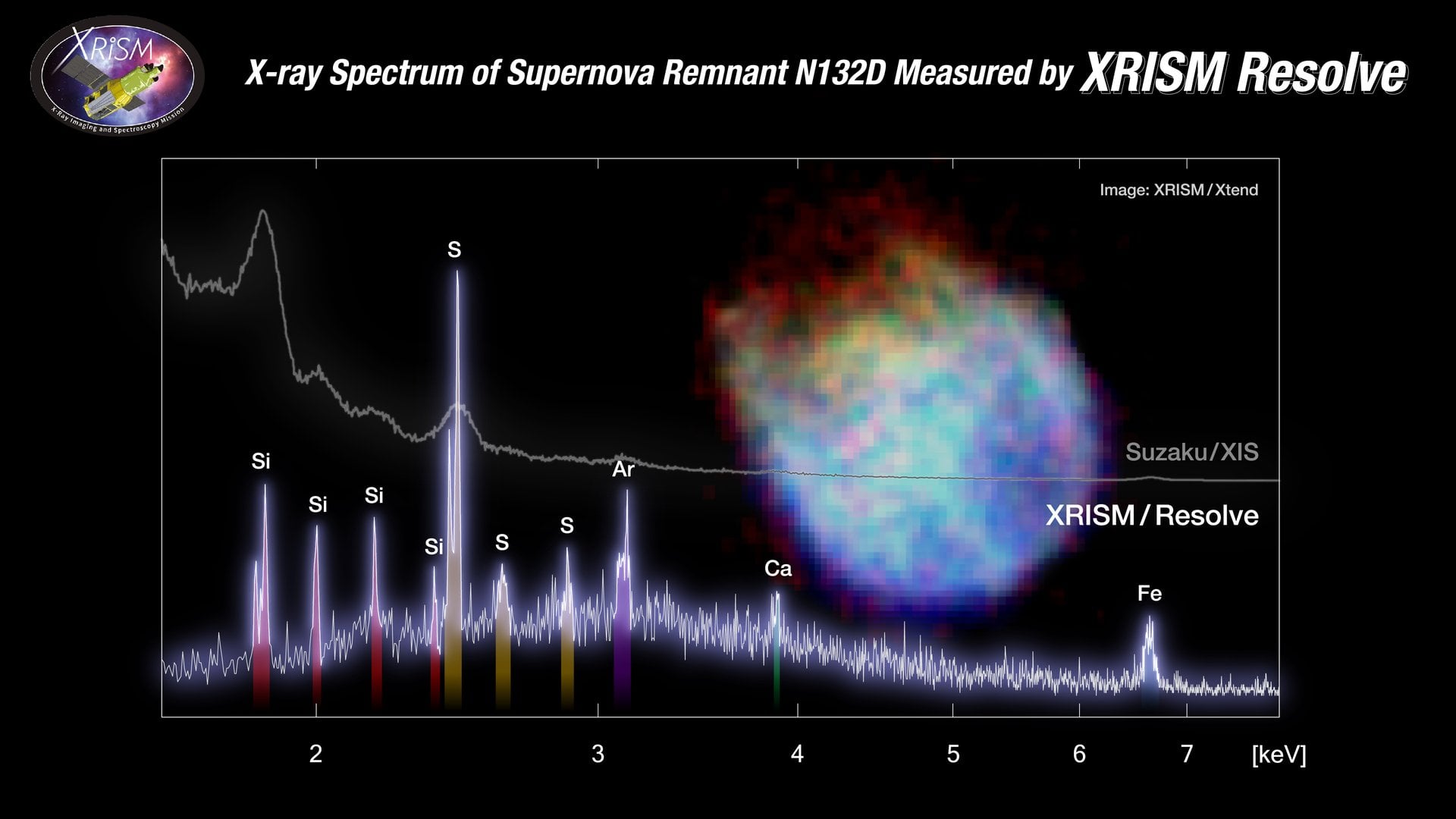 *Peaks in the XRISM/Resolve indicating the presence of certain elements. Credit: XRISM/JAXA*
Traditionally, scientists have used light-sensitive semiconductor chips known as Charge-Coupled Devices (CCDs) to observe particle paths in the hopes of resolving this “unidentified” emission line. In contrast, Sun and her colleagues relied on data collected by the X-ray Imaging and Spectroscopy Mission (XRISM), a space telescope jointly developed by the Japanese Aerospace Exploration Agency (JAXA) and NASA, with support from the European Space Agency (ESA). As Sun explained:
Nearly all the past studies used the CCD data, which lacks the required energy resolution to resolve the unidentified line. Now XRISM provides high-energy-resolution spectra that can resolve the line. As the line signals are very weak, we combined nearly three months of the XRISM data for such a search. There are many X-ray lines detected. They originate from known atoms, such as iron, silicon, sulfur, and nickel. X-ray emission lines that appear that are not at the known position of atomic lines are then the candidates for DM decay lines, which is the focus of this work.
Their work builds on a 2014 study led by Dr. Esra Bulbul, the lead scientist for cluster science and cosmology at the Max Planck Institute for Extraterrestrial Physics (MPE). Using data from the ESA's XMM-Newton mission, Bulbul and her colleagues detected a weak unidentified X-ray emission line in 73 galaxy clusters. The leading candidate for this emission line is a particle called a “sterile neutrino," a nearly massless subatomic particle that travels near the speed of light and barely interacts with normal matter. Looking to the future, Sun notes that investigating alternative candidate particles is crucial to resolving the mystery of DM:
WIMPs are still the leading candidate for dark matter, but billions of dollars of experiments have been done, only getting stronger and stronger upper limits, so alternative scenarios have to be considered. This study provides the strongest limits from high-energy-resolution data on the sterile neutrino at the 5 - 30 keV band, subsequently limiting the models for dark matter. With more XRISM data in the next 5-10 years or so, we will be able to either detect the line or improve the limit substantially.
Further Reading: UAH, the Astrophysical Journal Letters
