
Black holes are often referred to as cosmic vacuum cleaners, indiscriminately swallowing everything that strays too close. The bigger they are, the hungrier they should be. But observations of seven nearby galaxy mergers have revealed something strange: even when presented with gas clouds, supermassive black holes often ‘refuse to eat.’
The discovery came from ALMA observations led by Makoto Johnstone, a PhD candidate at the University of Virginia, studying pairs of supermassive black holes separated by only a few thousand light years. When two massive, gas rich galaxies collide, gravity drives vast amounts of cold molecular gas toward both galactic centres where the black holes reside. These brief, violent phases should trigger feeding frenzies, lighting up both black holes as active galactic nuclei among the most energetic objects in the universe.
 Two of the Atacama Large Millimeter/submillimeter Array (ALMA) 12-metre antennas gaze at the sky at the observatory’s Array Operations Site (Credit : Iztok Bončina/ESO)
Yet puzzlingly, not all merging galaxies behave this way. Some host two actively feeding black holes while others show only one glowing while its companion stays dark. Some seem to have no appetite at all despite plenty of available fuel.
ALMA’s observations revealed dense, chaotic piles of gas clouds surrounding many of the black holes, particularly the more massive ones. The mergers were clearly effective at delivering food right to the black holes’ doorsteps. But the current brightness of these black holes, which measures how fast they’re actually feeding, showed no correlation with the amount of gas available nearby.
Even with abundant fuel on hand, most supermassive black holes were nibbling rather than gorging. It seems that black hole growth during galaxy mergers could be highly inefficient, with inconsistent digestion of gas over short timescales.
“The inefficiency of the observed supermassive black hole growth, even when dense reservoirs of molecular gas are present, raises questions about the physical conditions necessary to trigger these growth episodes,” Makoto Johnstone, a PhD candidate at the University of Virginia.
The team compared systems where both black holes were active with mergers where only one showed obvious feeding behaviour. In some single cases, the inactive black hole truly seemed starved of cold gas. But in others, the gas was clearly present and the black hole still refused to eat, possibly caught between feeding episodes.
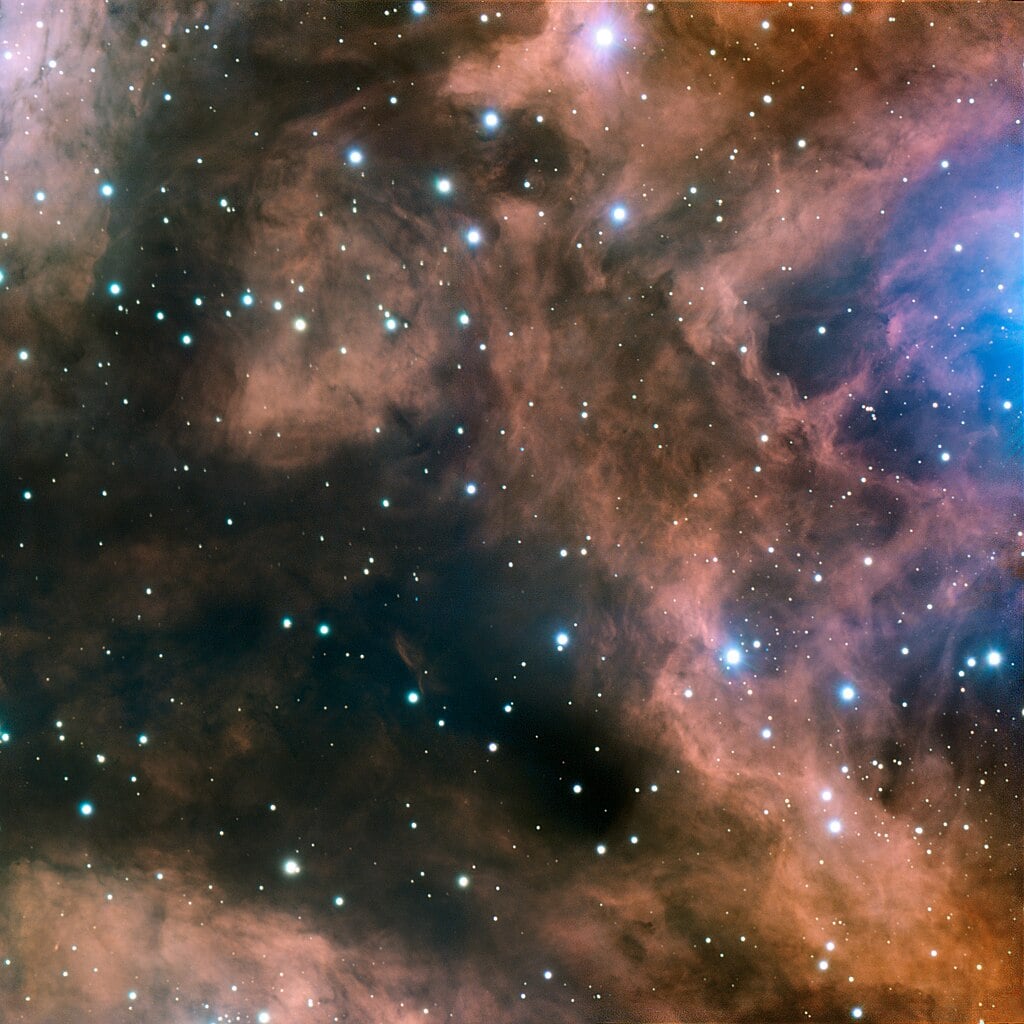 Gas clouds (like NGC 6357) are likely candidates to be absorbed by black holes (Credit : ESO)
ALMA also discovered that many active black holes sit slightly off centre from their main rotating gas disks. This displacement might be evidence of violent gravitational tussles during the merger that literally knock the black holes out of position.
Ezequiel Treister, principal investigator of the project, emphasised the significance of these unique ALMA observations that show how black holes are actively being fed during a major galaxy merger, an event that we strongly suspect is critical in setting up the observed connection between black hole growth and galaxy evolution.
The results reveal that in galaxy collisions, having enough energy to feed supermassive black holes is only half the story. Timing, turbulence, and dust decide when, and if, both black holes flare to life.
