The odds of finding any sort of smoking gun for non-baryonic (or exotic) dark matter --- the missing matter of the universe hypothesized to be made up of exotic elementary particles such as WIMPS (Weakly Interacting Massive Particles), seems to get longer with each passing year.
People have been looking for this form of exotic dark matter for the past 40 or 50 years. That is, since the idea was first brought to the fore by the late Swiss astronomer Fritz Zwicky and then confirmed by the late American astronomer Vera Rubin.
The concept of dark matter was invoked because astronomers couldn't explain galaxy rotation by known physics. Simply put, there was not enough matter in the rotating galaxies they were observing to hold the galaxies together. Yet alternate theories such as MOND (Modified Newtonian Dynamics) championed by the Israeli theoretical physicist Mordehai Milgrom have largely been castigated by mainstream astrophysicists.
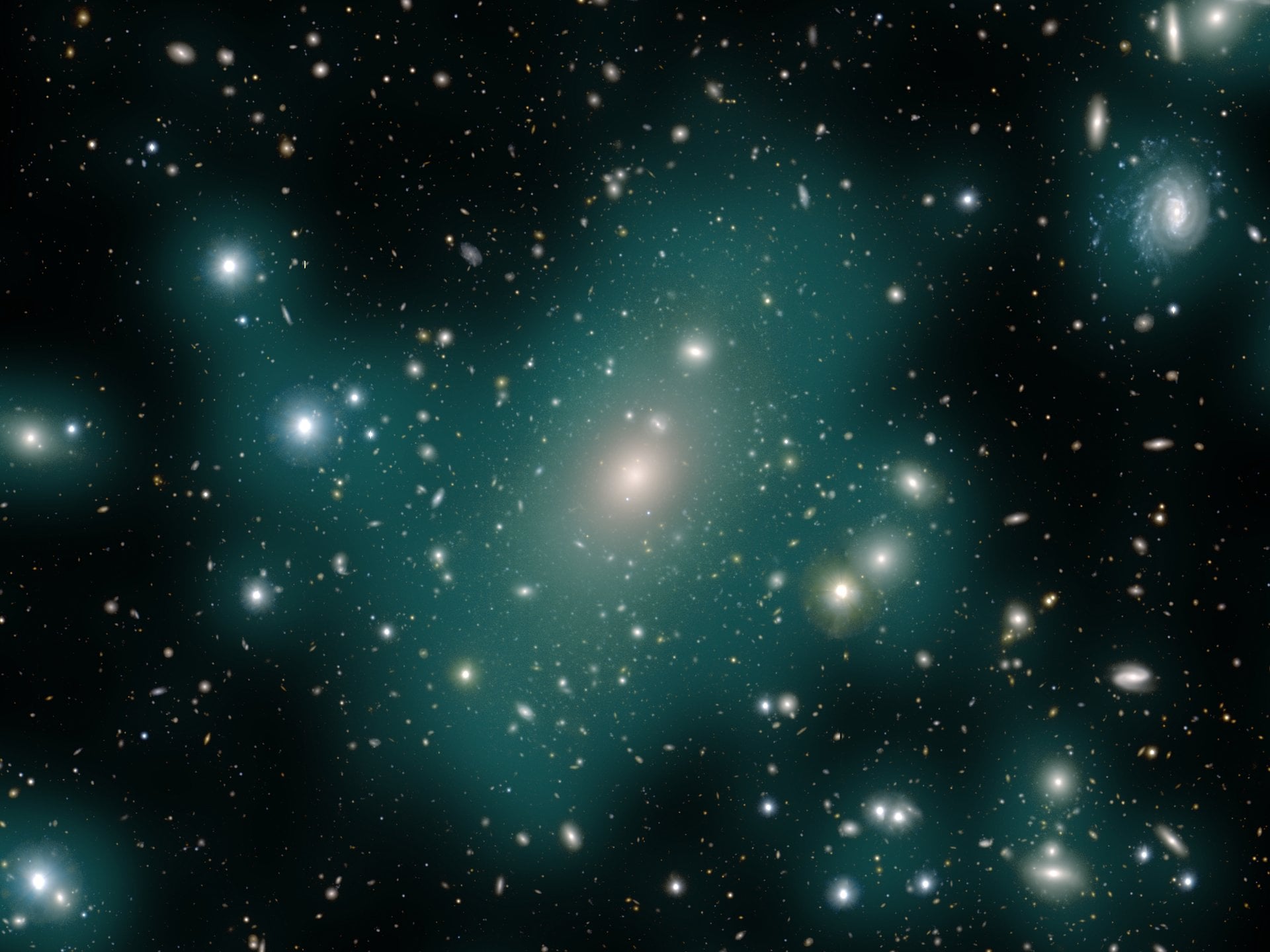
That’s in part because MOND requires physics beyond the Standard Model. Yet in a new paper just accepted for publication in the journal *Physical Review D*, a University of Bonn-led team reanalyzes nearby galaxy clusters such as Abell 0085, NGC 5044, and Abell 1795. The authors find that these largest gravitationally bound structures in the universe are richer in baryonic or normal matter than ever previously thought.
Using data from the WIde-field Nearby Galaxy cluster Survey (WINGS) and the Two Micron All Sky Survey (2MASS), the authors recalculated the masses for some 46 galaxy clusters.
The newly determined masses which are about twice as heavy as previously assumed are in good agreement with the predictions of Milgrom's theory of gravity (MOND), Germany’s University of Bonn reports. This newfound missing baryonic dark matter mainly consists of neutron stars and stellar black holes and also explains the observed quantities of heavy elements, the university notes.
Our paper gives a correct calculation of the stellar and gas content of galaxy clusters that for the first time accounts for all the atoms in the periodic table of elements, Pavel Kroupa, an astrophysicist at the University of Bonn and Charles University in Prague as well as one of the paper’s co-authors, tells me via email. It leads to the conclusion that the galaxy clusters are about two times heavier with normal matter than thought, Kroupa tells me.
Cosmic nucleosynthesis as we know it today, inherently required an enormous number of massive stars.
These stars that weigh more than 10 Solar masses each die by leaving a neutron star or a black hole, says Kroupa.
Exotic Dark Matter Models Are Lacking
Until now galaxy clusters were thought to contain 5 to 10 times more dark matter than normal matter so now "suddenly" we know that they can only contain 2.5 to 5 times as much dark matter, says Kroupa. This means that all models that have been presented with dark matter are "suddenly" wrong, he says.
A Plethora Of Undetected Normal Matter
Many of these galaxies contain a substantial population of stellar remnants—including white dwarfs, neutron stars, and stellar-mass black holes—which can be regarded as a form of baryonic "dark mass," Dong Zhang, the paper’s lead author and a doctoral student at the University of Bonn, tells me via email.
These galaxy clusters also contain a greater number of low-mass, metal rich start that contribute to the total mass of intracluster matter. That is, normal baryonic matter that’s literally located between galaxies in a cluster.
The Need For MOND
We need MOND to explain why massive elliptical galaxies formed so rapidly, says Kroupa. The most massive elliptical galaxies formed in a billion years or less and weigh ten to a hundred times more in normal visible matter than our own Milky Way Galaxy, he says.
Yet the well-studied and nearby dwarf galaxies --- the Large and Small Magellanic Clouds --- also show no signs of dark matter haloes.
In a MOND-based cosmological model galaxies do not have dark matter halos and so they very rarely merge, says Kroupa. They just orbit each other, like the nearby Small Magellanic Cloud is observed to have been orbiting the Large Magellanic Cloud (LMC), he says. If there were dark matter, then the SMC would have merged with the LMC within a billion years of its existence, says Kroupa.
The Bottom Line?
Over the past 40 years, there has not been much progress with dark matter, says Kroupa. So, it is simply false to continue further funding dark matter research; such work is a massive waste of taxpayer money, he says.