Galaxies don’t exactly move with urgency. At distances measured in hundreds of thousands of light years and timescales spanning hundreds of millions of years, even a direct collision unfolds slowly. The two spiral galaxies captured in NASA’s latest composite image, IC 2163 and NGC 2207, brushed past each other millions of years ago at speeds of hundreds of kilometres per second. From our perspective, they appear frozen mid embrace, their spiral arms reaching toward one another like dancers caught in an eternal waltz.
Galaxy mergers rank among the most dramatic events in the universe, yet they proceed with counterintuitive gentleness. Despite containing hundreds of billions of stars each, these galaxies won’t experience many actual stellar collisions. Stars are simply too small and too widely spaced. The average distance between stars is so vast that if you scaled the Sun down to the size of a grain of sand, the nearest star would sit roughly four kilometres away. When galaxies merge, their stars pass through each other.
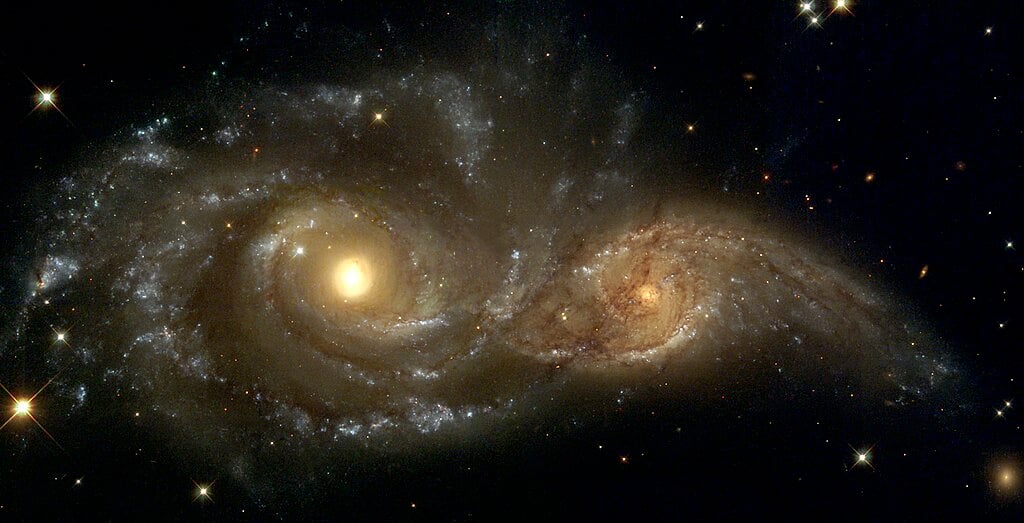
What does collide spectacularly is the gas. Each galaxy carries enormous clouds of hydrogen and helium distributed between its stars, and when these diffuse reservoirs slam together at hundreds of kilometres per second, they compress violently. This compression triggers one of nature’s most spectacular displays of runaway star formation. The blue and red specks scattered throughout the composite image mark regions where newborn stars blaze to life, their intense radiation heating surrounding gas to millions of degrees and generating the X-rays Chandra detects as ethereal blue highlights.
The gravitational forces at work during these encounters reshape the galaxies themselves. Tidal interactions, the same phenomenon that causes Earth’s oceans to bulge toward the Moon, pull long streamers of stars out from both galaxies. Over time, these tidal tails can stretch for hundreds of thousands of light years, creating the spectacular filamentary structures visible in deep images of merging systems. IC 2163 and NGC 2207 already show pronounced distortions where their spiral arms overlap, curving unnaturally as they bend toward their neighbour’s gravitational pull.
Billions of years from now, after multiple passes through each other’s gravitational wells, these two spirals will complete their merger and settle into a single elliptical galaxy. Their spiral structure will be erased, replaced by a smooth distribution of stars orbiting in random directions. This transformation from ordered rotation to chaotic motion represents one of the fundamental pathways through which galaxies evolve.
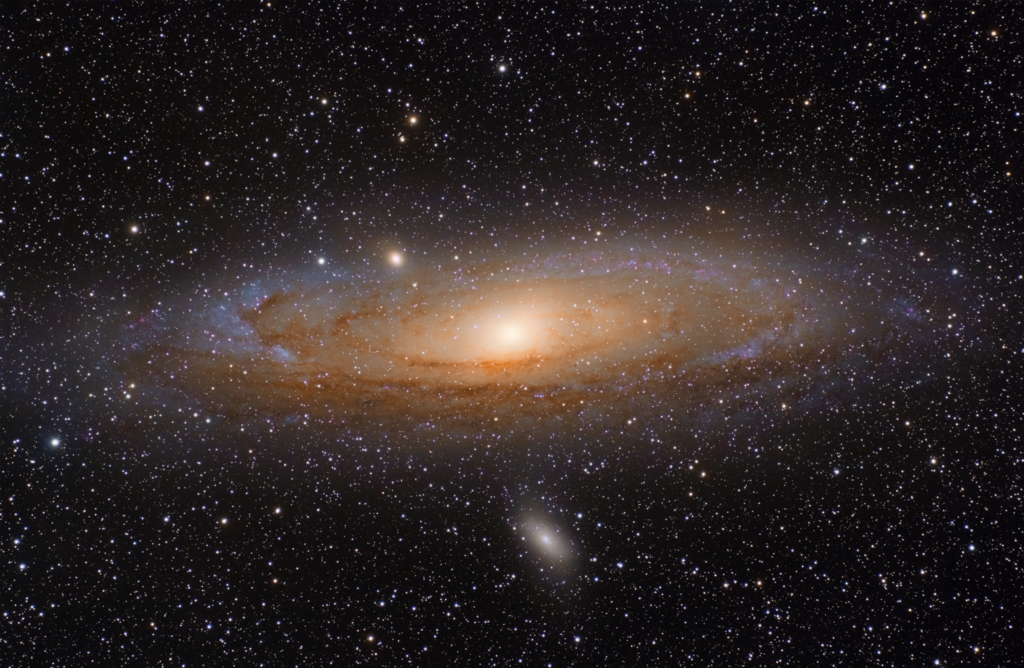
The Milky Way faces the same fate. In approximately four billion years, our Galaxy will begin merging with Andromeda, our nearest large galactic neighbour. This future collision won’t endanger Earth directly, the Sun will simply find itself reassigned to a new galaxy, but it will fundamentally transform the night sky our distant descendants might witness, assuming humanity survives that long of course!
Source : A Galactic Embrace