Newborn stars aren’t gentle. They blast ionised gas into space, carving luminous paths through the darkness. NASA’s Hubble Space Telescope has just captured fresh images of one of these stellar outbursts, showing bright ribbons of pink and green gas stretching across 32 light years of space.
The object designated HH 80/81, sits 5,500 light years away in Sagittarius. It represents a particularly violent example of what astronomers call Herbig-Haro objects, bright patches that appear when jets from forming stars collide with slower moving gas the star expelled earlier.
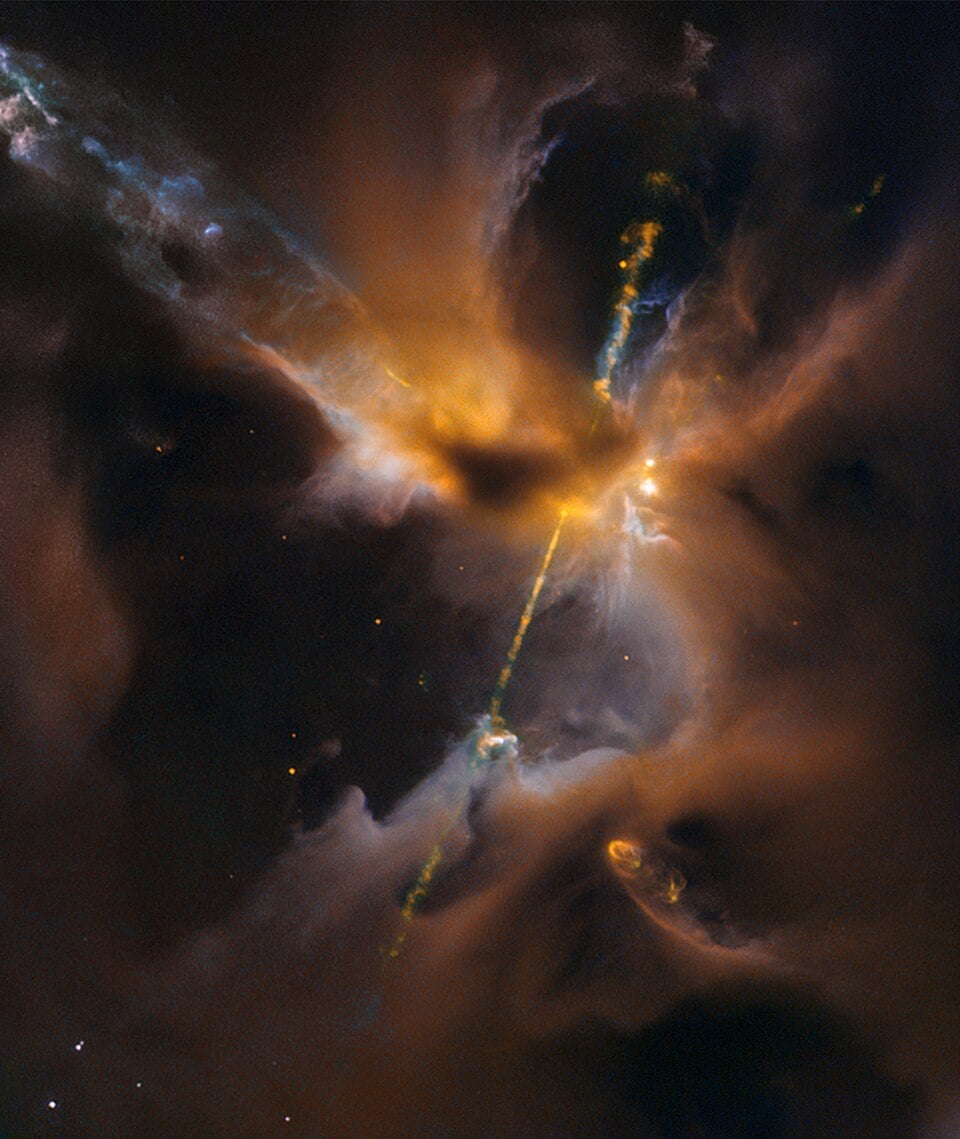
At the heart of HH 80/81 lies IRAS 18162-2048, a protostar with roughly 20 times the Sun’s mass. That makes it extraordinarily hefty by stellar birth standards. Most protostars that produce Herbig-Haro objects are relatively small, low mass affairs. This heavyweight is the only known example of its kind, the sole Herbig-Haro jet driven by such a massive young star.
The physics powering these spectacular displays begins deep within the protostar’s accretion disk, the swirling reservoir of gas and dust that feeds the growing star. Material from this disk doesn’t simply fall straight onto the star. Instead, it interacts with powerful magnetic fields threading through the protostar, which channel some particles toward the magnetic poles and fling them outward at tremendous velocities.
When Hubble measured the speed of material in HH 80/81, astronomers recorded outflows exceeding 1,000 kilometres per second. That’s the fastest jet speed ever documented from a young stellar object, whether measured in visible light or radio wavelengths. At those velocities, the ejected particles slam into previously expelled gas with enough force to create powerful shock waves.
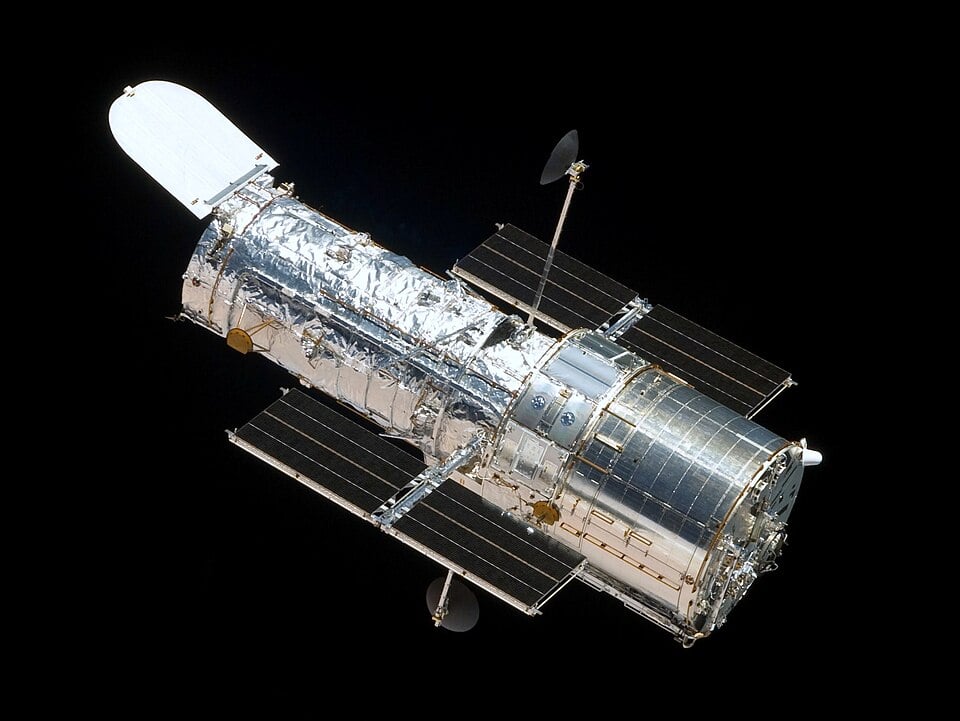
These shocks heat the surrounding clouds to thousands of degrees, exciting atoms and causing them to glow in the distinctive colours captured by Hubble’s Wide Field Camera 3. The pink regions trace emission from hydrogen, while the green shows oxygen radiating energy. Together, HH 80/81 creates the brightest Herbig-Haro display known to exist.
Hubble first photographed this object in 1995, but the new observations reveal fresh details about how these jets evolve. The telescope’s exceptional resolution allows astronomers to track movements and structural changes, building a timeline of how massive stars assemble themselves from collapsing gas clouds.
The 32-light-year extent of HH 80/81’s outflow makes it the largest protostellar jet system ever discovered, a record that reflects both the tremendous power of its source star and the incredible distances these stellar winds can travel before finally dissipating.