
Turn on a tap and watch the water hit the sink basin. Right where it lands, the water is fast and thin. Then, just a centimetre or two out, it suddenly slows and thickens. That abrupt transition is called a hydraulic jump. It happens in an instant, it's entirely unremarkable, and it's the same process driving the largest atmospheric wave ever found in the Solar System and that wave is on Venus.
In 2016, Japan's Akatsuki probe sent back images of something puzzling. A massive disturbance that was occasionally clocked at 6,000 kilometres wide that was sweeping repeatedly around Venus' equator. It moved through the planet's thick cloud layers, leaving a dark smear of denser cloud trailing behind it. Scientists could see it clearly but they just couldn't explain it.
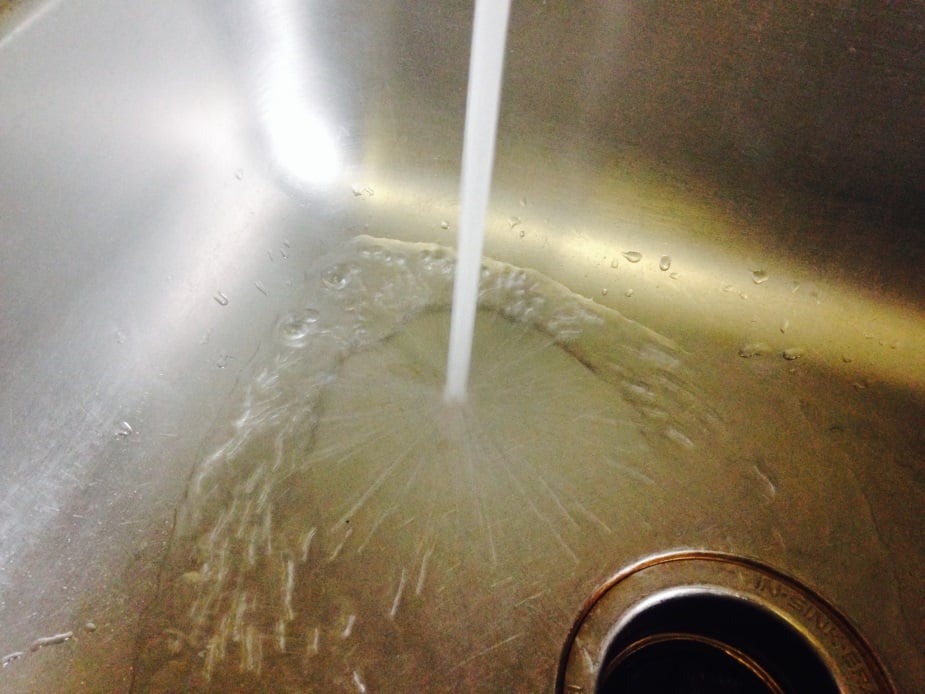 Hydraulic jump in a kitchen sink! (Credit : Katiey89)
Venus is already one of the stranger places in our Solar System. Its clouds don't just drift they super-rotate, circling the planet at roughly 60 times the speed it spins. That's the atmospheric equivalent of a Formula 1 car lapping a cyclist. And nestled within those clouds are three distinct layers, the lower two of which remain poorly understood.
Now, a team led by Professor Takeshi Imamura at the University of Tokyo has finally cracked the mystery. Using fluid dynamics models and atmospheric simulations, they've shown that a fast moving wave in Venus' lower cloud layer known as a Kelvin wave, periodically becomes unstable. When it does, the wind speed suddenly drops and the atmosphere piles up, just like the water in your sink. The resulting jolt forces a powerful upward current of air, driving sulphuric acid vapour high into the atmosphere where it condenses and forms that sweeping wall of cloud. It is, in short, the Solar System's biggest hydraulic jump.
"We identified the phenomenon, but for years we couldn't understand it," - Professor Takeshi Imamura from the University of Tokyo.
What makes the discovery particularly surprising is that in classical fluid dynamics, large scale horizontal processes and strong localised vertical effects like this don't usually interact.
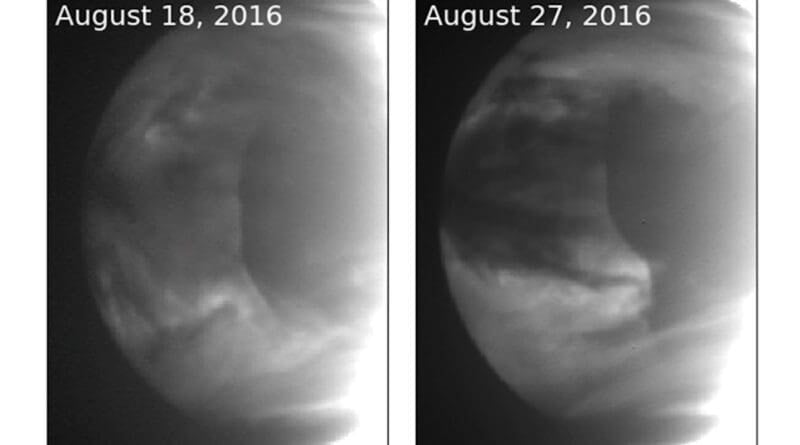 These images of Venus were taken Aug. 18 (left) and Aug. 27 (right), 2016, by the near infrared camera on Japan’s Akatsuki Venus probe, show the clear line of denser (darker) clouds moving across the planet (Credit: T. Imamura, Y. Maejima, K. Sugiyama et al.)
The same conditions that create a hydraulic jump in one planetary atmosphere may exist in others. Mars, the team suggests, could harbour something similar. As future missions venture deeper into the Solar System, understanding exactly how alien skies behave will matter enormously.
Source : Venus’ atmosphere jumps and waves
