Scientists have been making some incredible discoveries in space that are shedding new light on the origins of life. In addition to finding amino acids in asteroids, scientists have also found fatty acids found on Mars, sulfur-bearing molecules in interstellar space, and that peptides form spontaneously in space. Most recently, research based on data from the James Webb Space Telescope (JWST) has found an abundance of small organic molecules in a nearby galaxy.
The observations focused on an ultra-luminous infrared galaxy (IRAS 07251-0248), in which an international research team from the Consejo Superior de Investigaciones Científicas (CSIC) and multiple universities found evidence of an exceptionally large inventory of organics matter in both gaseous and solid form. Their findings offer further evidence that the building blocks of life as we know it began in space.
What makes IRAS 07251-0248 a particularly tempting target to study with Webb is the way its nucleus is obscured by vast amounts of gas and dust, which makes it very difficult to study its central supermassive black hole (SMBH) with conventional telescopes. In effect, cosmic gas and dust absorb most of the light produced by the SMBH and its surrounding region, which is then radiated outwards in infrared wavelengths (heat). Infrared telescopes like Webb can penetrate this dust, providing unique information on the core region, such as the dominant chemical processes at work inside.
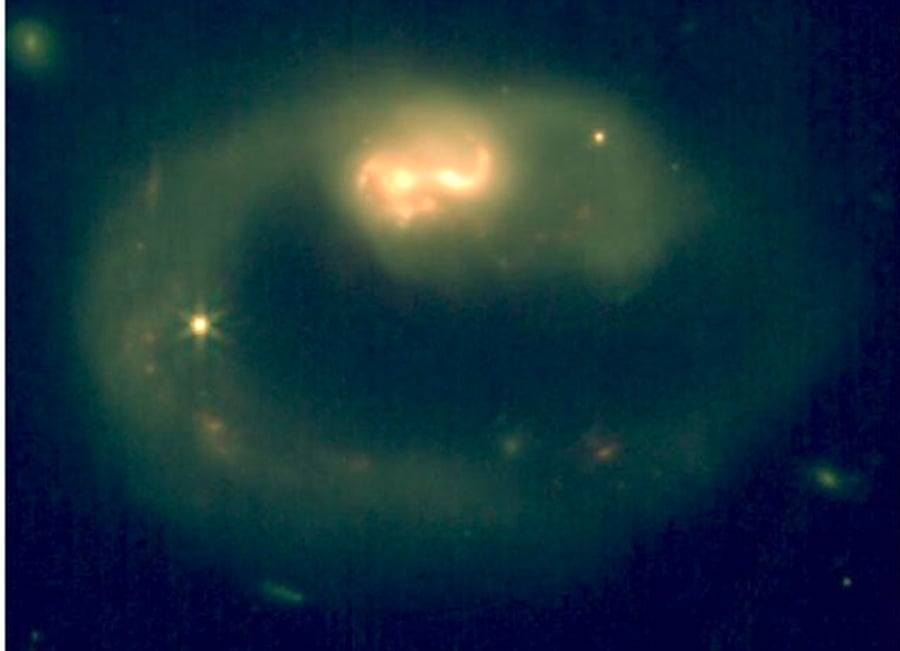
By combining data from Webb's Near-Infrared Spectrometer (NIRSpec) and Mid-Infrared Instrument (MIRI), the team was able to characterize the abundance and temperature of numerous chemical species in the galactic nucleus. This included hydrocarbons, which are fundamental building blocks of complex organic chemistry and of life as we know it. In addition to detecting the methyl radical (CH₃) for the first time in another galaxy, they also found benzene (C₆H₆), methane (CH₄), acetylene (C₂H₂), diacetylene (C₄H₂), and triacetylene (C₆H₂).
In addition to finding these molecules in a gaseous state, they also detected a large abundance of organics in solid form, such as carbonaceous grains and water ices. "We found an unexpected chemical complexity, with abundances far higher than predicted by current theoretical models," said CAB researcher and lead author Dr. Ismael García Bernete (formerly a researcher at Oxford University). "This indicates that there must be a continuous source of carbon in these galactic nuclei fuelling this rich chemical network."
"Although small organic molecules are not found in living cells, they could play a vital role in prebiotic chemistry, representing an important step towards the formation of amino acids and nucleotides," added co-author Professor Dimitra Rigopoulou from the University of Oxford.
The team's analysis was aided by the theoretical models of polycyclic aromatic hydrocarbons (PAHs) developed by the Oxford researchers involved in the study. Their results suggest that the organic molecules cannot be explained by high temperatures or turbulent gas motions alone. Instead, they suggest that the PAHs and carbon-rich dust grains were fragmented by cosmic-ray exposure, thereby releasing these organics in gaseous form. Since cosmic rays are very common in active galactic nuclei (AGNs), this explanation certainly fits the data.
Their interpretation is also supported by studies of similar galaxies, which found a correlation between the abundance of gaseous-state hydrocarbons and the intensity of cosmic-ray ionization. In short, their results suggest that dusty galactic nuclei produce organic molecules in abundance, thereby playing a vital role in the chemical evolution of galaxies. It also demonstrates the JWST's effectiveness in exploring environments previously inaccessible to scientists.
But what is especially exciting is the way their work opens new opportunities for studying the formation and processing of organic molecules in extreme environments, which could lead to a better understanding of how galaxies are seeded with the basic ingredients for life. Combined with other research showing that the ingredients of life can be found in space and emerge spontaneously, these findings are also encouraging for scientists engaged in the search for extraterrestrial life and civilizations.
Further Reading: University of Oxford, Nature Astronomy