United Launch Alliance said an issue affected one of the four solid rocket boosters that helped propel its Vulcan rocket into space Thursday on a mission for the United States Space Force. Despite the problem the rocket, making only its fourth flight, continued on its planned trajectory, the company said.
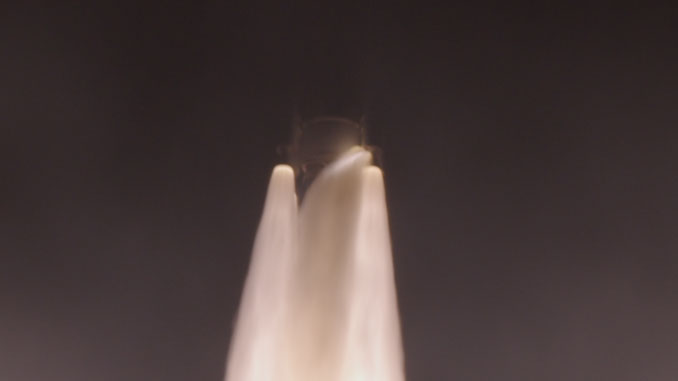
The 202-foot-tall (61.6 m) rocket thundered away from pad 41 at Cape Canaveral Space Force Station at 4:22 a.m. EST (0922 UTC) but less than 30 seconds into the flight, there appeared to be a burn through of one of the nozzles on a Northrop Grumman-built graphite epoxy motor (GEM) 63XL solid rocket boosters (SRBs).
Shortly after, as the rocket performed its pitch over maneuver, the vehicle began to roll in a more pronounced way than is typical for this stage of flight. The Vulcan rocket appeared to counteract the anomaly and the SRBs jettisoned as planned at T+ 1 minute, 37 seconds into the flight.
“We had an observation early during flight on one of the four solid rocket motors, the team is currently reviewing the data,” ULA said in a statement roughly an hour after liftoff. “The booster, upper stage, and spacecraft continued to perform on a nominal trajectory.”
Roughly 20 seconds after the liftoff of ULA’s Vulcan rocket on the USSF-87 mission, there appeared to be a possible burn through of at least one of the solid rocket booster nozzles. We’ve reached out to ULA for comment. Video shot by @ABernNYC for Spaceflight Now
Watch: pic.twitter.com/u2sFmlxSih
— Spaceflight Now (@SpaceflightNow) February 12, 2026
The rocket was carrying the USSF-87 mission. It’s a series of payloads for the U.S. Space Force, highlighted by at least one Geosynchronous Space Situational Awareness Program (GSSAP) satellite, though two may be onboard.
ULA leadership said prior to launch that it would be roughly 10 hours from liftoff until the end of the mission, so it might be Thursday afternoon before an update on the status of the payload is given.
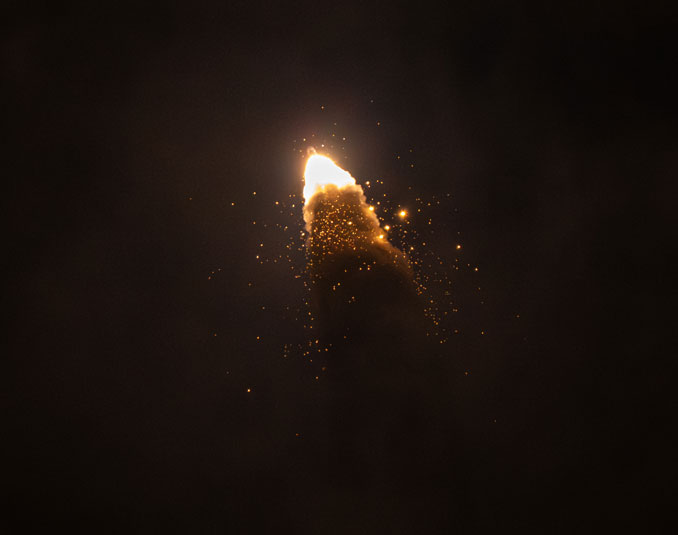
This was ULA’s second national security mission following completion of the Vulcan rocket’s certification in March 2025. There are several more on the company’s launch manifest for 2026, including a GPS satellite and satellites for the Space Force’s Space Development Agency.
ULA’s plan for 2026 was to launch 16 to 18 missions with Vulcan. The latter vehicle would launch from both coasts.
More SRB challenges
The “observation” noted on one of the SRBs on Thursday morning’s flight marks the second time in just four flights that ULA ran into a similar issue.
A burn through was noted during the second certification launch of Vulcan back on Oct. 4, 2024. ULA and Northrop Grumman went through a series of tests and analysis to address the anomaly, including a hot fire test in Utah.
Ultimately, the U.S. Space Force deemed Vulcan capable to launch national security payloads for it and the National Reconnaissance Office (NRO). The USSF-106 mission on Aug. 12, 2025, went smoothly, giving ULA leadership confidence in their launch vehicle.
“We’ve had a couple of anomalies that we’ve worked through. You all are aware of those. Those are behind us now and so the Vulcan rocket is ready to go,” said John Elbon, the interim CEO of ULA, during a virtual media roundtable on Tuesday.