
When the Sun erupts in its most violent flares, it doesn’t just hurl plasma and particles into space. These explosions also generate intense bursts of gamma radiation, the most energetic form of light in the universe. Solar physicists have detected these gamma ray signals for decades, yet the precise mechanism producing them remained frustratingly elusive. Now researchers at the New Jersey Institute of Technology have pinpointed the source.
The discovery, published in Nature Astronomy, reveals a previously unknown class of particles accelerated to extraordinary energies in the solar corona during major flare events. These particles, measured at several million electron volts, carry hundreds to thousands of times more energy than typical flare particles and move at nearly the speed of light.
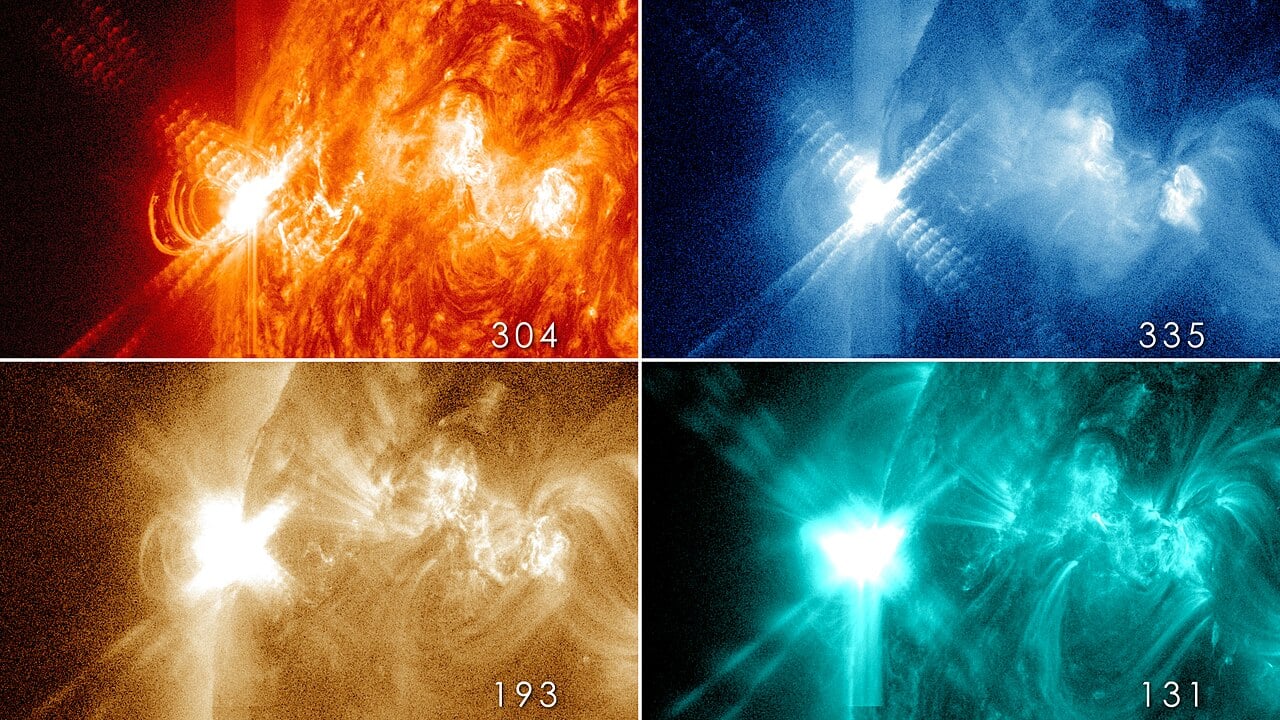 An X3.2-class solar flare observed in different wavelengths. Clockwise from top left: 304, 335, 131, and 193 Å (Credit : NASA/SDO)
The breakthrough came from analysing a powerful X8.2 class flare that erupted on September 10, 2017. By combining gamma ray observations from NASA’s Fermi Space Telescope with microwave imaging from NJIT’s Expanded Owens Valley Solar Array in California, the team identified exactly where the gamma rays originated.
“We knew solar flares produced a unique gamma-ray signal, but that data alone couldn’t reveal its source or how it was generated. Without that crucial information, we couldn’t fully understand the particles responsible.” - Gregory Fleishman, a research professor at NJIT’s Center for Solar-Terrestrial Research.
The convergence of gamma-ray and microwave signals pointed to a specific region in the solar atmosphere where trillions upon trillions of particles had been energised to extreme levels. The team traced the gamma rays to a process called bremsstrahlung, in which lightweight charged particles emit high energy light when they slam into material in the Sun’s atmosphere.
What makes this particle population unusual is its energy distribution. Typical flare electrons decrease in number as their energy increases. This newly discovered population behaves differently, with most particles concentrated at very high energies and relatively few lower energy electrons present.
The observations also revealed important clues about how solar flares accelerate particles in the first place. The high energy particle region sits near areas where magnetic fields decay rapidly and intense acceleration occurs, supporting long standing theories about magnetic energy release driving these extreme acceleration events.
The discovery fills critical gaps in solar flare physics and could ultimately enhance space weather forecasting. Major solar eruptions can disrupt satellites, communications systems, and power grids on Earth, making better predictions increasingly important as our technological infrastructure becomes more vulnerable to space weather events.
Key questions remain however. Researchers still don’t know whether these particles are electrons or their antimatter counterparts, positrons. Future observations from NJIT’s telescope array, currently being upgraded with fifteen new antennas and advanced instrumentation, may provide the answer by measuring polarisation of microwave emissions from similar events.
Source : NJIT Researchers Discover Long-Hidden Source of Gamma Rays Unleashed by Solar Flares
