
The dependable Hubble Space Telescope has been in orbit for more than 35 years now. It's at a point where it can reexamine objects it observed decades ago and can uncover changes that have transpired over human timescales. This is an impressive feat for a telescope that was projected to last only 15 years.
The latest astronomical object to be revisited by the Hubble is the Trifid Nebula. It's almost 5,000 light-years away, and is also known as NGC 6514, and Messier 20. Its name comes from the Latin word trifidus, which means "divided into three lobes." It's a combination of three different things: an emissions nebula, a reflection nebula and a dark nebula.
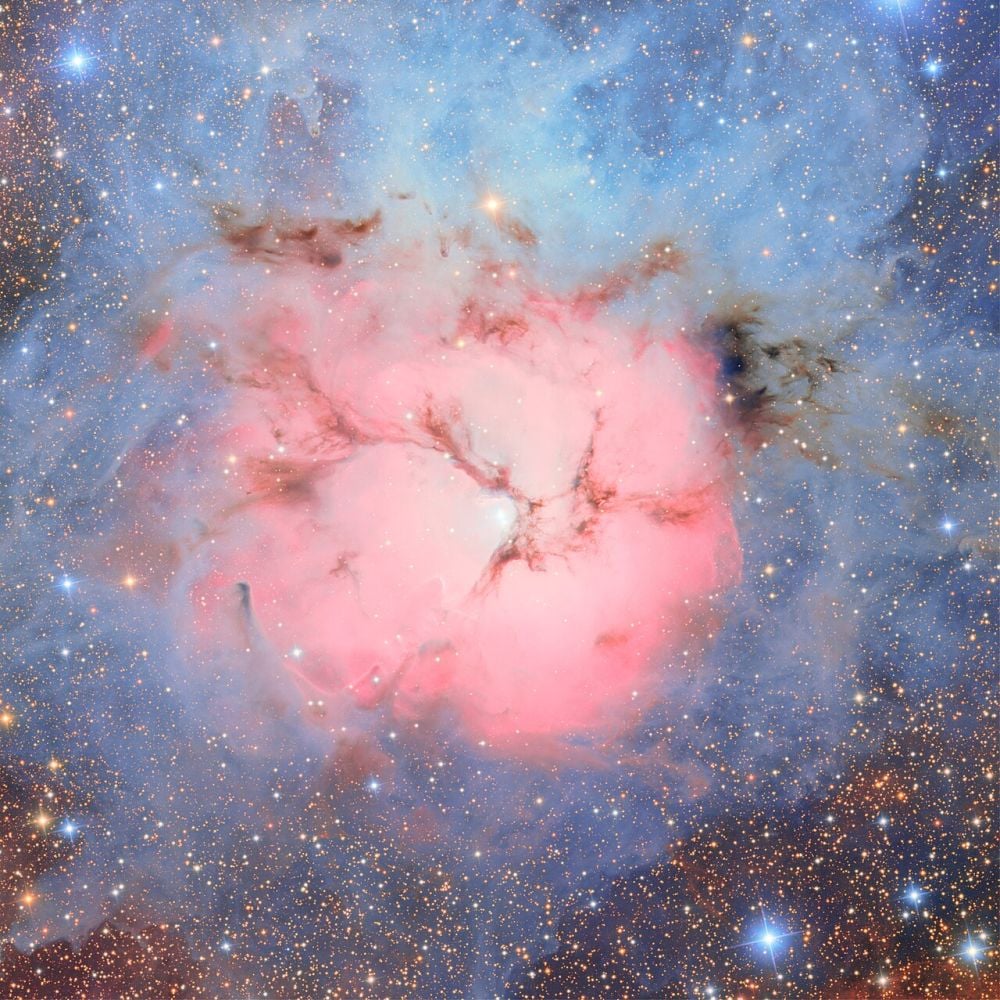 *The Vera Rubin Observatory captured this image of the Trifid Nebula. It shows the emission nebula (the pink region), a reflection nebula (the blue region), and a dark nebula (the dark regions). The Hubble image zooms in on a small portion of the nebula. Image Credit: By RubinObs/NOIRLab/SLAC/NSF/DOE/AURA - Trifid Nebula, CC BY 4.0, https://commons.wikimedia.org/w/index.php?curid=168377834*
It's all powered by a young, luminous O-type star named HD 164492A. The star is about 20 times more massive than the Sun and its powerful UV radiation lights the Trifid up. HD 164492A isn't alone though. It's surrounded by a star cluster with more than 3,000 members.
The Trifid Nebula is an active star-forming region, and many of the young stars are massive. Their powerful stellar winds have shaped the object and in effect blown an enormous bubble of gas. The shock-front edges of the bubble is where gas is compressed and coaxed into forming yet more stars.
The Hubble image focuses on a small part of the nebula. Central to this image is a region that looks like a sea slug with a pair of antennae protruding from its head. The horn on the left is part of a Herbig-Haro object, a bright patch of nebulosity lit up by an astrophysical jet from a nearby young protostar. These objects can change shape in a few years as the jet's power waxes and wanes. The Hubble caught some of these changes as it observed the object over the years. The Hubble's observations give astrophysicists an opportunity to learn about the energy in the jet, and how it changes over time.
The jet that looks like an extending antenna has a counterpart that comes out the opposite side of the hidden protostar. It's not as visible, but it's carving the reddish/orange line of dust opposite the visible antenna. It extends about as far as the "V" shape that looks like the sea slug's back.
The smaller antenna on the right hosts its own protostar, at the very tip. It has a tiny jet, and it also has a green arc above it that could be a protoplanetary disk. This disk is being dissipated by the powerful UV radiation that shapes the region. The protostar on the tip may be finished forming; it looks like it's cleared out the gas and dust around it with its own radiation.
To the left of the slug is a small, isolated, gaseous pillar. This is a region of dense gas that has resisted radiation.
There are more shifting, changing shapes apparent in the comparison of both images. These could be jets emanating form even more young stars obscured by gas and dust.
The blue region in the image's upper left is caused by yet more powerful, energetic stars that are out of frame. Their powerful UV radiation has stripped electrons from atoms and created a blue glow. Their powerful winds have sculpted a bubble in the region.
The black region in the lower right is where the dust is densest. The stars that are visible in this region are likely in the foreground and are not part of the Trifid Nebula.
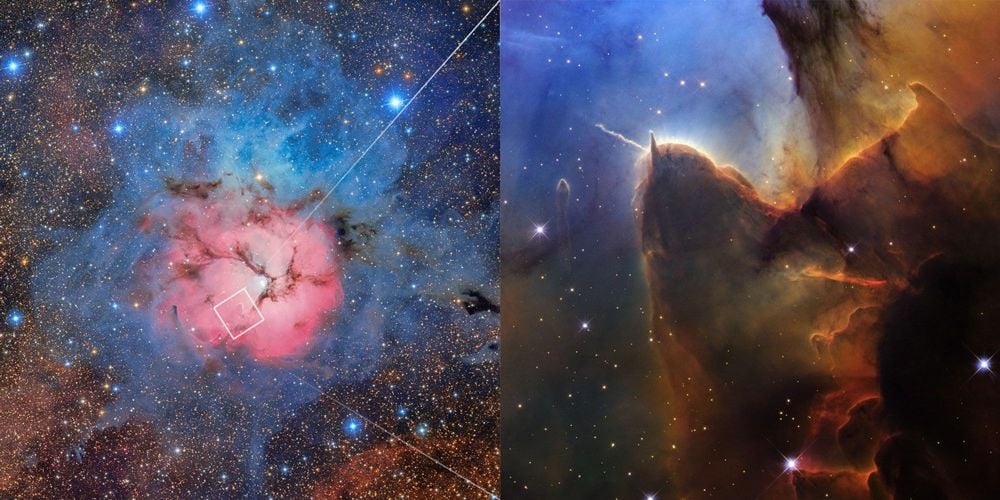 *The Vera Rubin Observatory's image of the Trifid Nebula is on the left, and the pullout shows where the Hubble's image is focused on. The VRO's image spans about 56 light-years and the Hubble's spans about 4 light-years. The entire nebula is about 21 light-years across. Image Credit: Rubin Observatory, NASA, ESA, STScI*
Throughout the image, fully formed stars appear as bright orbs that have cleared out their surrounding gas. This will eventually happen to the entire nebula as more of the young stars reach their primes.
The Trifid Nebula is only about 300,000 years old, young for an astronomical object. Eventually, all of the gaseous gorgeousness will dissipate into the interstellar medium due to photoevaporation and stellar winds, and the Trifid Nebula will be no more. This will take a few million years; nobody knows for sure.
But until that happens, it will serve as a wondrous, natural laboratory to study star formation and how young stars evolve and shape their surroundings. The Hubble has been remarkably long-lived and successfull, but it's mission is winding down as its gyros fail one by one. This could be it's last look at the Trifid Nebula.
But it won't be our last look. Multiple powerful telescopes are coming online in the next few years and they will let astronomers probe the Trifid even more deeply.
One day, maybe centuries or even millennia from now, we may have a thousand-year long movie of the Trifid as it changes and evolves, written by dozens of even hundreds of telescopes, with each one making it's own contribution.
We wonder how the Hubble will be remembered then.
