
The exact moment when life began on Earth may be forever hidden from us. But scientific research can explore the events leading up to that moment. Researchers have mad a lot of progress in finding the building blocks of life and in understanding how they formed.
New research in ACS Central Science extends that understanding.
It's titled "Electric Fields Can Assist Prebiotic Reactivity on Hydrogen Cyanide Surfaces." The lead author is Marco Cappelletti from the Department of Chemistry and Chemical Engineering at Chalmers University of Technology in Sweden. The corresponding author is Martin Rahm from the same institute.
The research shows that hydrogen cyanide (HCN) can play an important role in the chemistry of life. Scientists know that when it's combined with water, HCN can form polymers, amino acids and nucleobases. It may seem ironic that HCN could be involved in the appearance of life, since it's a powerful and highly toxic compound. But chemistry can be a weird world, and while HCN may be toxic to creatures like us, it has other chemical properties that can aid life.
“We may never know precisely how life began, but understanding how some of its ingredients take shape is within reach. Hydrogen cyanide is likely one source of this chemical complexity, and we show that it can react surprisingly quickly in cold places,” co-author Rahm said in a press release.
Some research shows that the Earth's surface was blasted by asteroids during the Late Heavy Bombardment, creating the presence of HCN on the planet's surface. It's also abundant elsewhere in the Solar System and beyond.
"Hydrogen cyanide (HCN) is present in many astrochemical environments, including interstellar clouds and comets," the authors write. "On Saturn’s moon Titan, large amounts of HCN ice are present in the atmosphere and, following surface deposition, may influence both chemical and geological evolution. However, despite HCN’s relevance to origin of life chemistry, the physiochemical properties of its solid state remain poorly characterized."
The strange molecule is known for unusual characteristics. "For example, the crystals of HCN exhibit a range of rare properties, including pyroelectricity, and the ability to glow and jump under certain conditions," the authors write.
To try to understand HCN and its relation to the origin of life, the researchers conducted computer simulations of frozen HCN. They simulated a stable HCN crystal as a 450 nm long cylinder. They matched its shape to known observations of 'cobwebs' of HCN crystals. These cobwebs branch out from a central point, and multi-facented ends that look like cut gemstones come together. The ends, or tips, have very strong electric fields.
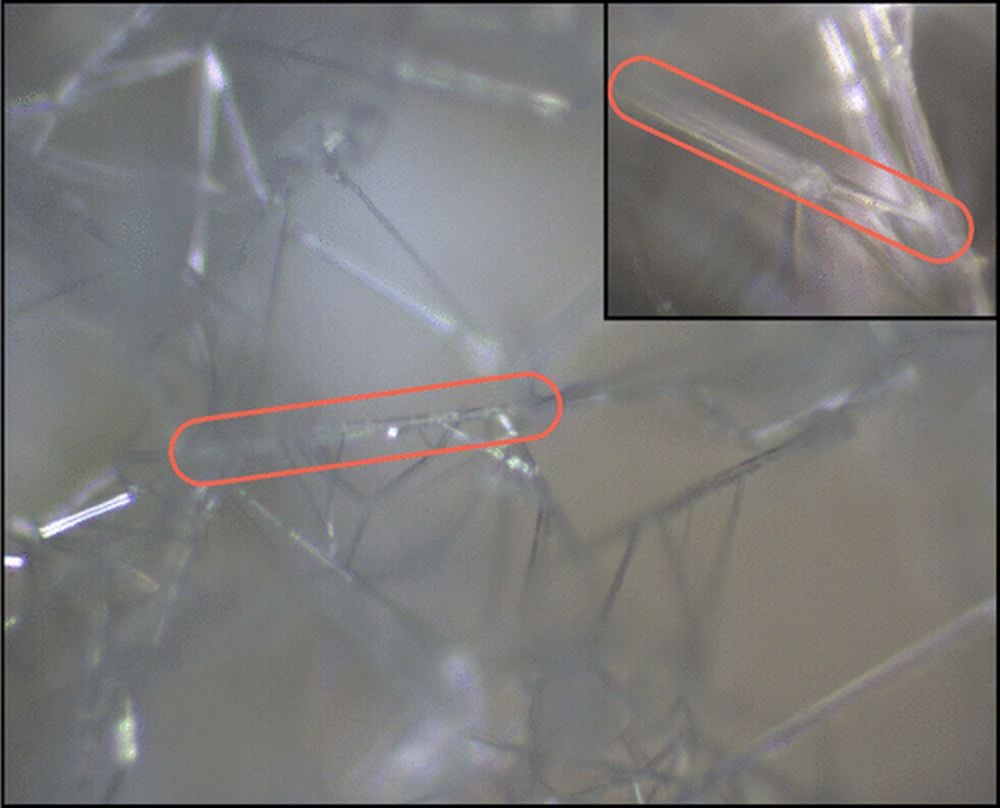 Microscope image of HCN crystals with 10× (full image) and 50× (top right inset) magnification. HCN crystallizes to high aspect-ratio needles (two are highlighted in red), which form a cobweb connectivity. Image Credit: NASA/JPL-Caltech.
"We suggest that the combination of tips of opposite polarity helps to explain the cobweb-structure of solid HCN, and that fracture can transiently expose energetic surfaces, capable of catalysis at low temperature," the authors write. The jumping behaviour of HCN referred to earlier can violently crack the crystal structure, exposing these ends and their strong electric fields.
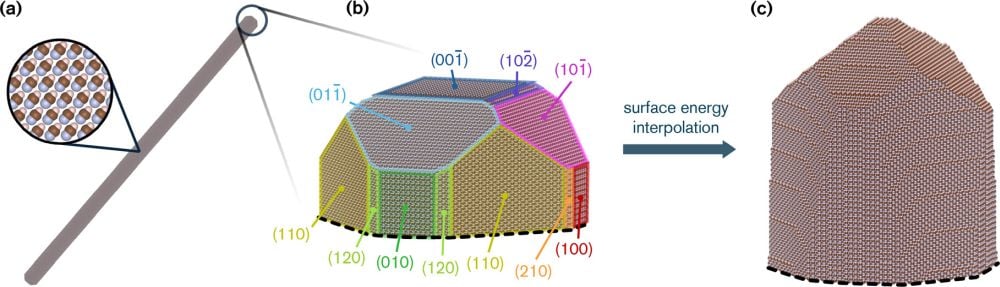 *This figure illustrates the faceted surface on the end of an HCN crystal. The ends have strong electric fields that can encourage catalysis. Image Credit: Cappelletti et al. 2025. ACS Central Science*
"Of particular interest to us is evaluating an alternative route for HCN ↔ HNC (isocyanide) isomerization through surface catalysis," the researchers explain. "Which processes enable HCN ↔ HNC isomerization remains an open question in astrochemistry."
One of HCN's catalytic reactions is the formation of isocyanide (HNC) on the HCN crystals. HNC is a critical building block in the synthesis of complex molecules and organic building blocks. HNC is like a more reactive bridge between simple inorganic molecules and complex biological polymers.
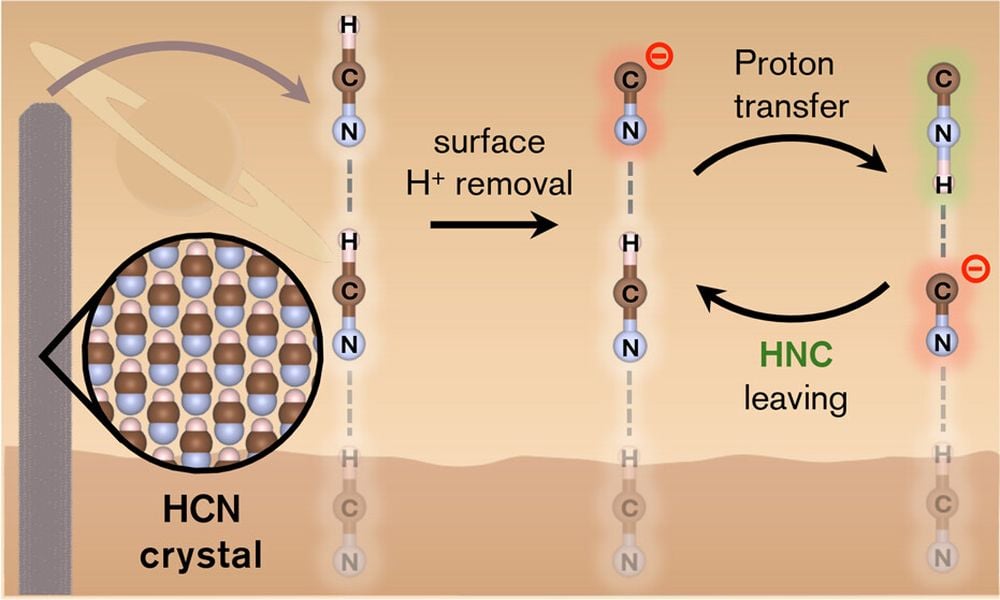 *"We suggest that the combination of tips of opposite polarity helps to explain the cobweb-structure of solid HCN, and that fracture can transiently expose energetic surfaces, capable of catalysis at low temperature," the researchers explain. "One such process is predicted to be the near-barrierless formation of isocyanide (HNC) on HCN crystals, following proton addition or abstraction, for example, via radiation or acid/base-chemistry. Such field-assisted surface mechanisms may contribute to HCN-to-HNC isomerization under relevant conditions, and are suggested to explain part of the out-of-equilibrium abundance of HNC in cold environments such as Titan’s atmosphere, and, potentially, in cometary comae." Image Credit: Cappelletti et al. 2025. ACS Central Science*
The researchers found that the crystals can foster chemical reactions that don't typically happen in cold environments. Since HCN is found in cold gas clouds, cold comets, and on Saturn's frigid moon Titan, the finding is significant in astrochemistry. And since HNC is even more reactive than HCN, its creation is important. HNC appeared in the simulations in hours to days, and its presence also suggests that even more complex prebiotic precursors could also form there.
Simulations are powerful tools, but the next step is experimentation.
"Validation of our predictions would benefit from laboratory studies of HCN surface chemistry under cryogenic conditions," the authors write. "One particularly relevant experiment would be to test whether physical stimuli, such as crushing HCN crystals in the presence of reagents like water, can expose high-energy surfaces and thereby accelerate prebiotically relevant chemical transformations."
More detailed astrochemistry observations are also next.
"Observational efforts targeting HNC/HCN ratios across environments and temperatures could further constrain the relevance and prevalence of these mechanisms under astrophysical conditions," the authors conclude.
