
Living long-term on the Moon means surviving the devastating toll that deep space takes on a human body. Astronauts in low gravity environments suffer muscle and bone loss, vision-altering fluid shifts, and heavy radiation exposure - all of which are incredibly hazardous to our biology. So, to help future lunar explorers survive, a new crew just arrived at the International Space Station (ISS). That might not sound surprising, except this crew is composed of worms.
C. elegans nematode worms, to be precise. They launched to the ISS aboard NASA Northrop Grumman CRS-24 resupply mission on April 11th. The experiment housing them, known as the Fluorescent Deep Space Petri-Pods project (FDSPP) was led by the University of Exeter, engineered by the University of Leicester, integrated by Voyager Space Technologies, and funded by the UK Space Agency.
That’s a lot of support for some little worms, so why are they drawing so much attention? Surprisingly, C. elegans (which measure only 1 mm in length) share a surprising amount of biology with us. They’re commonly used in medical research on Earth, and the idea is that, by exposing them to the harsh realities of orbit, scientists are hoping to learn how organisms adapt - or fail to adapt - when outside of Earth’s protective shell.
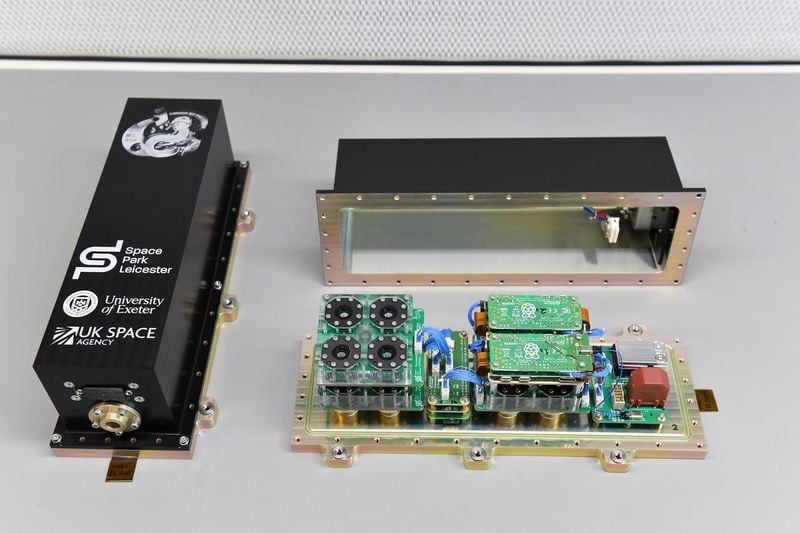 *Image of the Petri Pod housing the experiments. Credit - University of Exeter*
The worms will be housed in a device called a Petri Pod - basically a specially designed miniaturized life-support system. Each 10x10x30cm pod weighs about 3 kilograms and contains 12 experimental chambers that provide miniaturized life support, maintaining pressure, temperature, and a trapped volume of breathable air for the worms to breathe. They also contain an agar carrier to provide the worms food.
After some time onboard the ISS itself, these pods will be placed via robotic arm on the outside hull of the ISS, where they will remain for 15 weeks. During their exterior stay, they’ll face down both microgravity and intense cosmic radiation, all while being monitored remotely by researchers back on Earth. Four of the chambers in each Petri Pod are equipped with miniaturized cameras that will capture white-light photographic stills and time-lapses. But they will also track the worm’s biological responses by using fluorescent glowing signals.
Professor Mark Sims, the project manager at Leicester, noted how complex it was to build such a compact microgravity lab. “It has been both an interesting and challenging instrument to design and build,” he said in a press release from the University of Exeter. “Having now delivered the experiment…the project team from Leicester look forward to seeing the first images in orbit.”
Video of the CRS-24 Launch carrying the experiment. Credit - NASA YouTube ChannelThose first images should be forthcoming sometime soon. The FDSPP was successfully launched alongside dozens of other experiments and thousands of kg of resupply material last week, with a rendezvous at the ISS taking place on Monday. The experiment will rest inside the ISS for a little while before being deployed, but once it does, it will contribute to our own understanding of how our fragile biology physically decays when exposed to space.
“It might sound surprising, but these tiny worms could play a big role in the future of human spaceflight.” said Liz Lloyd, the UK’s Space Minister. “This remarkable mission…shows the ingenuity and ambition of UK space science, using a small experiment to tackle one of the biggest challenges of long-duration space travel.” Fully understanding that challenge will take a lot more than a few worms attached to the outside of a floating laboratory for a few months - but this is certainly a step in the right direction, however small its main contributors might be.
Learn More:
University of Exeter - Space Worms! Scientists launch microscopic crew into orbit to support future Moon missions
UT - Scientists Investigate the Biological Effects of Spaceflight Using Worms
