Galaxies like our Milky Way grew through cascading mergers of smaller galaxies that began billions of years ago. The ancient progenitors of galaxies like ours were small galaxies similar to modern-day dwarf galaxies like the Large and Small Magellanic Clouds. Research shows that both dwarf galaxies and ancient galaxies are less massive, have lower metallicity, and have lots of star-forming gas but relatively few stars. Astronomers try to understand ancient galaxies and how they grew to become so massive by studying dwarf galaxies that are interacting with each other and beginning to merge.
Two such galaxies are NGC 4490 and NGC 4485, known together as Arp 269. Arp 269 is about 26 million light-years away, and about 30 years ago, astronomers first detected the bridge of wispy gas connecting the pair. But even powerful telescopes like the Hubble couldn't uncover enough detail to piece together their interactive past.
But that all changed when the JWST was launched. 26 million light-years is within reach of the powerful JWST. With its infrared vision, the JWST can see through dust and gas and discern details in Arp 269 that other telescopes simply can't see.
This new image of Arp 269 is the ESA/JWST Picture of the Month, but it stems from the scientific effort to study the pair of galaxies and to piece together their history. The results are in new research in The Astrophysical Journal titled "FEAST: JWST/NIRCam View of the Resolved Stellar Populations of the Interacting Dwarf Galaxies NGC 4485 and NGC 4490." The lead author is Giacomo Bortolini from the Department of Astronomy in The Oskar Klein Centre at Stockholm University.
NGC 4485 is the larger of the pair of dwarfs and dominates the left side of the new image. NGC 4490 is on the upper part of the right side of the image. A tidal bridge of gas and stars extends from NGC 4485 and connects to NGC 4490's disk.
A critical part of understanding this merger is to identify the stellar population. The types and ages of stars can reveal a lot about the galaxies' interactions.
"NGC 4485 and NGC 4490 form the closest known pair of interacting late-type dwarf galaxies (at ∼7.4 Mpc), excluding the Magellanic Clouds," the authors write. "Near-infrared color–magnitude diagrams (CMDs) reveal a wide range of stellar populations in both galaxies..." There are young main sequence stars less than 200 million years old, much older AGB stars, and intermediate age stars. There are also many older red giant stars.
The observations also show two distinct bursts of star formation. "The CMDs show two distinct bursts of star formation beginning ∼30 and ∼200 Myr ago, the latter consistent with the most recent pericenter passage predicted by N-body simulations," the researchers write.
"Compact star-forming regions are seen along NGC 4490’s spiral arms, possibly originating from its infrared nucleus," the authors write. "A significant metallicity gradient is observed in the young stellar populations forming the bridge."
Based on their observations, the astronomers think that these galaxies approached one another closely about 200 million years ago, before going their own separate ways again. During that close approach, either ram pressure or tidal stripping removed gas from the smaller NGC 4485 which was then accreted by the more massive NGC 4490. This material mixed with existing gas in NGC 4490, leading to new star formation, especially throughout the bridge connecting the pair. This burst occurred about 30 million years ago.
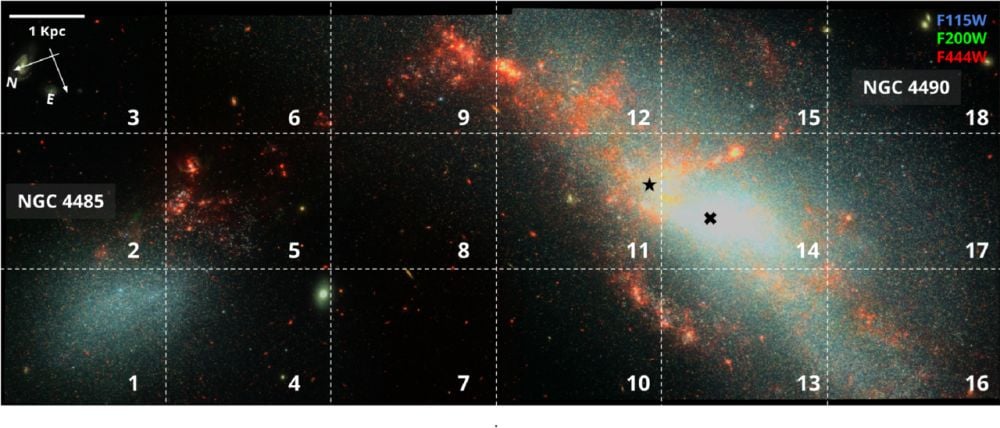
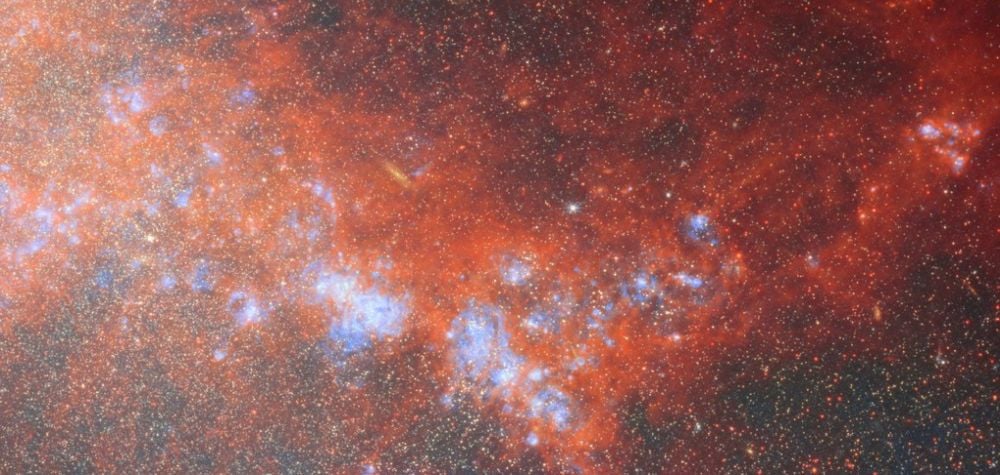
While the above image shows clusters of new star formation in red, the main image shows them in blue. These are regions where UV radiation from young stars is ionizing hydrogen gas, creating HII regions.
The researchers were not only able to constrain the timing of the bursts of star formation, and the types of stars formed. They were also able to constrain the different metallicities in the stellar populations. "This result strongly supports the scenario in which metal-poor gas stripped from NGC 4485 was mixed with the more metal-rich gas of NGC 4490, before forming the young population of stars we observe in the bridge region and around the main body of NGC 4490," the authors explain in their conclusion.
The NGC 4485–NGC 4490 dwarf galaxy system is an object of intense study, and other researchers have and continue to study it in different ways. Some researchers have focused on N-body simulations, while others have focused on the properties of the interstellar medium. The authors point out that their new research in The Astrophysical Journal is their first step toward a more detailed analysis and understanding of the new JWST data.
"Our results, together with other recent studies of resolved stellar populations in Local Volume galaxies, demonstrate the remarkable capabilities of JWST, far exceeding those of previous IR telescopes and providing unprecedented insights into the star formation processes of nearby dwarf galaxies," the researchers write. "This system provides a unique nearby laboratory for studying how tidal interactions shape the star formation and chemical enrichment history of dwarf galaxies," they conclude.
The ESA/JWST Picture of the Month represents the JWST's power to produce images that are both visually compelling and scientifically rich. Check out the gallery here.