
One of the most stubborn issues in cosmology today concerns the Universe's rate of expansion. Scientists know it's expanding, but defining the rate of that expansion is challenging. The rate of expansion is called the Hubble Constant, after American astronomer Edwin Hubble, who discovered that the Universe is expanding in the 1920s.
For decades, scientists have been trying to measure the Hubble Constant, and while they've made progress, certainty has eluded them. The Hubble Tension describes the tension between different methods of meausuring the Hubble Constant. When scientists use the Cosmic Microwave Background to measure it, they get one result: 67 km/s/Mpc. When they use Standard Candles from the Cosmic Distance Ladder, they get a different result: 73 km/s/Mpc.
There are different types of Standard Candles, which are astronomical objects with well-understood absolute magnitudes. One of them is Type Ia supernovae.
Astronomers have discovered a pair of supernovae (SNe) in exceptional circumstances that may help them resolve the Hubble Tension and determine the Hubble Constant once and for all. The SNe are billions of light years away, and their light is magnified and split into multiple images by strong gravitational lensing. The pair of SNe and the research around them were presented at the 247th Meeting of the American Astronomical Society.
Conor Larison from the Space Telescope Science Institute presented the findings. Larison is a post-doctoral researcher there, and is also part of the JWST VENUS collaboration. VENUS stands for Vast Exploration for Nascent, Unexplored Sources. It has nothing to do with the planet Venus. In the VENUS program, the JWST is taking deep observations of 60 rich galaxy clusters. Even though VENUS is only halfway complete, it's already found rare, ancient sources like individual stars from the early Universe. It's also found faint sources like ancient active black holes at the center of early galaxies, along with the two exploding stars, dubbed SN Ares and SN Athena.
Some galaxy clusters can act as strong gravitational lenses, and create multiply-imaged SNe. That's what's happening with Ares and Athena.
"Supernova Ares is at a pretty large distance compared to other core-collapse supernovae that we're able to see, and the only reason that we're able to detect this and follow it up is because of the magnification effect of the strong lensing from the galaxy cluster," Larison said at his presentation at AAS247. He explains that the JWST was able to gather spectra from the SN that will reveal things about SN physics in the early Universe. "But apart from the SN physics, this is a strongly-lensed supernova, meaning that its galaxy actually appears multiple times. Because of this, it will actually reappear in this galaxy cluster image again in 60 years," Larison added.
Galaxy clusters are massive, and relativity tells us that this much mass bends space time. The clusters and the SNe are in line with one another from our perspective, so as the light from the SNe travels toward us, it's bent by the clusters' mass. The light from the ancient, distant SNe is split into multiple images by the galaxy clusters that are lensing them.
“Strong gravitational lensing transforms galaxy clusters into nature’s most powerful telescopes,” said Seiji Fujimoto, principal investigator of the VENUS survey, in a press release. “VENUS was designed to maximally find the rarest events in the distant Universe, and these lensed supernovae are exactly the kind of phenomena that only this approach can reveal.”
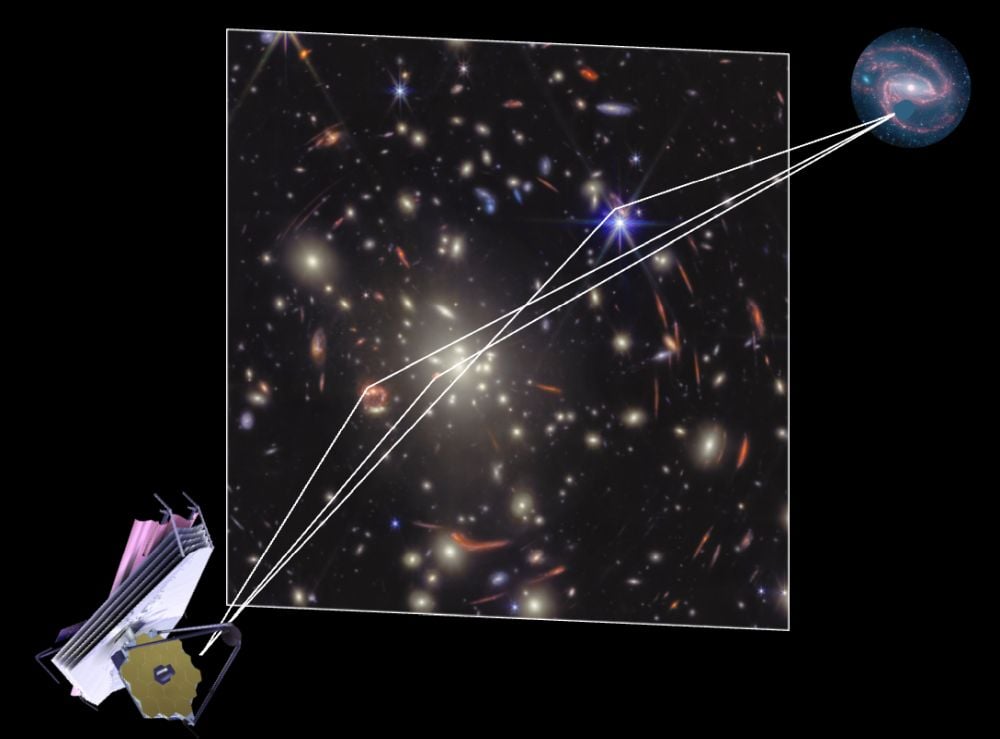 This image illustrates the gravitational lensing effect. As light from ancient, distant supernovae travel past massive galaxy clusters, the light is bent and split. As long as the supernovae and clusters are lined up from our perspective, the JWST can take advantage. This image shows light from the ancient supernova Ares being warped and split into multiple images by the MJ0308 galaxy cluster. Image Credit:
SN Ares was the first one discovered by VENUS, and it exploded when the Universe was only about 4 billion years old. SN Athena exploded about 6.5 billion years ago. Their light was not only bent and magnified, but stretched by the expansion of the Universe. The remarkable thing about SN Ares and SN Athena is that the multiple images of each will arrive at different times. This sets up a natural experiment to measure the Hubble Constant.
Repeat images of Athena will arrive in about 2 or 3 years, while two images of Ares will arrive in about 60 years. Since there are decades between the arrival of images, the Ares SN is an opportunity to predict and test the Hubble Constant.
“Such a long anticipated delay between images of a strongly lensed supernova has never been seen before and could be the chance for a predictive experiment that could put unbelievably precise constraints on cosmological evolution,”said Conor Larison. “It is hard to know what the key questions of the day will be in 60 years, but what is certain is that this reappearance will provide the most precise, single-step measurement of cosmology we have ever had the chance to make.”
SN Athena will also help measure the elusive value of the Hubble Constant. First astronomers use the existing observations of the SNe and the galaxy clusters to predict when the next images will arrive. Then they wait for the images to arrive, and the actual delay informs them of how accurate their predictions were.
“The predicted time delay to the next image of SN Athena of a few years will allow us to weigh in on the value of the Hubble Constant at a time when such an independent measurement is sorely needed,”says Justin Pierel, an Einstein Fellow at STScI, “It may help to cement the possibility of new physics, or alternatively, point to unknown systematics in the best current cosmological analyses.”
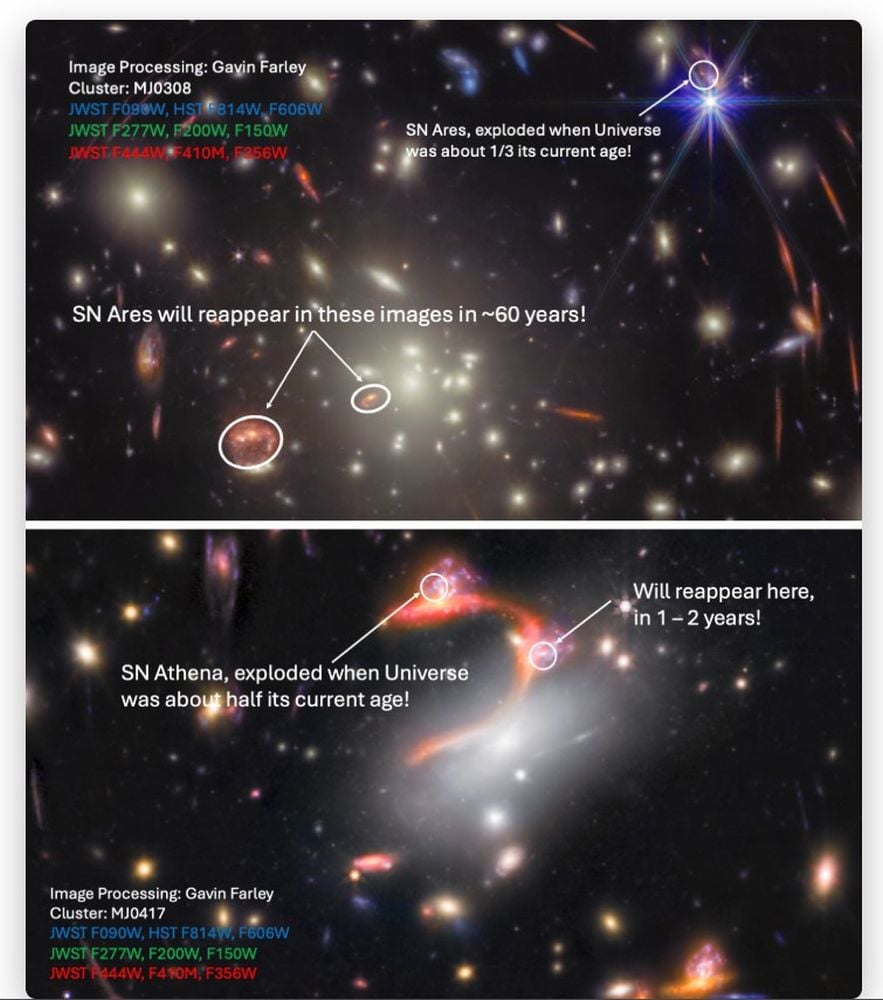 *These color images are composed of Hubble Space Telescope (HST) and James Webb Space Telescope (JWST) observations of the MJ0308 and MJ0417 galaxy clusters in which SN Ares and SN Athena were discovered, respectively. Both SNe will reappear in other lensed images years or decades from now, allowing for precise constraints on the expansion rate of the Universe. Image Credit: VENUS/Larison. Image Processing: Gavin Farley*
Time-domain astronomy is the study of objects that change over time, either in their position, their brightness, or in other ways. SN Ares and SN Athena can be seen as part of time-domain astronomy, but in their cases, billions of years have passed since they exploded, and years or decades will pass between the arrival of their images.
"The longer the time delay is, the better these supernovae are for constraininig cosmology," Larison said at AAS247. "Because the light from these background sources is bent and warped by these galaxy clusters, it arrives with a time delay that is directly related to the expansion history of the Universe. That expansion history depends on dark energy, which is 70% of the Universe," said Larison.
We don't know what dark energy is, but after 60 years our questions about it will likely be different than they are now. "Maybe in 60 years we won't know for sure what's happening over the expansion of the Universe, and SN Ares will help disentangle that," Larison said.
https://www.youtube.com/live/nss3zNi5SYA
