
When Halley's Comet blazed across English skies in April 1066, an elderly Benedictine monk named Eilmer watched from Malmesbury Abbey with growing recognition. "You've come, have you?" he reportedly said, crouching in terror at the glowing apparition. "You've come, you source of tears to many mothers." But Eilmer's words carried weight beyond mere dread, he realised he had seen this exact comet before, during its previous appearance in 989 when he was just a young man.
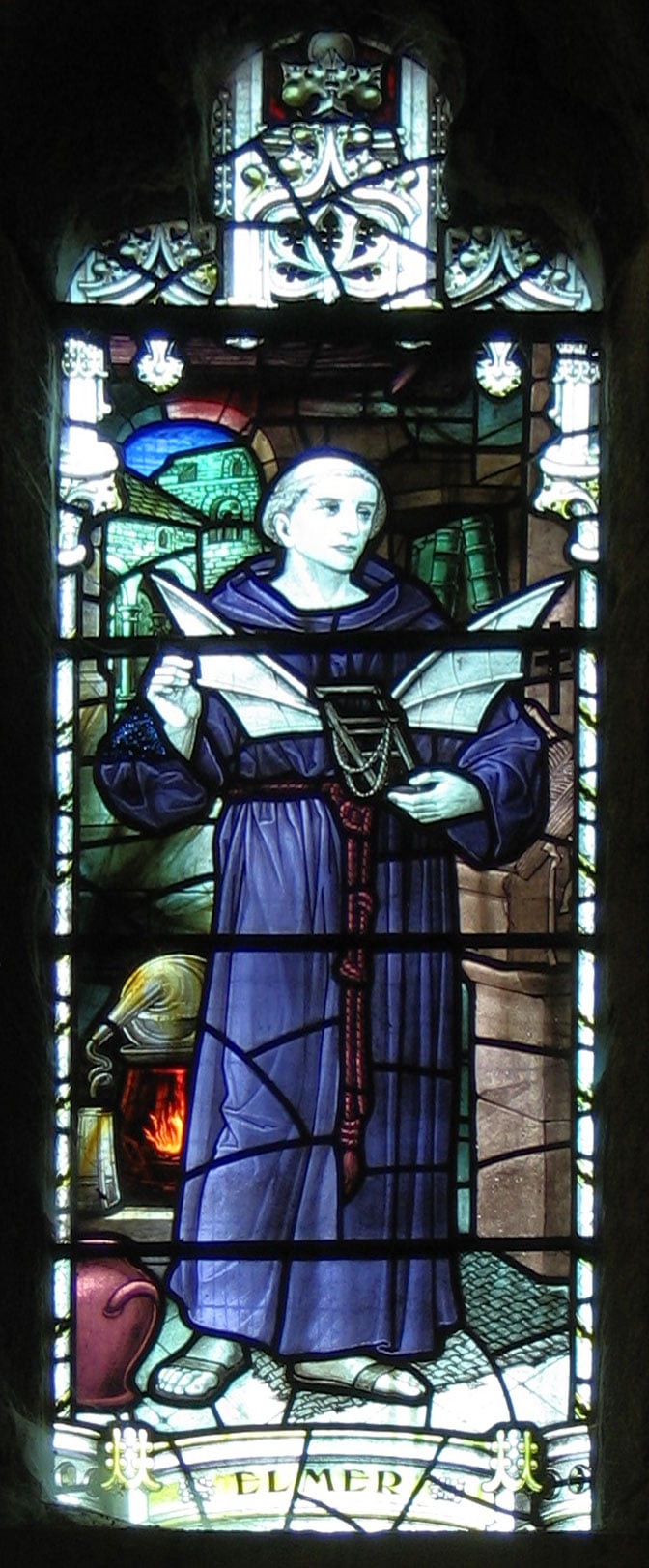 *Stained glass window showing Eilmer, installed in Malmesbury Abbey in 1920*
I have to confess though, as a thirteen year old boy during the comet's last visit in 1986, I understood Eilmer's sense of recognition perfectly. Squinting through a second hand refractor balanced precariously on a wobbly wooden mount, I caught fleeting glimpses of that famous fuzzy smudge, the same object Eilmer had witnessed nearly a millennium earlier, returning right on schedule.
That insight, documented by the 12th Century chronicler William of Malmesbury, makes Eilmer possibly the first person to recognise that comets could be periodic visitors rather than isolated omens. Yet Professor Simon Portegies Zwart from Leiden University argues this remarkable achievement has gone unnoticed by historians for centuries, overshadowed by the fame of Edmond Halley, who wouldn't make the same discovery until 1705.
Halley earned his place in astronomical history by analysing observations of bright comets in 1531, 1607, and 1682. Using Isaac Newton's newly published theory of gravitation, he calculated that these three appearances represented a single comet following an elliptical orbit with a period of approximately 76 years. He correctly predicted its return in 1758, though he died in 1742 without witnessing his prediction.
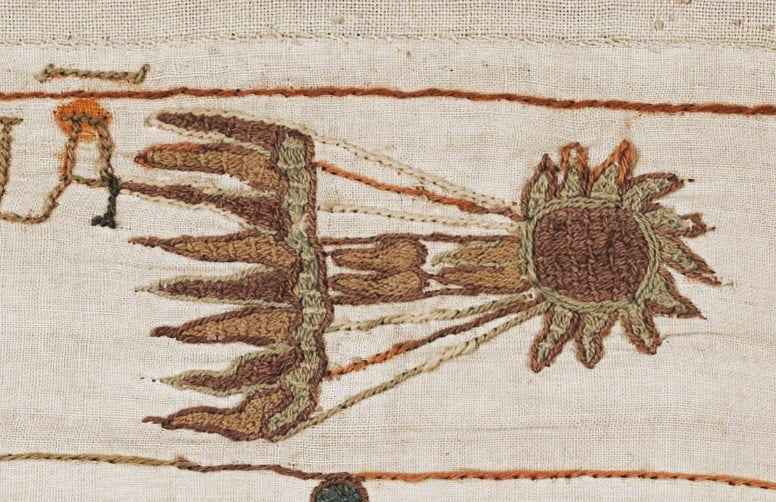 *Comet Halley as depicted in the Bayeux Tapestry*
When the comet dutifully reappeared as predicted, French astronomer Nicolas Louis de Lacaille bestowed Halley's name upon it in 1759. The designation stuck, making 1P/Halley one of astronomy's most recognisable names despite Halley never actually discovering the comet itself.
But Eilmer's story, preserved in William of Malmesbury's Gesta regum Anglorum, tells a different tale. The monk witnessed the comet's 989 appearance as a youth, then saw it return 77 years later in 1066, close to the comet's actual 76 year average period. Medieval Europeans typically viewed comets as terrifying omens presaging death, war, or famine, treating each appearance as an isolated supernatural event. Eilmer's recognition that the 1066 comet was the same object he'd seen decades earlier demonstrated remarkable observational memory and analytical thinking.
The 1066 appearance particularly terrified English observers. The comet arrived during King Harold Godwinson's brief reign and was immortalised on the Bayeux Tapestry, which documents that year's Norman invasion. Duke William of Normandy interpreted the comet as a favourable omen, while the English saw it as portending disaster, a prophecy fulfilled when William's forces killed Harold at the Battle of Hastings in October.
Source : Halley’s Comet wrongly named: 11th-century English monk predates British astronomer
