
The James Webb Space Telescope (JWST ) was designed to look back in time and study galaxies that existed shortly after the Big Bang. In so doing, scientists hoped to gain a better understanding of how the Universe has evolved from the earliest cosmological epoch to the present. When Webb first trained its advanced optics and instruments on the early Universe, it discovered a new class of astrophysical objects: bright red sources that were dubbed "Little Red Dots" (LRDs). Initially, astronomers hypothesized that they could be massive star-forming regions, but this was inconsistent with established cosmological models.
In essence, those models predicted that massive galaxies could not have formed less than a billion years after the Big Bang. This led to the theory that they might be quasars, the bright central regions of galaxies powered by supermassive black holes (SMBHs). This also challenged established models, as it was theorized that SMBHs wouldn't have had enough time to form either. In a recent paper, a team of astronomers led by Harvard University demonstrated that the mystery of LRDs could be explained by identifying them with accreting Direct Collapse Black Holes (DCBHs).
The study was led by Fabio Pacucci, a Staff Astrophysicist with the Harvard & Smithsonian Center of Astrophysics (CfA) and the Black Hole Initiative (BHI) at Harvard University. He was joined by Andrea Ferrara, a professor of cosmology at the Scuola Normale Superiore in Pisa, Italy, and Dale D. Kocevski, an associate professor of physics and astronomy at Colby College. The paper detailing their findings, "The Little Red Dots Are Direct Collapse Black Holes," recently appeared online and is being reviewed for publication in the journal Nature.
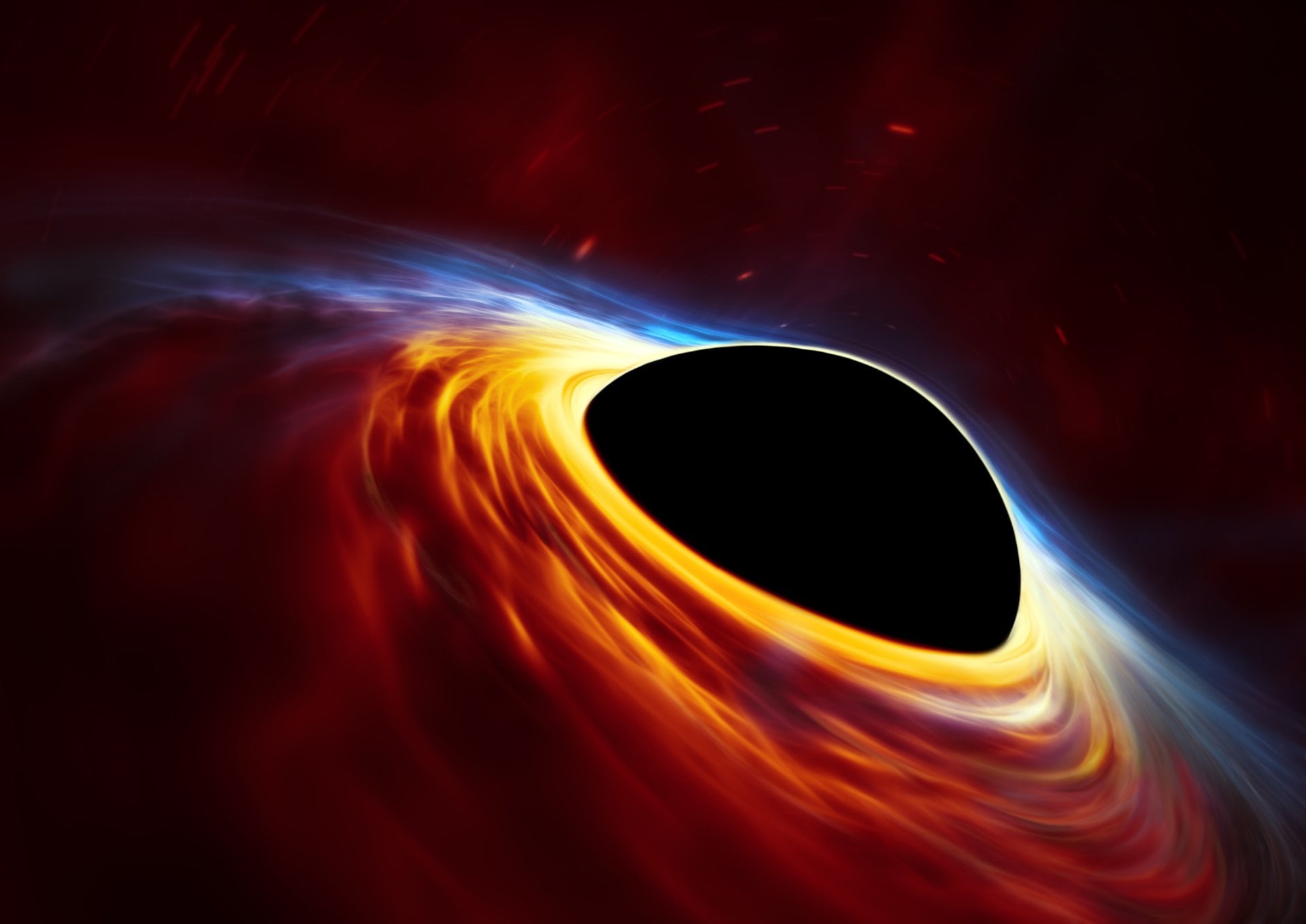 *Artist's impression of a rapidly-spinning supermassive black hole and its accretion disk. Credit: ESO/ESA/Hubble/M. Kornmesser*
Their research is based on radiation-hydrodynamic (RHD) simulations developed to model the emission properties of DCBHs, a class of black holes that form directly from clouds of cold gas. This differs from conventional models that predict how black holes form from the collapse of massive stars. These massive stars, a theoretical class known as Population III, were the first stars in the Universe, forming from hydrogen and helium with little to no traces of heavier elements (like metals).
They were massive, extremely hot and bright, and very short-lived compared to more modern generations of stars, remaining in their main sequence phase for about 2–5 million years. Over time, these black holes would then merge with other black holes (via galactic mergers and other mechanisms) to form massive black holes (MBHs). However, this process could occur only over billions of years, not the few hundred million years between the Big Bang and the emergence of these galaxies.
As Pacucci explained to Universe Today via email, this is where the standard models come into conflict with modern observations:
That process works well in the nearby Universe, but it becomes very difficult to explain extremely massive black holes (sometimes more massive than a billion times the mass of our Sun!) appearing so early, when the Universe was only a few hundred million years old. Simply put, there does not seem to be enough time for stellar-mass black holes to grow to millions or billions of solar masses using conventional growth rates, creating a tension between theory and observations. This long-standing problem is where the theory of DCBHs comes into play: instead of starting small, these black holes are born already massive, providing a natural shortcut that bypasses the time bottleneck mentioned above.
In contrast, DCBHs are theorized to have not formed from the seeds of Population III stars, but collapsed directly from clouds of hydrogen in the early Universe. They were originally proposed as a means of resolving the discrepancy between the Standard Model of Cosmology and the LRDs observed by Webb. In their paper, Pacucci and his colleagues tested how DCBHs that are actively accreting material from their surrounding environment could reproduce what Webb observed during the early Universe.
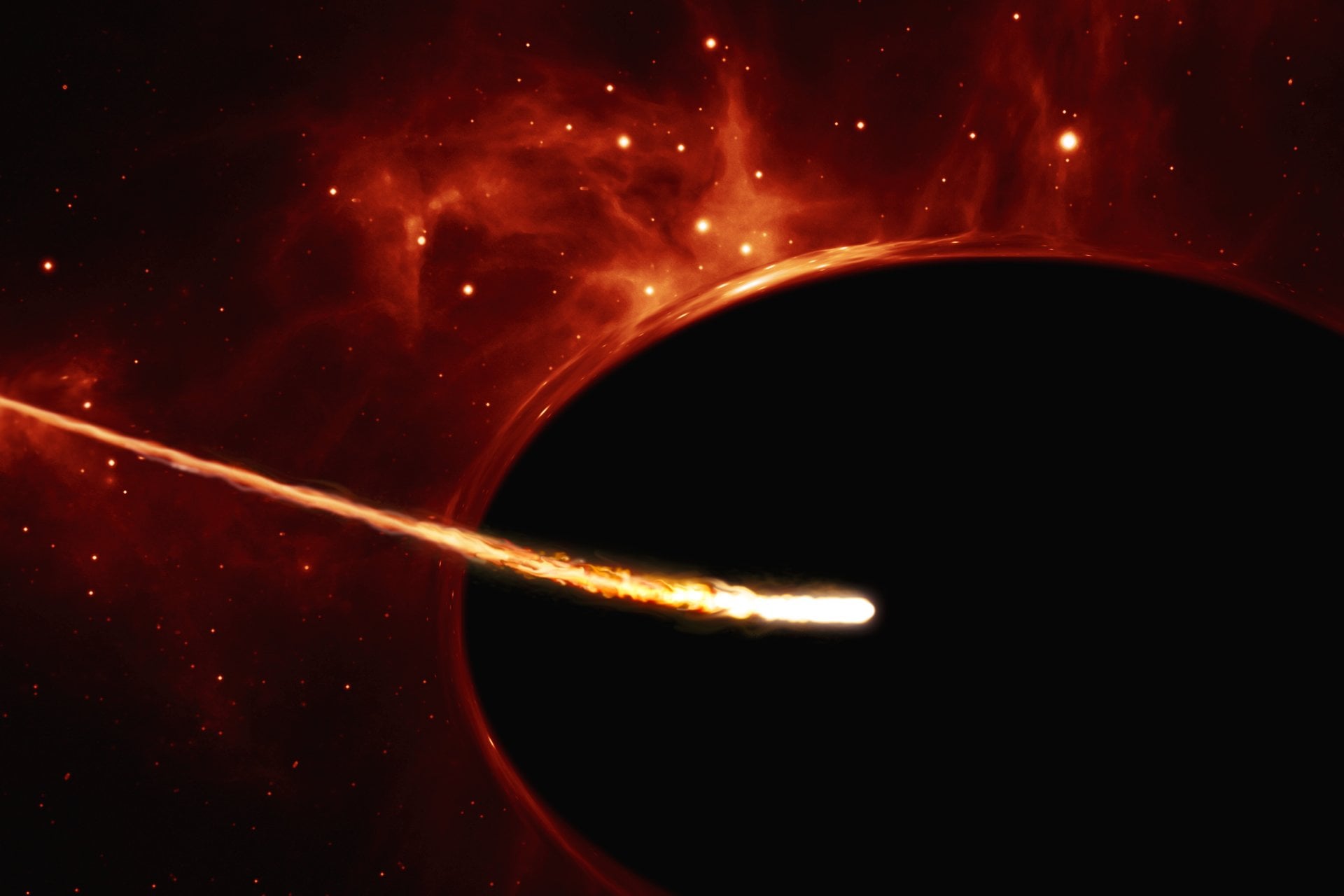 *This artist’s impression depicts a Sun-like star close to a rapidly spinning supermassive black hole (SMBH). Credit: ESO/ESA/Hubble/M. Kornmesser*
"Our radiation-hydrodynamic simulations track both how gas falls onto the black hole and how the radiation it produces affects its surroundings," said Pacucci. "This interaction naturally creates an extremely dense environment that absorbs high-energy radiation and reprocesses it into the ultraviolet and optical light, which JWST observes after it is redshifted into the infrared. When we turn these simulations into mock observations, they match JWST data on Little Red Dots incredibly well, showing that their properties can be explained by well-understood physical processes in the early Universe."
They found that their simulations reproduced the specific characteristics of LRDs, including their weak X-ray emission, the presence of metal and high-ionization lines, the absence of star-formation features, their abundance and redshift evolution, and their long-lived radiation-pressure-driven variable phases. Similarly, the presence of dense gas clouds surrounding the black holes also accounted for their extremely compact nature and why they appear overmassive relative to any stellar components. Said Pacucci:
All the puzzling properties of the LRDs are explained within a single, self-consistent framework, without requiring any ad-hoc assumptions. What makes our model especially powerful is its simplicity, built on decades of theoretical work showing how direct collapse black holes are expected to form and evolve over cosmic time. One of JWST's primary scientific goals is to identify the first black holes and uncover how they formed.
Astronomers have been searching for these primordial objects for decades, but direct evidence has remained elusive. Our results suggest that JWST is witnessing exactly this long-sought phase: the formation and growth of massive black hole seeds through direct collapse. This would be a major breakthrough, showing that the earliest black holes formed efficiently and early, and that JWST is finally opening a direct observational window onto their birth.
By making discoveries that challenged the most widely held cosmological models, Webb has done precisely what it was designed to do. While LRDs were initially a mystery that confounded astronomers and cosmologists, the DCBH scenario has since been experimentally confirmed, providing vital insights into one of the earliest periods in cosmic history.
Further Reading: arXiv
