
Whenever a new telescope is about to begin observations, scientists say they're looking forward to finding answers to some outstanding questions. After all, each new telescope is deliberately designed to address some of these questions. But they also remark that new telescopes inevitably reveal new surprises, and how excited they are to confront those surprises. When it comes to the JWST, both of these expectations have come true.
The JWST's powerful infrared capabilities allow it to look further back in time than any previous telescope. Many of the headlines it's generated are about the surprises it's uncovered in the early Universe. It's found black holes much more massive than we thought possible, and it's also found fully-formed galaxies earlier than current theories can explain.
Now it's found another suprising galaxy in the early Universe. Indian researchers have discovered a mature grand spiral galaxy very similar to the Milky Way that existed only 1.5 billion years after the Big Bang.
The discovery is in new research in Astronomy and Astrophysics titled "A grand-design spiral galaxy 1.5 billion years after the Big Bang with JWST." The authors are Rashi Jain and Yogesh Wadadekar. They're both from the National Centre for Radio Astrophysics – Tata Institute of Fundamental Research in Pune, India.
"It's forcing us to rethink our theoretical framework." - Rashi Jain, NCRA, Tata Institute of Fundamental Research
The new galaxy is named Alaknanda after a Himalayan river that's the headstream for two other rivers named Ganga and Mandakini. Mandakini is also the Hindi name for the Milky Way.
Alaknanda is a large galaxy about 10 kiloparsecs (32,500 light-years) across with about 16 billion solar masses, only slightly less massive than the Milky Way.
"This is among the highest redshift spiral galaxies discovered with JWST" the authors write. "Our morphological analysis using GALFIT reveals that this galaxy is a well-formed disk, with two symmetric spiral arms that are clearly visible in the GALFIT residual." GALFIT is a widely-used tool for modeling galaxies based on their light profiles.
The most interesting thing about Alaknanda is its fully-formed spiral shape. "Detection of a spiral galaxy at z ∼ 4 indicates that massive and large spiral galaxies and disks were already in place merely 1.5 billion years after the Big Bang," the researcher write in their article.
As far as astronomers understand it, it takes a long time for the spiral form to take shape. "Alaknanda has the structural maturity we associate with galaxies that are billions of years older," explained lead author Jain in a press release. "Finding such a well-organised spiral disk at this epoch tells us that the physical processes driving galaxy formation—gas accretion, disk settling, and possibly the development of spiral density waves—can operate far more efficiently than current models predict. It's forcing us to rethink our theoretical framework."
The analysis of Alaknanda was only possible because of gravitational lensing. The Abell 2733 galaxy cluster in the foreground amplified the light from the distant galaxy. The gravitational lensing made Alaknanda appear twice as bright, and that let the JWST image it in detail. The JWST's instruments are equipped with a versatile set of filters, and by employing 21 of them, the telescope could dissect its light in detail. All of this data allowed the researchers to determine the galaxy's characteristics.
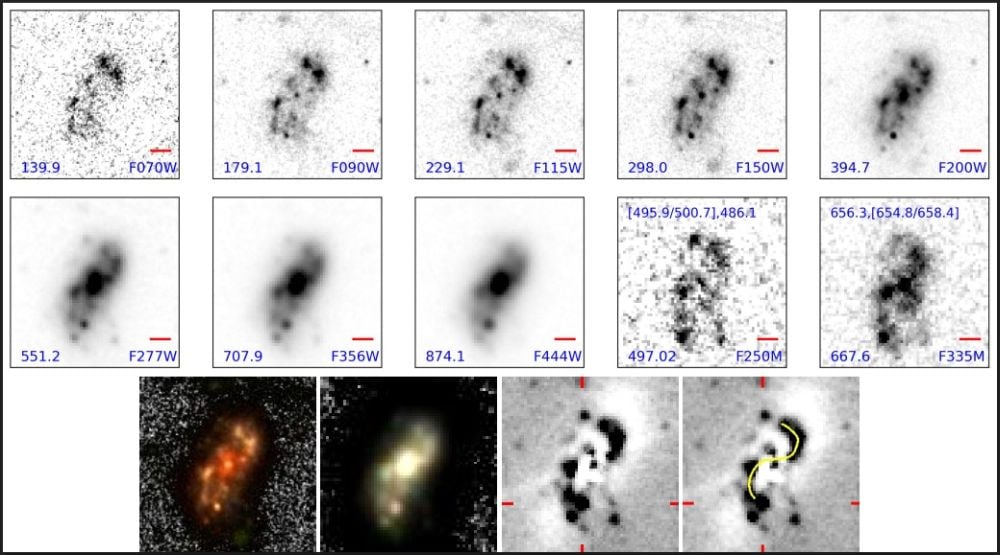 *This image from the research illustrates how the JWST's different filters can reveal a galaxy's properties. Image Credit: Jain and Wadadekar 2025. A&A*
Alaknanda is forming stars at a high rate, about 63 solar masses of stars each year. For comparison, the Milky Way forms stars at the rate of about 1 to 2 solar masses per year. This is in line with ancient galaxies that tended to form stars more rapidly than modern galaxies. 50% of its stars formed after z=4.6, or after about 13.1 billion years ago. That's shocking, since it means that it formed half of its stars in a mere 200 million years, an extremely brief period of time in the cosmic perspective.
"Somehow, this galaxy managed to pull together ten billion solar masses of stars and organise them into a beautiful spiral disk in just a few hundred million years." - Yogesh Wadadekar, NCRA, Tata Institute of Fundamental Research.
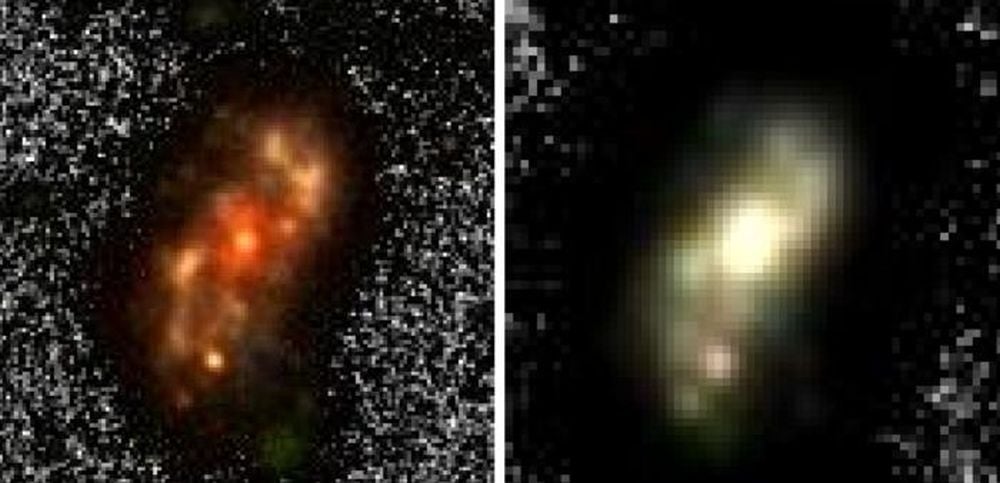 The image on the left was obtained with near-UV filters, while the image on the right was obtained with optical filters. The image on the left highlights star-forming regions, where young stars emit copious amounts of UV radiation. The image on the right highlight the galaxy's central disk. Image Credit: NASA/CSA/ESA, Rashi Jain (NCRA-TIFR)
This discovery is another nail in the coffin for our longstanding theories of galaxy formation and the early Universe. Alaknanda is one of a growing list of ancient galaxies that defy theory. While other, theory-breaking ancient galaxies are disk-shaped, Alaknanda is a grand spiral, one of the clearest examples of one so far back in time, emphasizing its role as a theory-challenging discovery.
"Alaknanda reveals that the early Universe was capable of far more rapid galaxy assembly than we anticipated," said study co-author Yogesh Wadadekar. "Somehow, this galaxy managed to pull together ten billion solar masses of stars and organise them into a beautiful spiral disk in just a few hundred million years. That's extraordinarily fast by cosmic standards, and it compels astronomers to rethink how galaxies form.”
It's possible that our understanding of how spiral arms form is incorrect. The current theory of galaxy formation says that it takes a long time for gas to accrete onto the galaxy from the surrounding space. Then, the gas has to settle into a rotating disk. Finally, density waves form in the disk and cause spiral arms to form.
But it's possible that in some cases, including Alaknanda, an encounter with another galaxy can initiate the formation of the spiral arms. The problem with that is that astronomers think those types of spiral arms fade away and don't last long.
Alaknanda has a candidate companion galaxy that could explain how it formed its spiral arms.
"There also exists a small spheroid galaxy near the southern end of the galactic disk," the authors explain. "This discovery raises several questions regarding the dominant mechanism responsible for the origin of spiral structure in this galaxy, and whether it is induced by the dissolution of clumps over time or via interaction with its candidate satellite galaxy," the authors write.
The dissolution of clumps refers to the clumpiness that forms in unstable disk galaxies. As these clumps dissovle, they could form spiral arms. "This indicates that spiral galaxies may have evolved from a clumpy phase, i.e., the dissolution of clumps in the high redshift clumpy galaxies may be a potential mechanism for the origin of spiral galaxies," the authors explain.
The answer may lie in further observations with the JWST and the Atacama Large Millimetre Array (ALMA). If astronomers can determine how fast Alaknanda is rotating, and if its disk is rotating in an orderly fashion, they may be able to determine if the spiral arms formed by interactions with a companion or through dissolving clumps.
For the companion scenario to be true, the disks would have to be relatively hot and unstable, and ALMA and the JWST can help with that. "Future NIRSpec/IFU or ALMA observations will be helpful to ascertain whether the disk of Alaknanda is dynamically hot or cold, and will provide constraints on the formation mechanism behind the spiral arms in this intriguing galaxy," the authors conclude.
