Warmer oceans are not good. Shallow, glib commentators might try to laugh it off, but their laughter reveals an infantile lack of seriousness in their thinking. Earth is one big, life-supporting system, and we know from the geological record that when the system falters, life pays the price.
What price will this unabated warming extract from us? From the web of life?
New research in Advances in Atmospheric Sciences shows how 2025 was another record year for the oceans in terms of how much heat they're absorbing. It's the eighth year in a row that a new record has been set. The research is titled "Ocean Heat Content Sets Another Record in 2025," and the lead author is Yuying Pan from the State Key Laboratory of Earth System Numerical Modeling and Application, in the Institute of Atmospheric Physics at the Chinese Academy of Sciences.
"Global ocean warming continued unabated in 2025 in response to increased greenhouse gas concentrations and recent reductions in sulfate aerosols, reflecting the long-term accumulation of heat within the climate system, with conditions evolving toward La Niña during the year," the authors write.
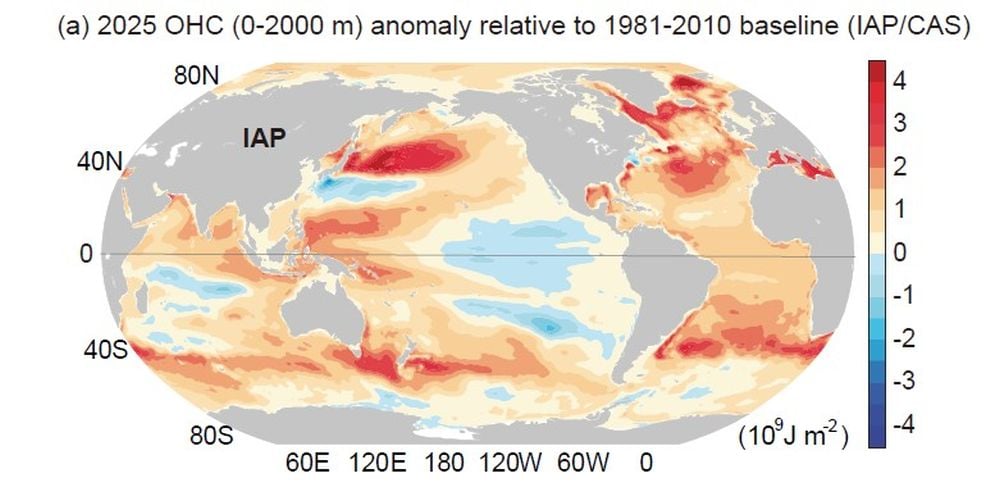
In a vast system like the world's oceans, the heating wasn't uniform. "Regionally, about 33% of the global ocean area ranked among its historical (1958–2025) top three warmest conditions, while about 57% fell within the top five," the researchers explain. These include the tropical and South Atlantic Ocean, Mediterranean Sea, North Indian Ocean, and Southern Oceans. This illustrates the broad warming of the world's oceans.
More than 50 scientists from 31 institutions around the world are behind this research. Their work shows that the oceans absorbed 23 Zetta Joules (23,000,000,000,000,000,000,000 Joules of energy), an extraordinary amount of energy. It's equal to about 37 years of global primary energy consumption at 2023 levels.
"Long-term observational records reveal a clear and sustained increase in global upper OHC since the late 1950s," the researchers write. "Despite differences in input data and processing approaches, all three datasets consistently show marked ocean warming throughout the upper 2000 m."
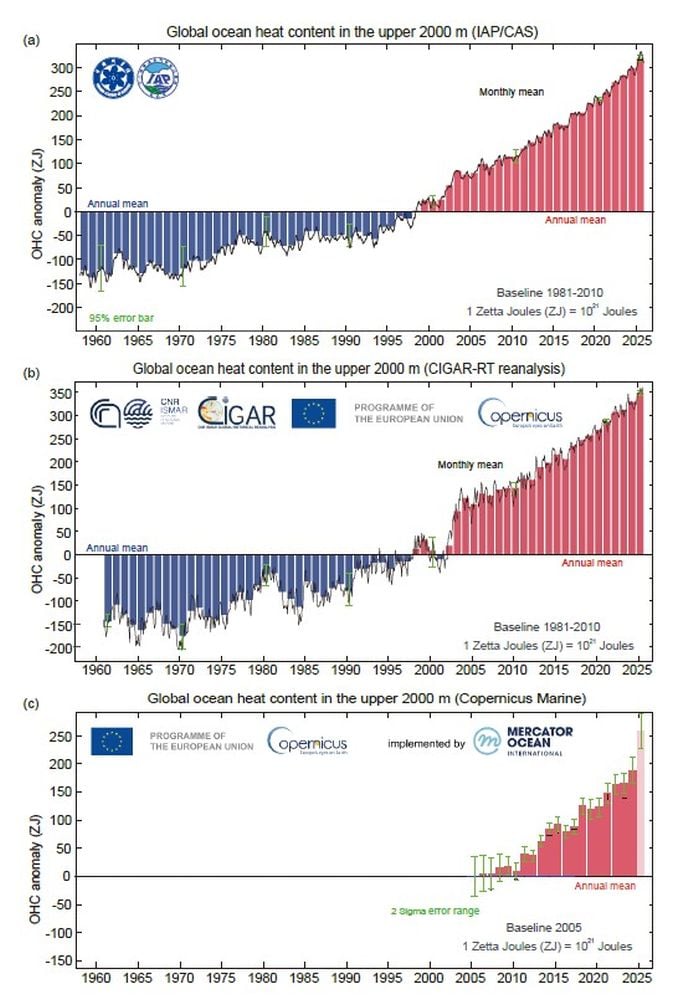
As greenhouse gases warm the globe, the ocean is the repository of almost all of that heat, about 90% of it. That makes ocean heat content (OHC) a strong indicator of long-term climate change. The actual atmosphere only absorbs about 1%. Because the oceans constitute so much mass, they're relatively unaffected by short-term variability from things like volcanic eruptions, El Niño, and random weather patterns. Ocean warming is not easily dismissed, and when the oceans are warming, we should be paying close attention.

"Global annual mean sea-surface temperature (SST) in 2025 was the third warmest year in the instrumental record and remained about 0.5 °C (approximately 1°F) above the 1981–2010 average baseline," according to a press release. The transition from El Niño to La Niña in the tropical Pacific Ocean accounts for a slightly lower SST in 2025 than in 2023 and 2024, but the overall pattern is clear.
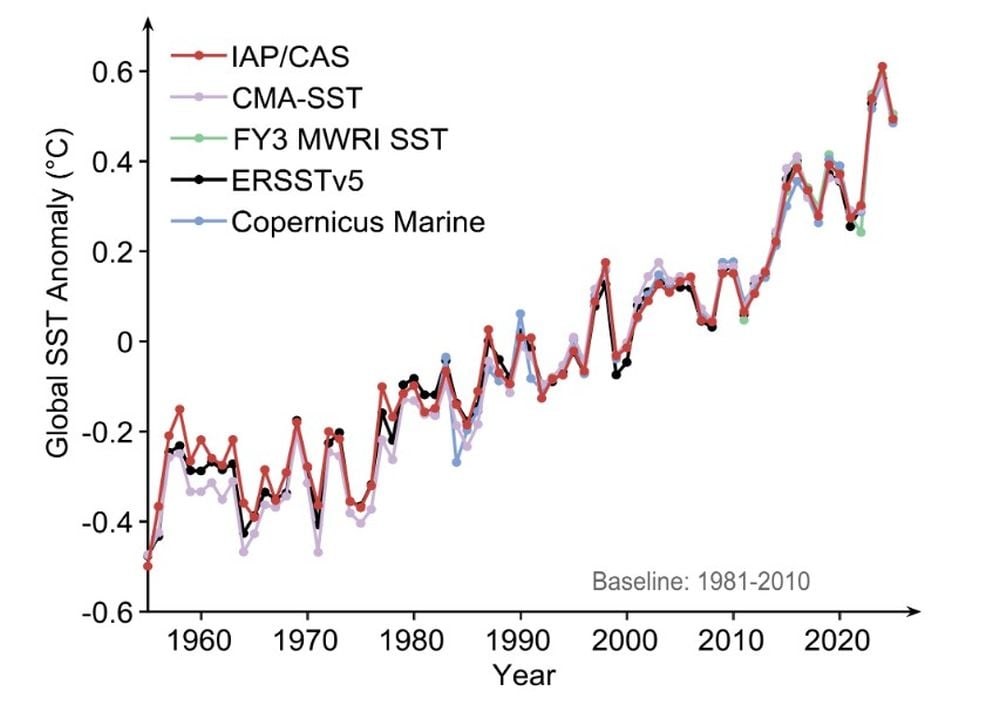
The temperature at the surface is critical because it has a powerful effect on global weather. The higher temperature means more water evaporates, leading to heavier rains. This also creates more energetic storms. In hurricane-prone Florida, repeated hurricanes have driven insurance premiums up by as much as 40% since 2022, with some insurers abandoning the state completely. These are the difficult-to-dismiss real-world outcomes.
The warming of the oceans also changes its chemistry. This means less oxygen as well as amplified acidification. Acidification affects organisms' ability to construct their shells, weakening their chances for survival. Warming also creates stratification, making it more difficult for colder, nutrient-rich water to well up and fuel phytoplankton blooms. Phytoplankton is the base for marine food webs, and if phytoplankton takes a hit, so do many more lifeforms.
We're seeing more sustained heat waves, just like climate scientists warned us about decades ago. We're seeing more severe rain and flooding events, just like we were warned. We're seeing ocean acidification, and they warned us about that, too.
Climate scientists aren't fun at parties anymore, but that was never their function. For decades they've been gathering rigorous evidence of global climate change, including the warming of the oceans. The problem is how slow to react humanity is.
There's little uncertainty about the consequences of warming oceans and climate change. The only uncertainty is in our reaction to it.
There are some encouraging signs. Renewable energy is on the rise, and things like solar panels are becoming cheaper and are in more widespread use than ever. Breakthroughs in materials like perovskite promise even greater solar energy gains. New battery technologies like iron salt batteries hold great promise for storing solar energy. Some advanced economies are reducing their coal production and use, and China is undergoing a rapid change from coal to nuclear energy.
The problem is, carbon emissions are still rising. The rise has slowed and the world seems to be approaching a plateau, which is good news. But the global climate won't stop warming the moment emissions stop rising. The effects will be long-lasting. Any added carbon emissions will cause continued rising, until we reach net zero.
But everybody reading this has most likely heard all of this before.