
No two snowflakes are the same, and neither are nebulae. The NASA/ESA/CSA JWST showed how undeniable that statement is when it imaged PMR 1, also known as the Exposed Cranium Nebula (ECN). The glowing cloud of gas and dust bears an eerie resemblance to a cosmic x-ray of a human skull, complete with a double-hemisphere arrangement of grey matter.
The ECN is about 5,000 light-years away in the constellation Vela, and astronomers have known about it for decades. It's a planetary nebula, which, as most Universe Today readers know, has nothing to do with planets. As a planetary nebula, it's the result of an aging star that shed its outer layer into space, where the gas is irradiated and illuminated by the star inside it.
The insightful JWST has given us an extremely detailed view of the ECN that astronomers in decades past could only dream about. Prior to these JWST images, they were limited to an older Spitzer Space Telescope image of the nebula.
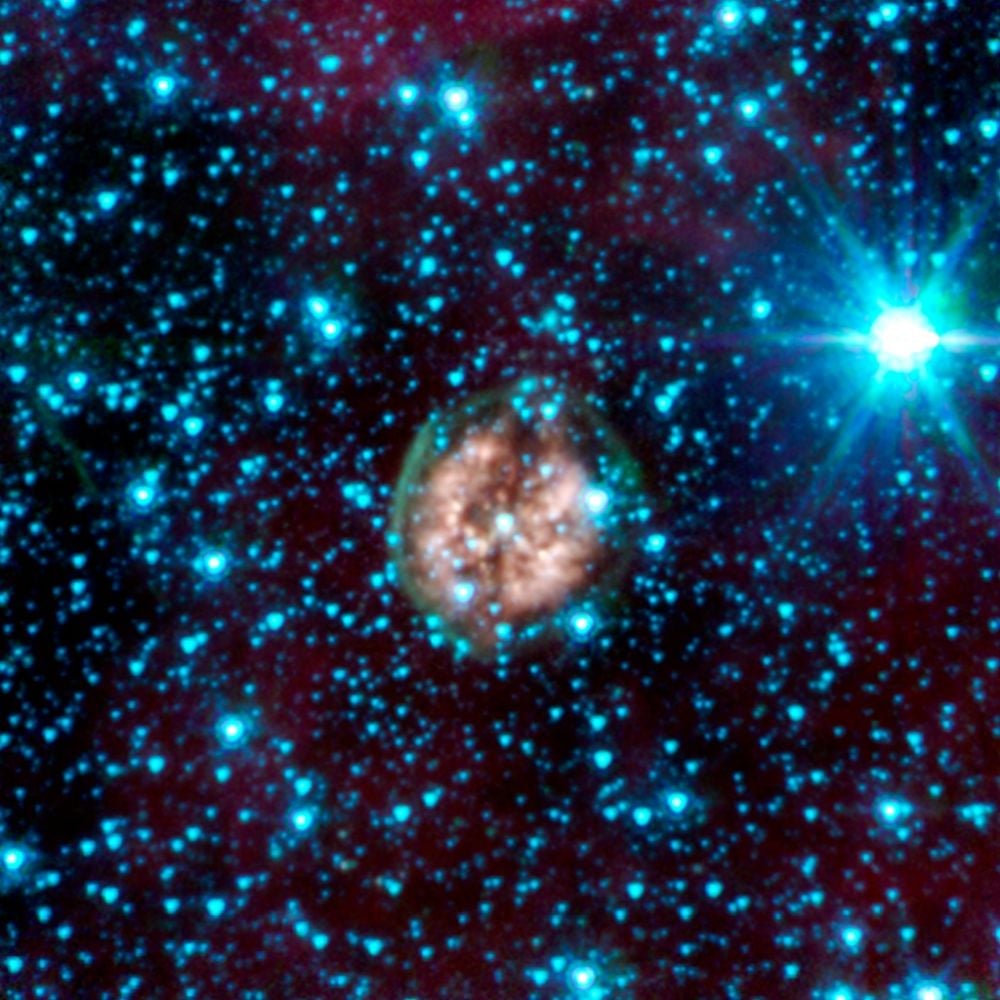 This Spitzer Space Telescope image of the Exposed Cranium Nebula is from 2013. While no doubt intriguing at the time, it lacks the detail uncovered by the far more advanced JWST. Image Credit: NASA/JPL-Caltech/J. Hora (Harvard-Smithsonian CfA)
The star inside the nebula will eventually become a white dwarf, but right now it's in a transitional stage.
The CSPN (Central Star Planetary Nebula) in this case is a Wolf-Rayet type star. It's not a classic Wolf-Rayet star. Those stars are massive, hot, and often explode as supernovae.
Instead, this star was a main sequence star that swelled up to become a red giant late in its life. Specifically, it's called a WC4 or WO4 star. These are lower-mass main-sequence stars that exhibit properties of Wolf-Rayet stars. The main characteristic they share is that they've shed their outer hydrogen layer, and emission lines of either Carbon or Oxygen are visible. This accounts for the C in WC4 and the O in WO4.
The type classification, along with an observed emission line of highly-ionized nitrogen, suggests that the star has followed a very complex evolutionary path. So while it's not a full-blown WR star, it still exhibits some of the powerful traits that define those stars. Among these are extremely powerful and fast stellar winds. They're responsible for removing the star's own outer hydrogen layer, leaving behind a helium-burning core. These same winds have exposed the nitrogen, which would normally be buried.
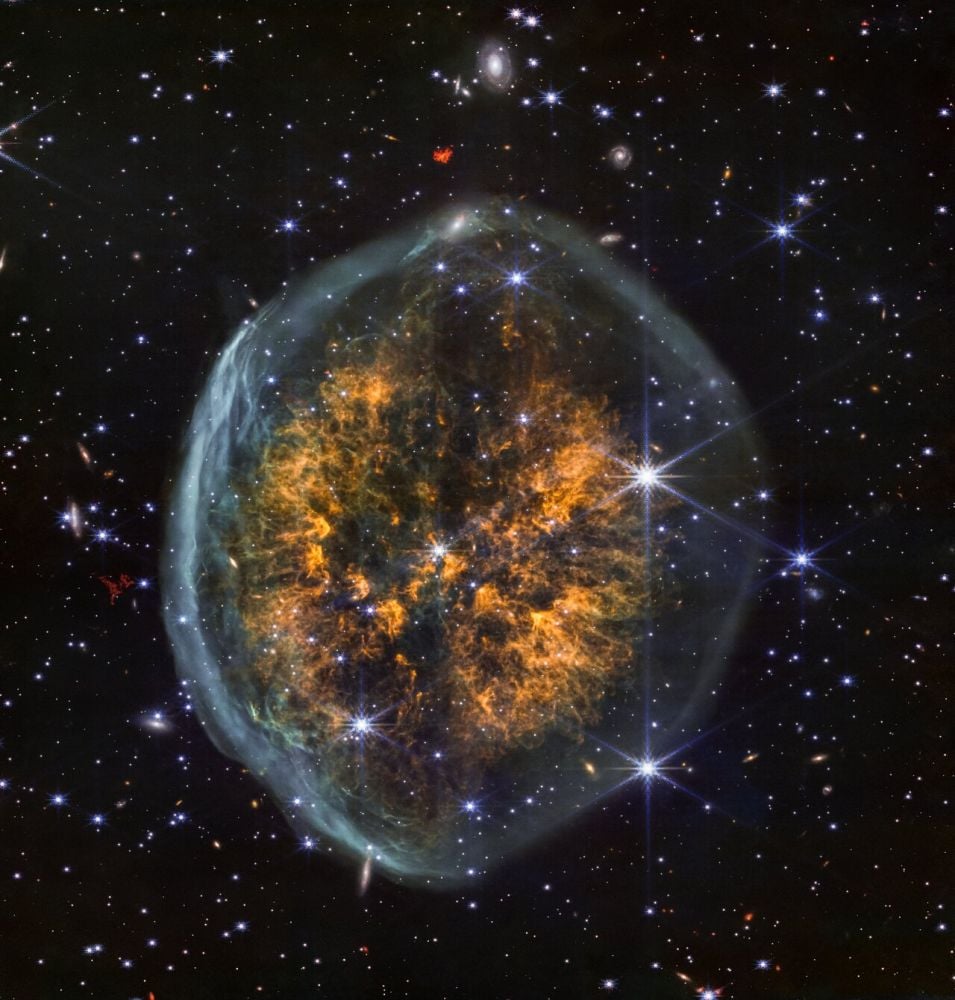 The JWST's NIRCam image of the ECN. The outer shell is cool hydrogen shed from the star's outer layer. The interior is hot ionized gases. Image Credit: NASA, ESA, CSA, STScI, Image Processing: Joseph DePasquale (STScI)
The JWST images show us the evidence of the star's journey. The outer shell is made of hydrogen shed by the star's powerful winds. That shell is blue in these images.
The inner cloud is more morphologically complex, and also contains a larger number of chemicals. It's a more chaotic mix of hot, ionized gases. A curious feature of the ECN is the dark line running through the middle, like a line dividing brain hemispheres. It could be caused by a stellar outburst, or a more regular flow from the star. The top of the MIRI image shows what could be gas being ejected by this flow.
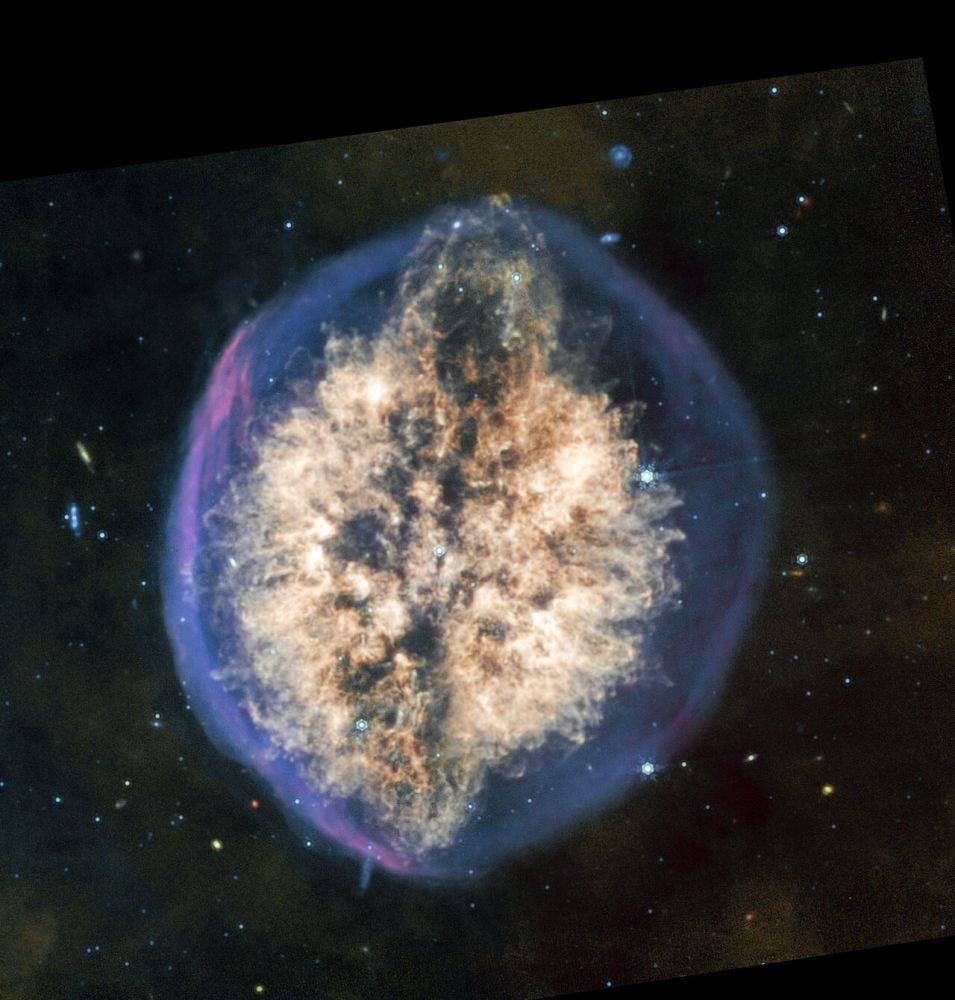 The JWST's MIRI image of the ECN. Hot ionized gas appears to be escaping from the top of the nebula in this image. This could be driven by the same outflows our outburst that's creating the dark dividing line between the nebula's "hemispheres." Image Credit: NASA, ESA, CSA, STScI, Image Processing: Joseph DePasquale (STScI)
While the underlying stellar journey of this star and nebula are compelling scientifically, the object itself is visually stunning. It's a reminder of nature's complexity, and also of the pattern-seeking algorithm that runs in our human operating system. Our brains see a brain.
The nebula is a short-lived phenomenon, in astronomical terms. It might last for about 10,000 or 20,000 years. But nebulae like this one are still important objects.
They seed their galaxies with heavier elements fused during the star's life. Over time, this is how Nature raises the metallicity of galaxies, which in turn affects the metallicity of stars, which then dictates tye type of planets that can form.
Metallicity also dictates whether life can arise. Without elements heavier than hydrogen and helium, nothing living could ever form.
Structures like these are important on the road to complex life like us. Without their heavy elements, we wouldn't exist. The JWST, a product of our complex brains, is closing the loop by showing us this cosmic "brain" in the night sky.
