The International Space Station (ISS), which has been continuously occupied for 26 years, is approaching retirement. By 2030, all participating space agencies will bring their astronauts home for the last time, and the station will be maneuvered so it burns up in Earth's atmosphere. The legacy of this station is unmatched, and its successors (of which several are planned) will have extremely big shoes to fill. Nevertheless, there's no shortage of space programs and commercial interests looking to place new space stations in orbit.
Some space agencies, such as NASA and the Indian Space Research Organization (ISRO), hope to deploy new stations. At the same time, China aims to expand its existing Tiangong station to double its current size while Roscosmos recently announced that it will recycle its existing ISS modules to create a space station crewed by Russian cosmonauts and international partners. As for the commercial sector, the companies hoping to participate, and the concepts they're proposing are legion!
With multiple space agencies planning on taking the "next great leap" - going back to the Moon, to Mars, and beyond - space stations are part of an incremental approach to secure those next great leaps. And the orbital lanes in LEO could be getting a little crowded as a result.
The First Stations
Space stations are a means of establishing an enduring human presence in space. First deployed at the end of the Apollo Era, they represented humanity's next step in space exploration. Before this, NASA and the Soviet space program were locked in a state of competition - the Space Race - where they were dedicated to "getting there first." This included being the first to send a satellite (Sputnik) to space, the first man to space (Yuri Gagarin), and the first astronauts to land on the Moon (Neil Armstrong and Edwin "Buzz" Aldrin).
But with the success of the Apollo missions, which landed a total of six lunar modules and twelve astronauts on the lunar surface, the Space Race was officially over. It was at this point, during the early to mid-1970s, that NASA and the Soviets began contemplating their next moves. Having reached space many times over, they decided to focus on technologies that would enable long-duration stays in space. In essence, they shifted from getting to space to staying there.
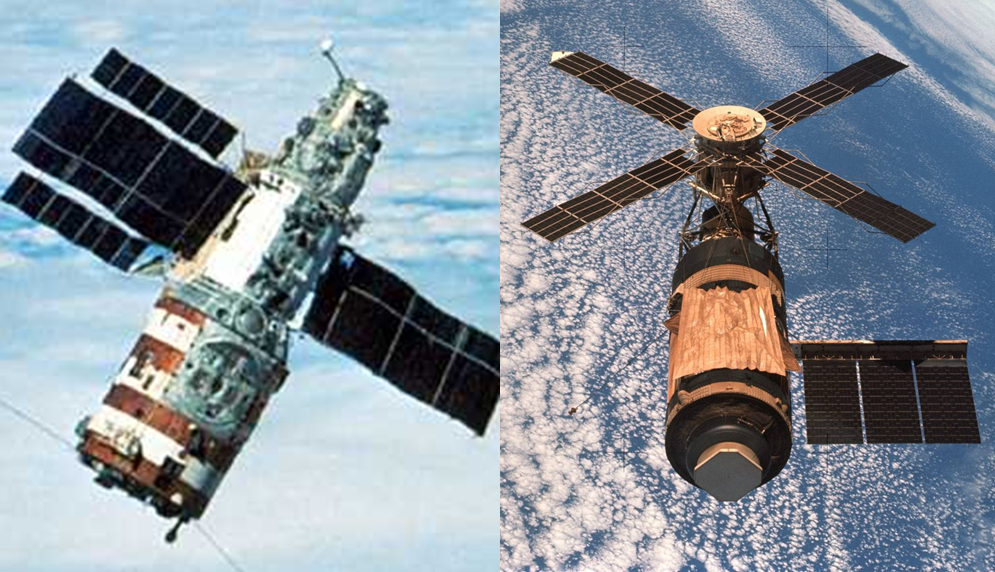
Having ceded the "Race to the Moon," the Soviets achieved an early lead with the Salyut program. The program ran from 1971 to 1986 and launched four crewed scientific research stations and two crewed military stations that operated under the guise of the program (Almaz stations). The Salyut stations conducted research on the challenges of long-term spaceflight, as well as a variety of scientific experiments.
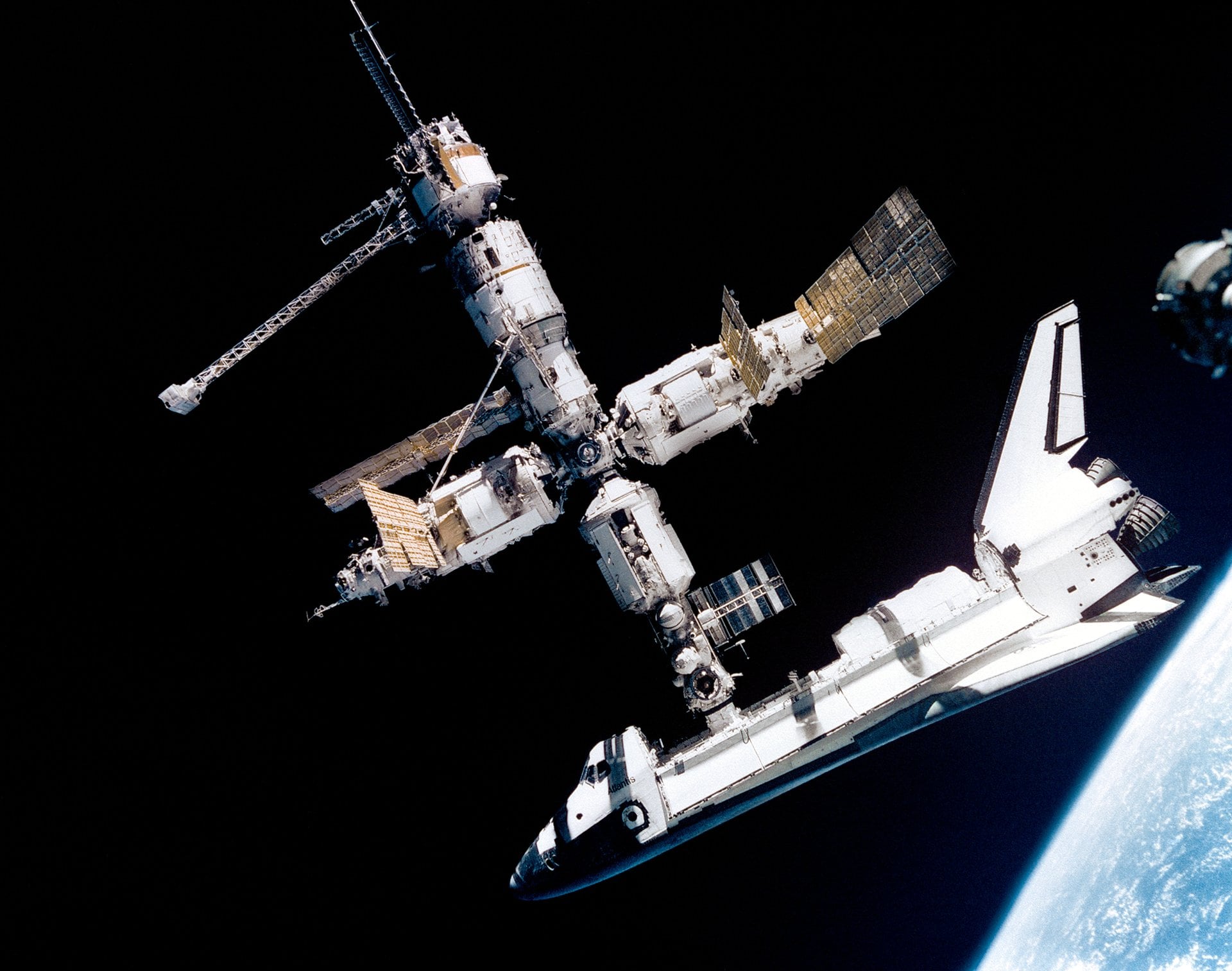
The stations also set several spaceflight records, including mission duration, extravehicular activities (EVAs), and the first crew handover in space. Salyut established a legacy for modular space stations and represented a critical step from single-module and docking-port stations to more complex ones. This would be realized with the Soviet-Russian Mir space station (Russian for "peace"), which remained in operation from 1986 until it was deorbited in 2001.
This station was made up of seven modules, including the Salyut-derived Mir core module*, the Kvant-1 and -2 modules (where scientific research was conducted), Kristall (microgravity manufacturing), Spektr (Earth-related studies), Priroda (Earth-sensing), and the docking module. Mir also established a precedent for international cooperation in space through the Interkosmos, Euromir, and Shuttle–Mir* programs.
Meanwhile, the U.S. responded with its own single-module station, Skylab, which was occupied between 1973 and 1974 but remained in orbit until 1979. The station was created from the third stage of a repurposed Saturn V rocket and deployed as a payload by the same rocket. Skylab was America's first long-duration space station, containing an orbital workshop, a solar laboratory, and an Earth observatory, and was the site of hundreds of experiments.
While NASA hoped to create its own Space Station Freedom to succeed Skylab, and Roscosmos hoped to succeed Mir with Mir-2, these were cancelled in 1993 in favor of participation in the ISS. By 1998, NASA and Roscosmos had placed the foundational elements of the ISS in orbit, and expeditions commenced by 2000. Since then, NASA, Roscosmos, the Canadian Space Agency (CSA), the European Space Agency (ESA), and the Japan Aerospace Exploration Agency (JAXA) have added modules and elements that have enhanced the Station’s capabilities.
ISS Retiring
Originally, the ISS was intended for a 15-year mission, and NASA planned to deorbit the station by 2016. But the mission has been repeatedly extended due to the vital research it enables and the international support its received. This culminated in the Space Frontier Act of 2018 in July 2018 and the Leading Human Spaceflight Act a few months later, both of which extended ISS operations until 2030.
In August 2022, Congress passed similar provisions in the Creating Helpful Incentives to Produce Semiconductors (CHIPS) and Science Act, which President Biden signed into law. While Russian officials have announced that they will withdraw from the ISS after 2024 (later pushed to 2025), Russian cosmonauts have continued to participate in joint missions with NASA and other space agencies. As of the publication of this article, no final departure date has been formalized.
Unfortunately, the continued occupation means that the oldest modules in the ISS are more than 20 years old. This has led to all kinds of maintenance issues over the years, not to mention health-related concerns. In terms of the former, the modules have experienced structural fatigue, persistent air leaks, and degrading hardware, with maintenance costs hovering around $1 billion annually. In September 2019, the Zvezda Service Module began experiencing higher-than-normal air leaks, which have persisted despite multiple repairs.
In terms of the latter, more than 25 years of continuous occupation by astronauts and cosmonauts have left the station filled with microorganisms that could pose health risks. In 2019, NASA shared the results of a comprehensive study of the microorganisms and fungi present on the ISS, which found diverse populations of both that "may include opportunistic pathogens." In a 2022 interview with Russia's state-owned RIA Novosti news agency, the Director of the Institute of Biomedical Problems at the Russian Academy of Sciences (RAS), Oleg Orlov, addressed these risks:
An analysis of the results of microbiological monitoring of the habitat of the ISS RS modules, carried out within the framework of the full-time medical control operations, indicates that the state of the ISS habitat is deteriorating. It is an objective process. Generalized results show that in 65% of the analyzed samples of the latest expeditions, microorganisms were found in quantities exceeding regulatory requirements.
Among the representatives of bacterial flora isolated from the habitat of the ISS, species that are of medical importance and are capable of causing allergic reactions and some types of soft tissue and upper respiratory tract diseases have been identified.
With the ISS slouching toward retirement and space agencies expressing doubts about further extensions, attention is shifting to what will replace this venerable workhorse and research platform in space.
The Lunar Gateway
In the near future, NASA hopes to deploy the Lunar Gateway in orbit around the Moon. This station is a collaborative project between NASA, the European Space Agency (ESA), the Japan Aerospace Exploration Agency (JAXA), and the Canadian Space Agency (CSA). This space station was conceived through concept studies conducted between 2012 and 2018, and was originally designated the Deep Space Habitat (DSH). By 2015, it was approved as part of NASA's NextSTEP (Space Technologies for Exploration Partnerships) studies and began receiving funding for development.
In 2018, the International Space Exploration Coordination Group (ISECG) identified the Gateway as essential to lunar exploration, missions to Mars, and beyond. The modular design consists of a core composed of the Power and Propulsion Element (PPE) and the Habitation and Logistics Outpost (HALO). These modules will launch no sooner than 2027, followed by the European System Providing Refueling, Infrastructure and Telecommunications (ESPRIT), the Lunar International Habitation Module (Lunar I-HAB Module), the Canadarm3 robotic manipulator arms, and the Crew and Science Airlock Module.
The station will also be paired with reusable surface elements, collectively known as the "Artemis Base Camp," which were announced in 2020 as part of NASA’s Lunar Surface Sustainability Concept. The base will include a Lunar Terrain Vehicle (LTV) to transport crew members around the landing zone, a pressurized Habitable Mobility Platform (HMP) for longer trips across the surface, and a lunar Foundation Surface Habitat (FSH) that will house up to 4 crew members during shorter surface stays.
On May 2nd, 2025, the second Trump administration released its FT 2026 budget request, which proposed canceling the Lunar Gateway program. However, the budget, signed into law on July 4th, allocated $2.6 billion to the Gateway, requiring $750 million to be spent between 2026 and 2028. Similarly, discussions have arisen about repurposing the Lunar Gateway for other missions.
This includes now-Administrator Jared Isaacman's policy blueprint, "Project Athena," in which he explored repurposing modules or propulsion-related hardware for a nuclear-powered tug vehicle. However, neither Isaacman nor NASA has announced any such plans.
Tiangong
The construction of China's Tiangong ('Heavenly Palace") modular space station began with the deployment of the Tianhe ("Harmony of the Heavens") core module in April 2021, and finished the following year with the deployment of the Wentian ("Quest for the Heavens") and Mengtian ("Dreaming of the Heavens") laboratory modules. The station is based on experience gained from its predecessors, Tiangong-1 (2011-2016) and Tiangong-2 (2016-2019), and has been continuously occupied by taikonauts since June 5th, 2022.
As of 2026, a total of 30 taikonauts have launched to Tiangong (Shenzhou-10 to -22), serving in crews of three for periods of about six months - though the station can accommodate up to six taikonauts during mission handovers. According to the China Manned Space Agency (CMSA), the station has conducted research into spacecraft rendezvous, permanent human operations in orbit, long-term autonomous spaceflight, bioregenerative life support systems (BRLSS), and autonomous cargo and fuel supply.
On October 4th, 2023, the Chinese Academy of Space Technology (CAST) announced that three new modules will be added, effectively doubling its size and crew capacity. Chinese state media have also stated that the station will foster international cooperation by accommodating crews from "several countries," which may include ESA members. This is in keeping with plans to make Tiangong a successor to the ISS.
The planned expansion will also extend the mission's duration to 2037, 10 years longer than previously announced. The research activities that are planned will include further studies into long-duration stays in space, space medicine, agriculture, technological innovations, and tests involving the Mengzhou spacecraft - Shenzhou's replacement, which is designed to transport six or seven taikonauts to orbit or the Moon.
In this respect, Tiangong will also play a role in China's plans to construct the International Lunar Research Station (ILRS) in collaboration with Roscosmos. Speaking of which...
Russian Orbital Station
In recent years, Russia has announced similar plans to build a successor station to the ISS. However, in December 2025, the Director of the Institute of Biomedical Problems of the Russian Academy of Sciences (RAS), Greg Orlov, announced that Russia would continue using the modules that make up the Russian Orbital Segment of the ISS after 2030, which would henceforth be known as the Russian Orbital Station (ROS), or *Rossiyskaya orbital'naya stantsiya*.
This represents a major change from what Russian officials have stated in recent years, which was their intent to create a new station to succeed the ISS. Plans for a Russian space station began in earnest in 2009 with the proposed Orbital Piloted Assembly and Experiment Complex (OPSEK). This plan called for a station that would include the six modules that make up the Russian Orbital Segment, but it was abandoned in 2017 in favor of maintaining participation in the ISS program.
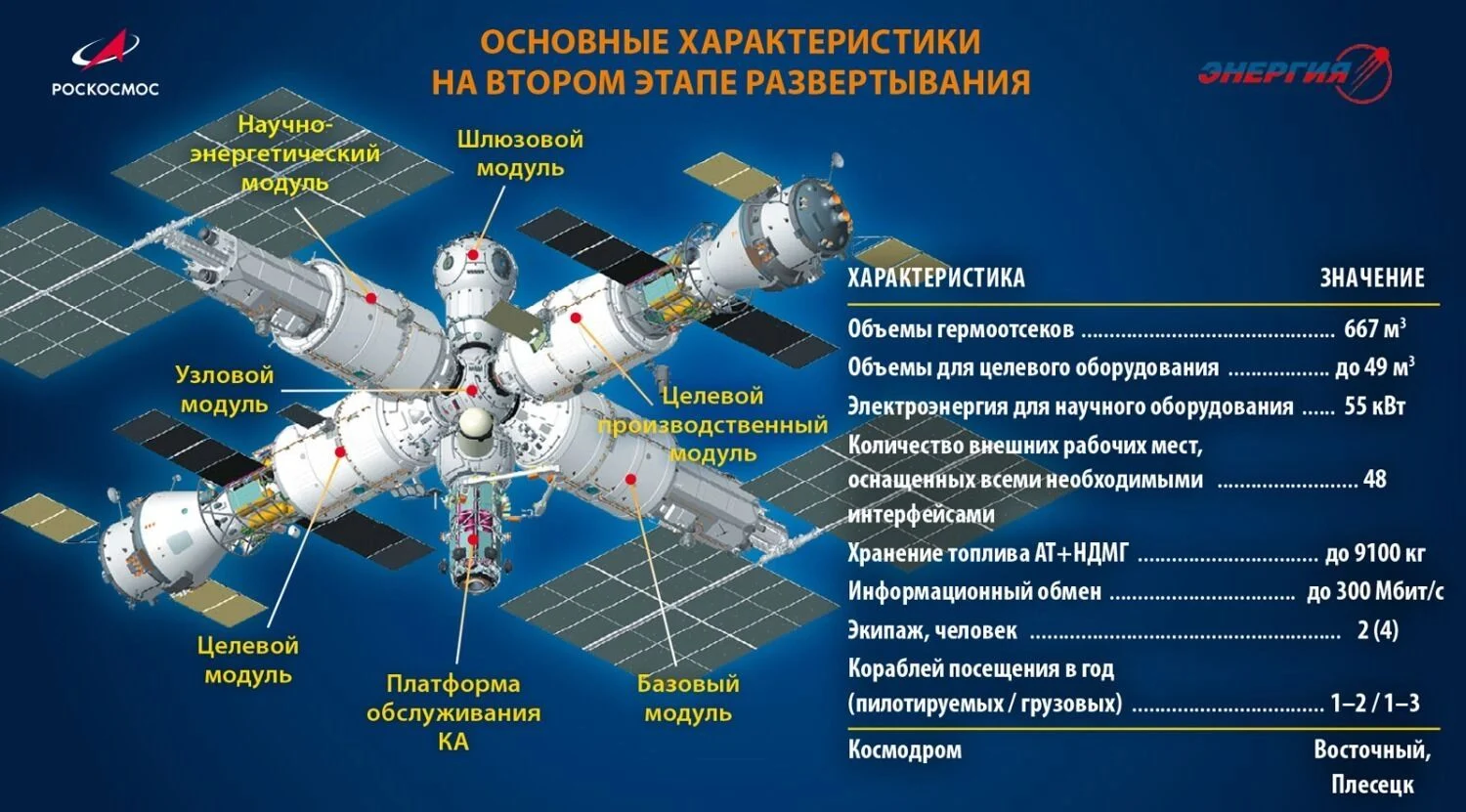
The plans were revived after 2021, when Roscosmos announced it would terminate its involvement in the ISS by 2024, citing concerns about the condition of its aging modules. At this point, the OPSEK concept was renamed the Russian Orbital Service Station (ROSS), which would no longer include Russia's ISS modules. The updated plan included launching the four core modules between 2027 and 2030, including the scientific and energy module, the Universal Node (UNM), the Gateway (SM), and the Base Module (BM). By 2035, up to three more modules were to be added, with the possibility of a private habitat for space tourism.
However, due to budget constraints arising from sanctions and the termination of international agreements (due to Russia's invasion of Ukraine in 2022), Russian planners returned to the idea of reusing its ISS modules. Per this new plan, Russia will separate its modules from the ISS once the program is completed in 2030, forming the core of the ROS, with other modules to follow. However, given the age of the modules and associated health concerns (which Orlov addressed as recently as 2022), there is significant doubt that this plan will remain in place for long.
Bharatiya Antariksh
In 2019, the Indian Space Research Organization (ISRO) announced that it would build the Bharatiya Antriksh Station (BAS) in orbit by 2035. According to repeated ISRO statements, the station will build on the agency's plans to begin sending crewed missions to orbit (Gaganyaan). As then-ISRO chief Sreedhara Somanath stated in October 2023:
Our Gaganyaan program is towards a human space flight capability to space, and once that happens, we will be able to look at space station building in subsequent modules. The timeline for this space station project spans the next 20 to 25 years. We will be definitely looking at manned exploration, a human spaceflight for a longer duration, space exercise there in our agenda.
Similar to China, India views this station as integral to its plans of becoming a major power in space exploration, science, and research in the coming decade. This will include completing the Ganganyaan program and conducting a crewed Moon landing by the year 2040. The development of the BAS is scheduled to begin with the launch of the first module (BAS-1), along with solar panels and a docking port compatible with ISS, in 2028.
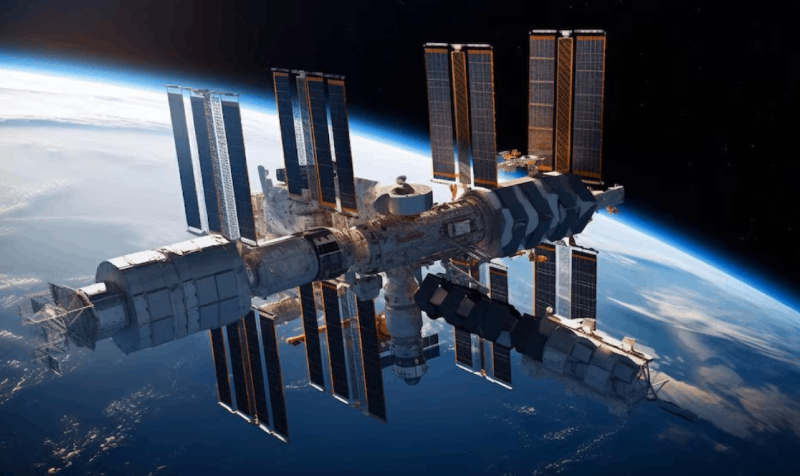
The BAS will feature a five-module configuration consisting of the Base Module (BAS-1), the Core-Docking Module (BAS-2), the Science research Module (BAS-3), the Laboratory Module (BAS-4), and the Common Working Module (BAS-5). The station will measure 27 by 20 meters (88.5 by 65.5 feet), orbit at an altitude of 400-450 km (250-280 mi), and house a crew of three to four. The ISRO has also stated that the station will be accessible by all major space agencies, including NASA, Roscosmos, the ESA, and JAXA.
And these are just the plans proposed by the world's major or rising space agencies. Stay tuned for part II, where we will address the many concepts being explored by commercial space companies.