Baby pictures are some of a family's most cherished artifacts. The same thing can be said of the Hubble Space Telescope and the infant stars it immortalizes in its scientific portraits. But while we know how babies are conceived and how they form in great detail, the same can't be said for star formation.
With modern medical imaging, it's a routine matter to peer inside the womb and see what's happening. Scientists understand the growth and development of the fetus in great detail, despite being hidden during pregnancy. Baby stars are a more formidable target. Not only because they're many light-years distant, but because they're born in a murky cloud, and the natal cloud of gas and dust obscures the details of their formation.
But the Hubble has made progress despite the obscuration of its targets. The Hubble Mission Team has released several of the telescope's stellar baby pictures that illustrate some of its efforts and some of its findings. They're from the SOFIA Massive (SOMA) Star Formation Survey. These images are of massive baby stars, since the formation of massive stars is an ongoing mystery. The SOFIA researchers have published several papers presenting their results.
Star formation is one of the most fundamental processes in the cosmos. Astrophysicists know that stars form from densities that collapse in molecular clouds. The process is reasonably well understood for stars with low masses like our Sun. But there's a lot of detail and many unanswered questions when it comes to the formation of more massive stars, those with at least 8 to 10 solar masses. Understanding these stars is important, since they're considered important drivers of the growth and evolution of galaxies. They also have powerful winds, energetic radiation, and when they explode as supernovae they have a profound effect on their surroundings, even triggering further star formation.
Once a star reaches about 8 solar masses, its outward radiation pressure becomes so strong that it should blow anymore incoming material away, preventing it from accreting onto the star and ending its growth. This is a conundrum, since we routinely observe stars with up to 100 solar masses or more.
Massive stars also form very quickly, in as few as 100,000 years. But no matter how astrophysicists study and model the physics of star formation, they can't figure out how they form so rapidly.
Massive stars also form in groups for some reason. They rarely form alone, and where we find one we usually find more. This complicates the study of their dynamics and the details of their accretion and stellar feedback.
The Hubble can see in a portion of the infrared spectrum, which means it can see through some of the gas and dust that obscures the machinery of massive star formation. Young protostars themselves have powerful jets that cut holes and openings in their veils of gas and dust, and the Hubble can detect the light that shines through these openings. These observations can reveal detail about the radiation, the dust content, and the structure of these stars. Part of the scientific effort to understand massive star formation lies in finding connections between these young stars and the stage of stellar evolution or formation they're in, and these observations can help.
The star formation region Cepheus A features in one of the images. It's 2,300 light-years away, making it one of the nearest massive star formation regions. It features dense molecular clouds and ionized gas, and a collection of baby stars. One particular protostar provides half of Cepheus A's brightness, which naturally attracts astronomers' attention.
It's called HW2, and has about 16 solar masses. It's still growing very rapidly at the fastest rate seen for its type of object.
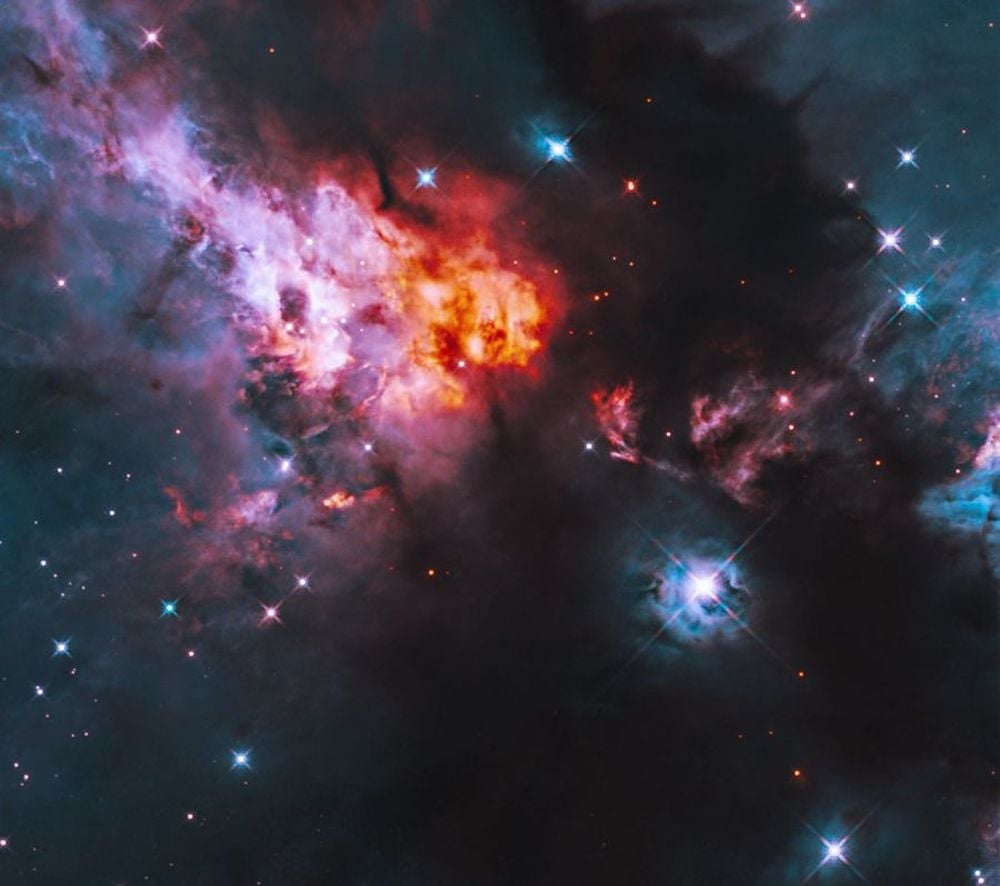
G033.91+0.11 is another star formation region in the Milky Way. A reflection nebula in the center of the image is created by light from a hidden protostar that bounces off of the gas and dust. This is different from an emission nebula, where gas is heated up by UV radiation from a nearby star and emits its own light.
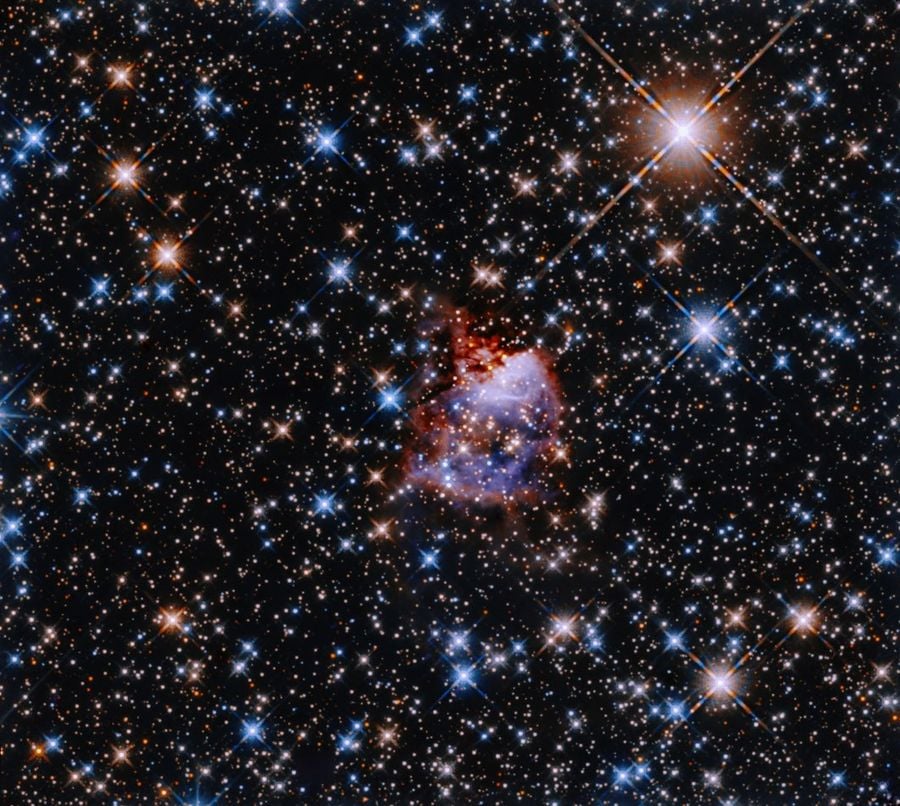
The next image features GAL-305.20+00.21, another site of massive star formation. An emission nebula is prominent near the image's center. The gas that makes up the nebula is ionized by the radiation from a massive young protostar hidden within the region's larger collection of gas and dust clouds.
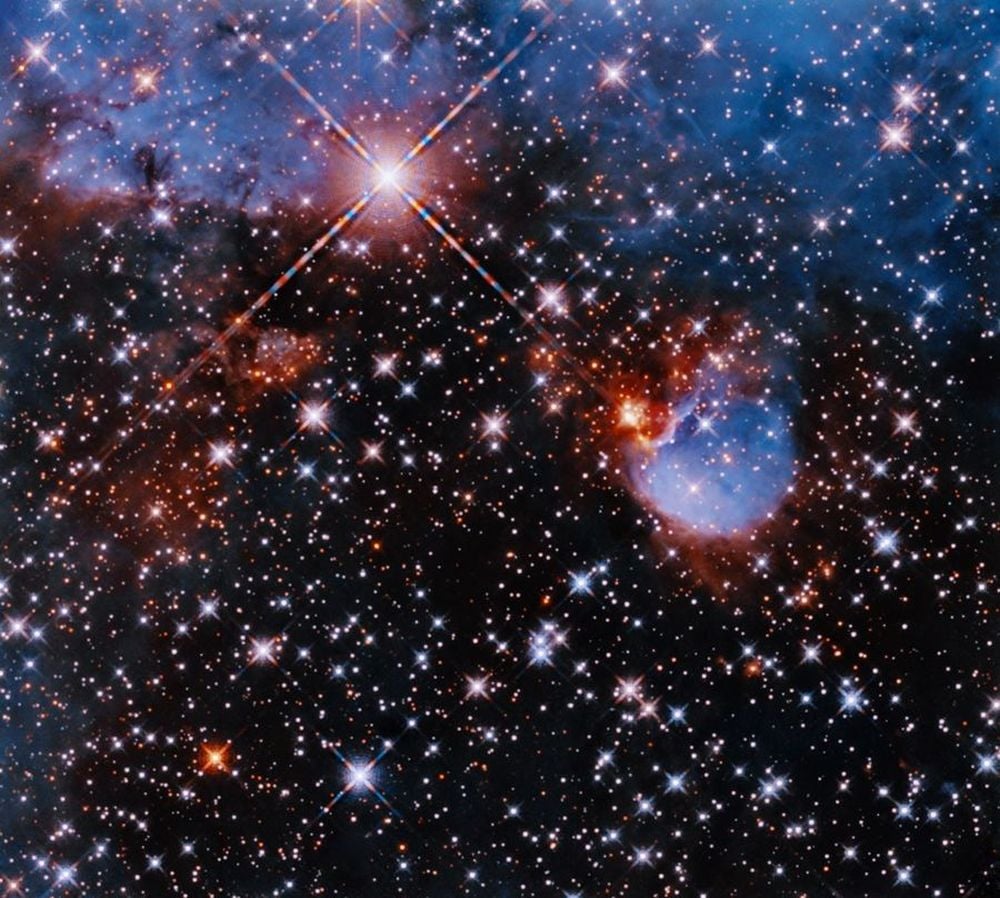
IRAS 20126+4104 is a massive protostar in a region about 5,300 light-years away. It's a B-type protostar, meaning it's extremely luminous, very massive, and very hot. Young protostars often emit powerful jets from their poles, created by their strong magnetic fields, which funnel infalling material from their accretion disks out of the poles. In this image, the young protostar's jets are creating a bright region of ionized hydrogen. Its jets have been studied in detail as part of the effort to understand massive protostars and how they form.
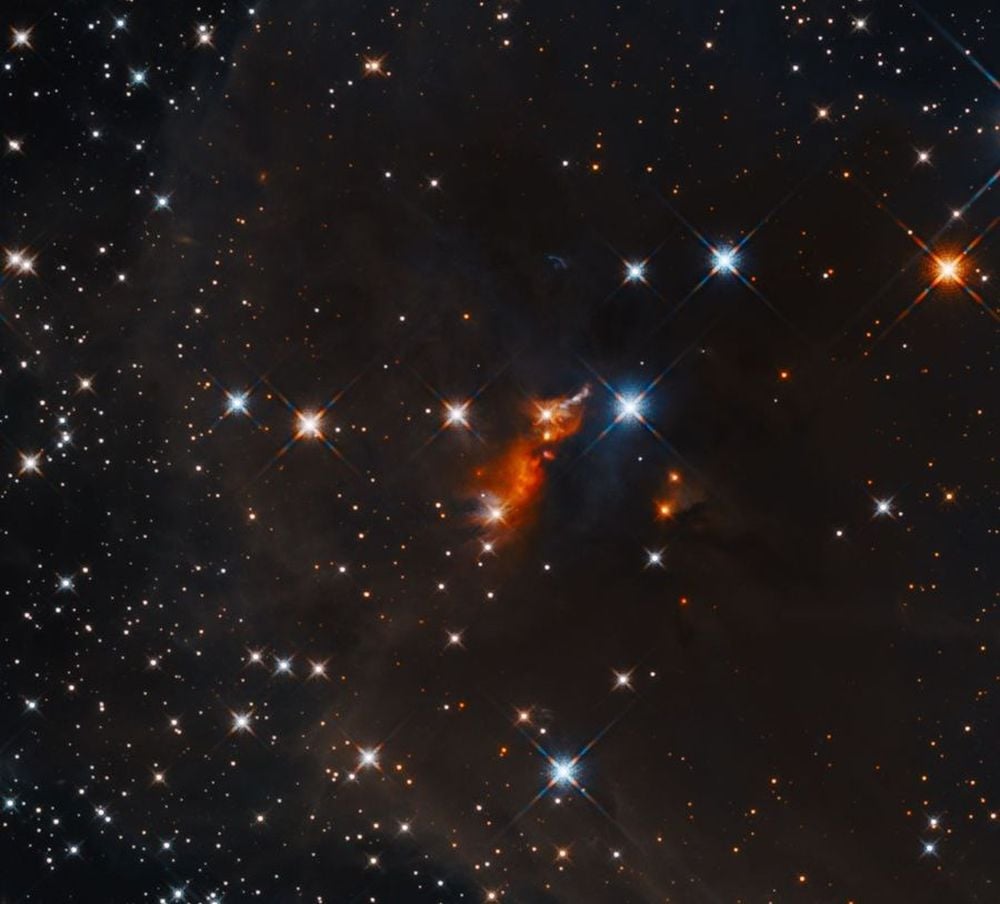
Research from 2023 showed that IRAS 20126+4104 is a ZAMS star, a Zero-Age Main Sequence star, that has just begun to fuse hydrogen into helium. The star is both receiving infalling material from outside the disk that obscures it and losing mass as a result of shocks from incoming material, illustrating why the formation of these massive protostars are difficult to understand.
The Hubble has been observing protostars for decades, and its effort has helped slowly pull the veil back from their gaseous wombs. Now, other more modern telescopes like the JWST are peering ever deeper into these stellar nurseries. But the Hubble has played an important role and will continue to, and these images show us how.