
One of the critical aspects of exoplanet habitability is the long-term stability of the stars they orbit. Some stars are extremely massive and blast through their hydrogen fuel in only a few million years. Rigel, the blue supergiant in Orion, is an example of one of these. It will shine for only about 10 million years. That's not much time for life to arise on planets.
Some stars, like red dwarfs, will last much longer than the current age of the Universe, but their pronounced flaring activity may hamper the habitability of their planets.
Stars like our Sun may represent a sweet spot: it will shine for about 10 billion years before it swells up to become a red giant. Obviously, it's long-term stability has allowed complex life to form.
The Sun is a G-type star, also known as a yellow dwarf. These types of stars are common, and so are their slightly lower-mass cousins, K-type stars, which are also known as orange dwarfs. They're cooler than the Sun, warmer than red dwarfs, and like G-type stars, are also stable and long-lived. While stars like the Sun will "live" on the main sequence for about 10 billion years, K-type orange dwarfs can live for multiple tens of billions of years: from between about 20 to 70 billion years. That long-lived stability puts them on the radar for astronomers studying stellar habitability. There are about twice as many K-type stars than G-type stars in the solar neighbourhood.
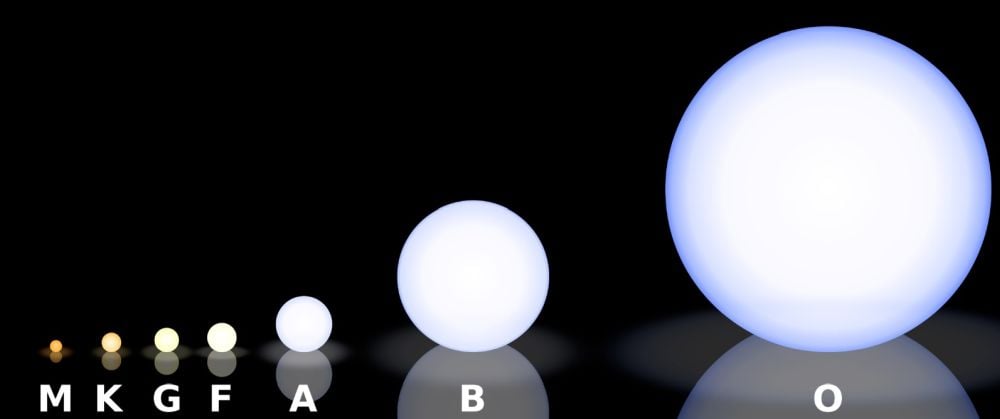 *This image illustrates the range of types of main sequence stars. Red dwarfs (M dwarfs) are on the left and are the least massive, coolest, dimmest, and most long-lived stars. On the right are blue giants (O-type) stars, the most massive, hottest, and short-lived stars. Image Credit: By Rursus - Own work, CC BY-SA 3.0, https://commons.wikimedia.org/w/index.php?curid=3015833*
A team of astronomers have completed a census of more than 2,000 K-type stars in the Sun's neighbourhood. They captured detailed spectra for hundreds of them that reveals their ages, their spins, their temperatures, and location in the Milky Way. These factors contribute to the habitability of exoplanets that orbit them.
The researchers presented their results at the 247th meeting of the American Astronomical Society. Sebastián Carrazco-Gaxiola, lead author and astronomy graduate student at Georgia State University, presented them at a press conference. A related paper submitted to The Astronomical Journal titled "The Solar Neighborhood LV: Spectral Characterization of an Equatorial Sample of 580 K Dwarfs," helps explain the results. It's also available at the preprint site arxiv.org.
“This survey marks the first comprehensive look at thousands of the Sun’s lower-mass cousins,” lead author Carrazco-Gaxiola said in a press release. “These stars, known as ‘K dwarfs,’ are commonly found throughout space, and they provide a long-term, stable environment for their planetary companions.”
The search for habitability is a massive undertaking. The Milky Way contains at least 100 billion stars, possibly as many as 400 billion stars, astronomers don't know for certain. Anything that helps researchers effectively sift through this bewildering number of stars is valuable. Especially since the detailed observations of individual stars and exoplanets necessary to constrain habitability consumes so much resources. Results like these help narrow the search and lets astronomers use observational resources more effectively.
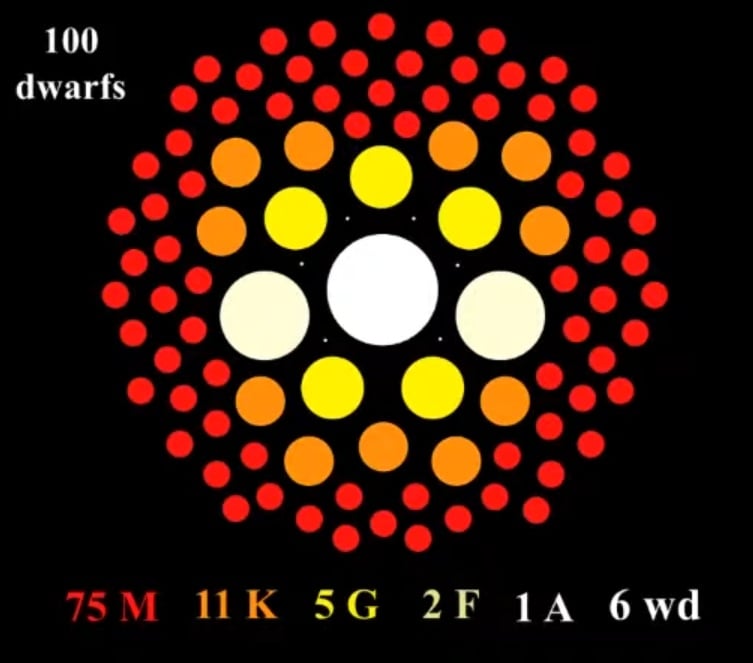 This graphic helps illustrate the dwarf stars within 10 parsecs of the Sun. It shows the number of each type of star for every 100 stars in the neighbourhood. K-type stars are the second most plentiful type, yet are under-represented in exoplanet surveys. Image Credit: Carrazco-Gaxiola et al. 2025.
"We present a spectroscopic characterization of 580 K dwarfs within 33 pc, observed with the CHIRON echelle spectrograph on the SMARTS 1.5m telescope," the authors write. According to the NASA Exoplanets Archive, only 7.5 % of them, or 44 stars, are known to host confirmed exoplanets. "Our results identify 529 mature, inactive K dwarfs as prime targets for terrestrial planet searches, providing a crucial resource for exoplanet habitability studies in the solar neighborhood," the researchers explain.
Another 1.5 m telescope in Arizona, the Tillinghast Telescope, also contributed to the survey. Both telescopes have high-resolution echelle spectrographs, and by having one in each hemisphere, the researchers had all-sky coverage.
"The CHIRON spectrograph on the SMARTS telescope in Chile and the TRES spectrograph on the Tillinghast Telescope in Arizona are such complementary instruments,” said Allyson Bieryla, an astronomer at the Center for Astrophysics | Harvard & Smithsonian. “The power of having these two telescopes in opposite hemispheres is that it gives us access to all the K-dwarfs across the entire sky."
Different parts of the Milky Way are more habitable than others, and the survey also determined the locations of each of the stars. The metallicity is more favourable in the thin disk, which is where most of the galaxy's stars are, including K-dwarfs.
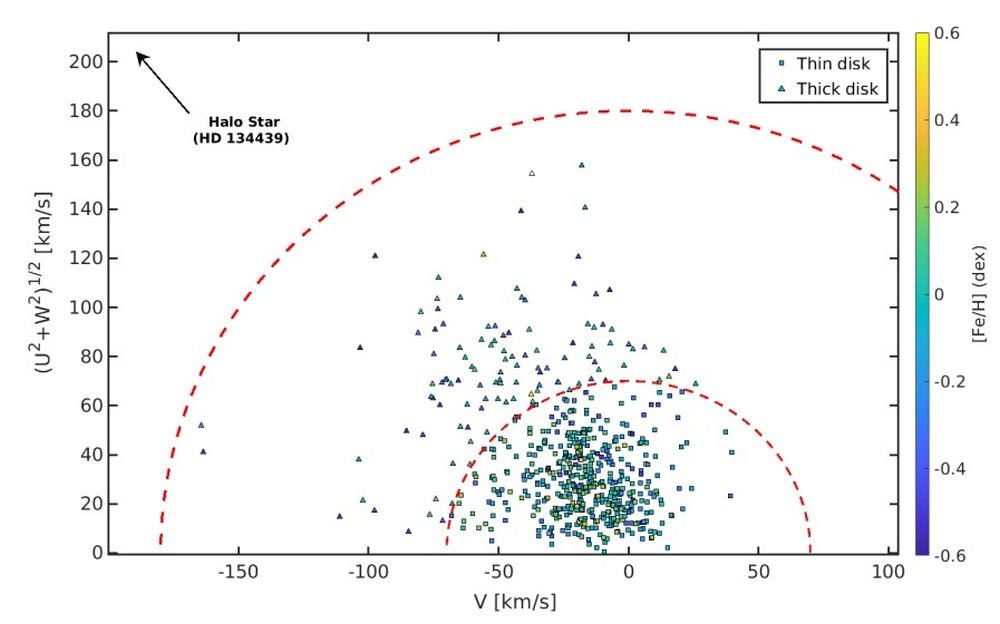 This figure shows the locations and metallicities of stars in the sample. The left y-axis shows the stars' velocity through the galaxy which can also show which part of the Milky Way they're in. The dotted red lines show different velocities, which roughly delineate the thin disk, thick disk, and halo populations. The colour key on the right y-axis colour codes the stars' metallicity. 464 of the stars are in the thin disk, 107 are in the thick disk, and only one is in the halo. Image Credit: Hubbard-James et al. 2025.
K-type stars comprise about 11% of the stars within 33 parsecs, or about 108 light-years. Not only are they more longer-lived than Sun-like stars, but they also don't suffer from pronounced flaring activity UV output that red dwarfs (M dwarfs) do. Their flaring and UV radiation make their habitability suspect. "Compared to M dwarfs, K dwarfs produce less extreme ultraviolet radiation and exhibit reduced flare activity, potentially offering more stable environments for atmospheric retention on orbiting planets," the authors explain. The researchers are particularly concerned with finding mature, quiescent K-type stars, since these stars have the least amount of troublesome flaring and high-energy radiation.
Though the characteristics of K-type stars make them favourable targets in the study of habitability, they haven't received their due attention, according to the authors. Within about 25 parsecs, K-type stars host fewer exoplanets than M dwarfs and Sun-like stars. This is only due to observational bias. Sun like stars are brighter, making it easier to detect their orbiting planets. And M-dwarfs have a more favourable planet-to-star mass ratios, which aids exoplanet detection.
“This survey will be the foundation for studies of nearby stars for decades to come,” said Distinguished University Professor of Physics and Astronomy Todd Henry, who serves as Carrazco-Gaxiola’s adviser and is a senior author on the study. “These stars and their planets will be the destinations for spacecraft exploration in the far future of space travel.”
