
Venus is often called Earth's twin, but spend any time with it and the comparison falls apart quickly. Its surface is hot enough to melt lead, its atmosphere is a crushing blanket of carbon dioxide, and its clouds are made of concentrated sulphuric acid. Somewhere beneath those acid clouds, between the surface and the main cloud deck at around 47 kilometres up, a thin mysterious haze has drifted for billions of years, stubbornly resisting every attempt at explanation. Until now.
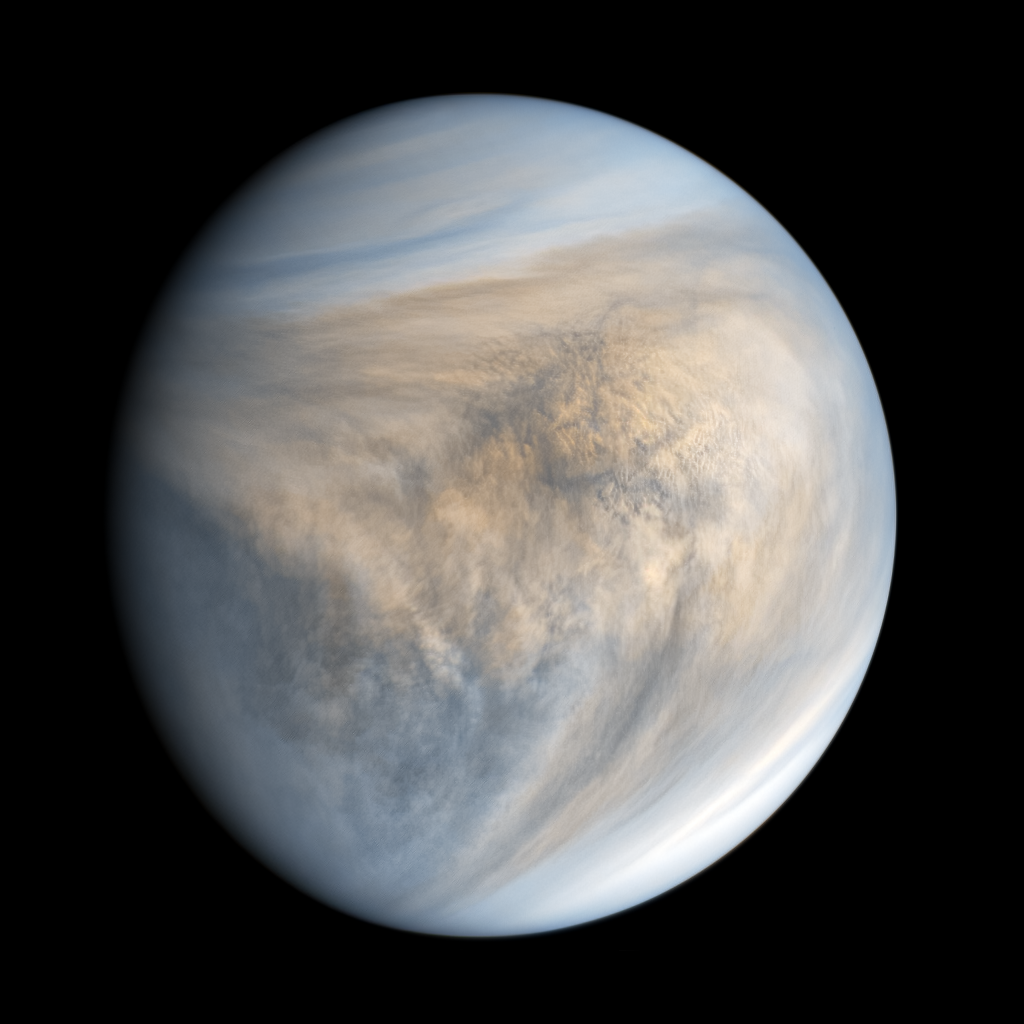 The thick clouds of Venus revealed here through ultraviolet imaging (Credit : Kevin M. Gill)
A team led by Hiroki Karyu, Takeshi Kuroda and Naoki Terada at Tohoku University in Japan, working with the Royal Belgian Institute for Space Aeronomy, has identified the source of Venus's lower haze and it turns out to be cosmic dust, the tiny mineral particles shed by meteors burning up in the planet's atmosphere. The research, published in Nature Astronomy, solves a puzzle that has been open since the Venera and Pioneer Venus spacecraft first measured the haze layer over half a century ago.
The mechanism the team uncovered is an elegant chain of events. Meteors constantly rain down on Venus, just as they do on every planet. As they burn up high in the atmosphere, they leave behind nanometre sized mineral particles, fragments so small that thousands would fit across the width of a human hair. These particles drift downward and become embedded within the sulphuric acid cloud layer above. As they sink deeper into the warmer lower atmosphere, the sulphuric acid surrounding them evaporates, leaving behind solid mineral cores. Those cores then collide and clump together, building up the haze layer that has puzzled planetary scientists for decades. When the team ran their simulations, the results matched measurements collected by spacecraft probes all the way back to the 1970s.
The team found that these particles act as seeds for cloud formation (much like tiny particles do here on Earth) boosting Venus's cloud production by an estimated 20 to 30 percent a significant contribution to the planet's climate that had never previously been accounted for. Even more intriguingly, the metallic content of the dust, particularly iron, may explain the so called ‘unknown UV absorber,’ a mysterious substance that strongly absorbs ultraviolet sunlight and has a measurable effect on the planet's energy balance. The identity of that absorber has been debated for decades, and iron rich cosmic dust now emerges as the most plausible candidate.
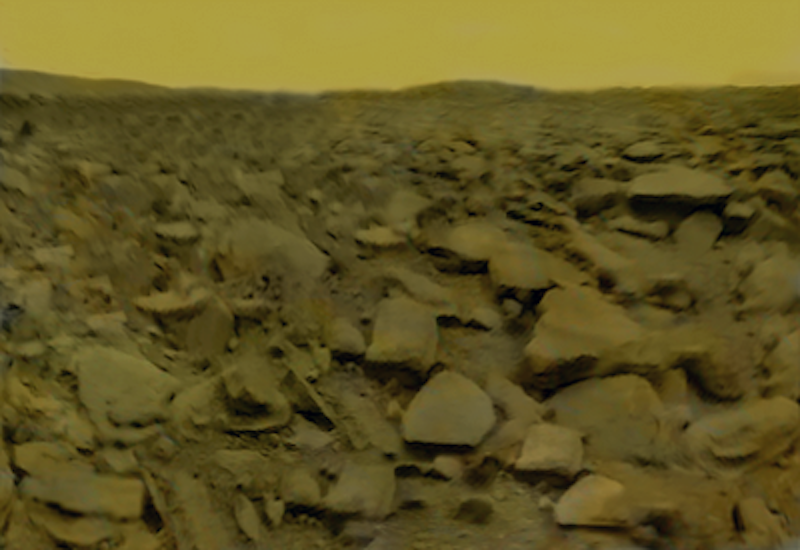 The scene from the surface of Venus from the Venera 9 lander (Credit : Ted Stryk, Venera 9)
If cosmic dust is shaping the atmosphere and climate of our nearest planetary neighbour, similar processes are almost certainly at work elsewhere, perhaps in the atmospheres of Jupiter and Saturn, and potentially on planets orbiting other stars entirely. Material from space, it turns out, is not a passive visitor, it's an active ingredient in planetary weather.
NASA's DAVINCI mission, currently planned for the late 2020s, will descend through Venus's atmosphere and directly sample its layers giving scientists their first opportunity to test these predictions for the first time.
Source : Cosmic Dust Identified as the Source of Venus' Enigmatic Lower Haze
