
Space News & Blog Articles
Spanish launch startup PLD Space raises $209 million to scale its rocket production
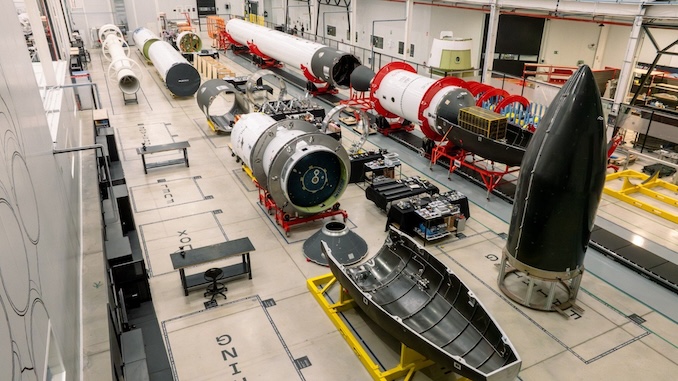 PLD Space’s manufacturing facilities show the flow of production for its Miura 5 rockets. Image: PLD Space
Spanish startup launch company, PLD Space, raised €180 million ($209 million) in its latest funding round as it works towards the inaugural flight of its next rocket, Miura 5.
The company was founded in 2011, becoming the first private Spanish rocket company. It debuted with the launch of the Miura 1 rocket in 2023 and has been developing a series of rockets, including the Miura 5, which lands in the ocean before being recovered for reuse; the Miura Next, a medium-lift rocket with propulsive landing capabilities; and both heavy and super-heavy versions of the Miura Next, which feature three and five boosters, respectively.
“Miura 5 was designed to address a clear and growing capacity gap in the market, and this investment support strengthens our ability to transition into commercial operations,” said Ezequiel Sánchez, PLD Space’s Executive President. “It accelerates the build‑out of the industrial and launch infrastructure required to deliver reliable access to space for an expanding pipeline of global customers.”
In November 2025, PLD Space said it was aiming for the first flight of its Miura 5 rocket in the first quarter of 2026, but with this announcement of this Series C fundraising, the company now says that inaugural flight will be sometime in 2026.
PLD Space has said it aims to launch more than 30 times per year by 2030.
“As demand for dependable access to space continues to rise, we are reinforcing the redundancy, test cadence and flight cadence needed to sustain continuity across multiple locations,” Sánchez said. “This approach strengthens operational buffers and assurance frameworks that global operators increasingly rely on to secure their long‑term access‑to‑orbit strategies.”
This latest funding infusion was driven by Japanese manufacturer Mitsubishi Electric Corporation, which invested €50 million ($58 million) into the company.
“We are pleased to collaborate with PLD Space, a company taking on the challenge of satellite launch services with a view toward the global market,” said Tomonori Sato, Mitsubishi Electric’s Executive Officer, in a statement. “By combining PLD Space’s launch capabilities with Mitsubishi Electric’s strengths in the satellite business, we aim to address evolving customer requirements, including those in the global market.”
Mitsubishi Electric said its investment into PLD Space will afford it “priority access to launch services using the Miura 5 rocket, thereby enhancing the feasibility of building a satellite constellation.”
To date, PLD Space raised more than €350 million ($407 million). Other investors in this latest round included the Spanish Ministry of Science, Innovation and Universities; Spanish public funds management company, COFIDES (Compañía Española de Financiación del Desarrollo); and Spanish fun Nazca Capital.
European competition
PLD Space was selected as one of five companies to participate in the European Launcher Challenge. Its selection was made in the summer of 2025 with the financial backing of the European Space Agency (ESA) Council of Ministers in November.
The goal is for the competing companies to achieve a successful orbital launch no later than 2027 and if successful, ESA will contribute to every operational launch from these challengers until 2030 at the latest.
The five companies selected for competition were (in alphabetical order):
Isar Aerospace (Germany) MaiaSpace, an ArianeGroup subsidiary (France) Orbital Express Launch Ltd or Orbex (United Kingdom) PLD Space (Spain) Rocket Factory Augsburg (Germany)On Feb. 18, 2026, Orbex announced it was closing up shop after a deal to be acquired by another startup, The Exploration Company, didn’t pan out.
In a statement to the news outlet European Spaceflight, MaiaSpace said it was delaying its inaugural launch to April 2027.
Isar Aerospace launched its first Spectrum rocket in 2025, but it failed to reach orbit, crashing near the launch site less than 30 seconds after takeoff. It’s second test flight, ‘Onward and Upward,’ was set to launch in January, but a pressurization valve issue delayed that to no earlier than March 19.
Fellow German startup, Rocket Factory Augsburg is working towards the inaugural launch of its RFA One rocket, but a target date hasn’t been announced.
When you subscribe to the SpaceZE News Feed, we will send you an e-mail when there are new updates on the site so you wouldn't miss them.
