
Space News & Blog Articles
SpaceX’s most-flown Falcon booster launches on record 33rd flight
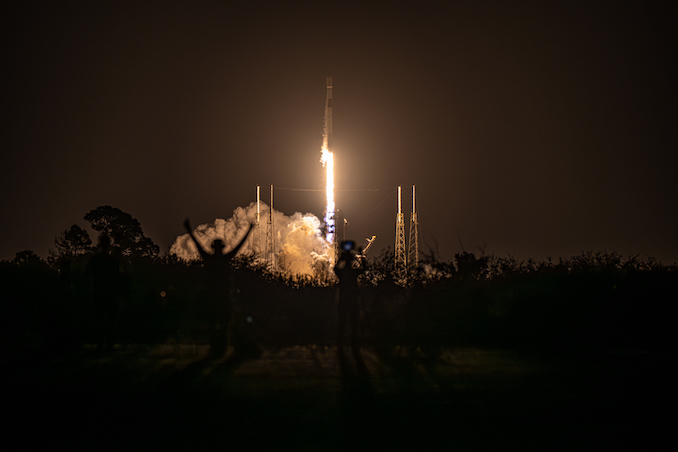 A SpaceX Falcon 9 rocket lifts off from Space Launch Complex 40 (SLC-40) at Cape Canaveral Space Force Station to begin the Starlink 6-104 mission on Feb. 21, 2026. Image: Michael Cain/Spaceflight Now
Update Feb. 21, 12 a.m. EST (0500 UTC): SpaceX confirms satellite deployment.
SpaceX’s most flown Falcon 9 rocket booster launched once again Saturday night, making its 33rd mission to space and back as the company works to certify its boosters for up to 40 flights each.
The Starlink 6-104 mission added another 28 broadband internet satellites to SpaceX’s growing low Earth orbit constellation of more than 9,700 satellites.
Liftoff from Space Launch Complex 40 (SLC-40) at Cape Canaveral Space Force Station happened at 10:47 p.m. EST (0347 UTC). The Falcon 9 rocket flew on a south-easterly trajectory upon leaving the pad.
The 45th Weather Squadron forecast a greater than 95 percent chance for favorable weather during liftoff, citing no specific meteorological concerns.
The 33rd flight of Falcon 9 booster 1067 came about 2.5 months after its previous launch in early December. Its previous missions include four flights for NASA, the European Commission’s Galileo L13, and 20 batches of Starlink satellites.
Nearly 8.5 minutes after liftoff, B1067 landed on the droneship, ‘A Shortfall of Gravitas,’ positioned in the Atlantic Ocean. This was the 143rd landing on this vessel and the 575th booster landing to date for SpaceX.
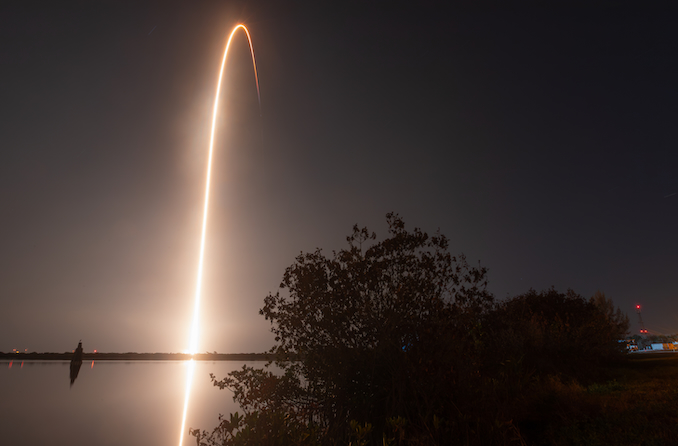 A streak shot of SpaceX’s Falcon 9 rocket as it lifts off from Space Launch Complex 40 (SLC-40) at Cape Canaveral Space Force Station to begin the Starlink 6-104 mission on Feb. 21, 2026. Image: Adam Bernstein/Spaceflight Now
When you subscribe to the SpaceZE News Feed, we will send you an e-mail when there are new updates on the site so you wouldn't miss them.
