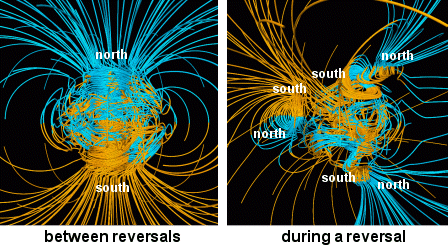
Every so often (in geologic time) Earth's magnetic field does a flip. The north and south magnetic poles gradually trade places in a phenomenon called a geomagnetic reversal. Scientists long thought this happened every ten thousand years or so. However, new evidence from deep ocean cores show that at least two ancient reversals didn't follow that script. One took about 18,000 years to flip and the other took 70,000 years. Such lengthy time lapses could have seriously affected Earth's atmospheric chemistry, climate, and evolution of life forms during the Eocene period of geologic history.
The discovery of these temporally anomalous geomagnetic reversals came from research done by Yuhji Yamamoto of Kochi University of Japan and Peter Lippert of the University of Utah Department of Geology and Geophysics. They worked together on a 2012 drilling expedition in the North Atlantic to investigate climate change during the Eocene Epoch. That's a period of geological history that occurred between 56 to 34 million years ago and a time of shifting climate regimes. Continental landforms such as the early Rocky Mountains were in place, the Himalayas were forming, and the giant supercontinents were breaking apart.
Drilling Through Time
To study the rocks laid down in this period, the team drilled in the North Atlantic off the coast of Newfoundland to extract sediment cores. These are essentially time capsules built grain by grain and layer by layer over millions of years, from up to 300 meters below the sea floor. Hidden inside these rock cores are the tracks of magnetic fields, and each track records the polarity of the magnetic field when the layers were first laid down as sediment.
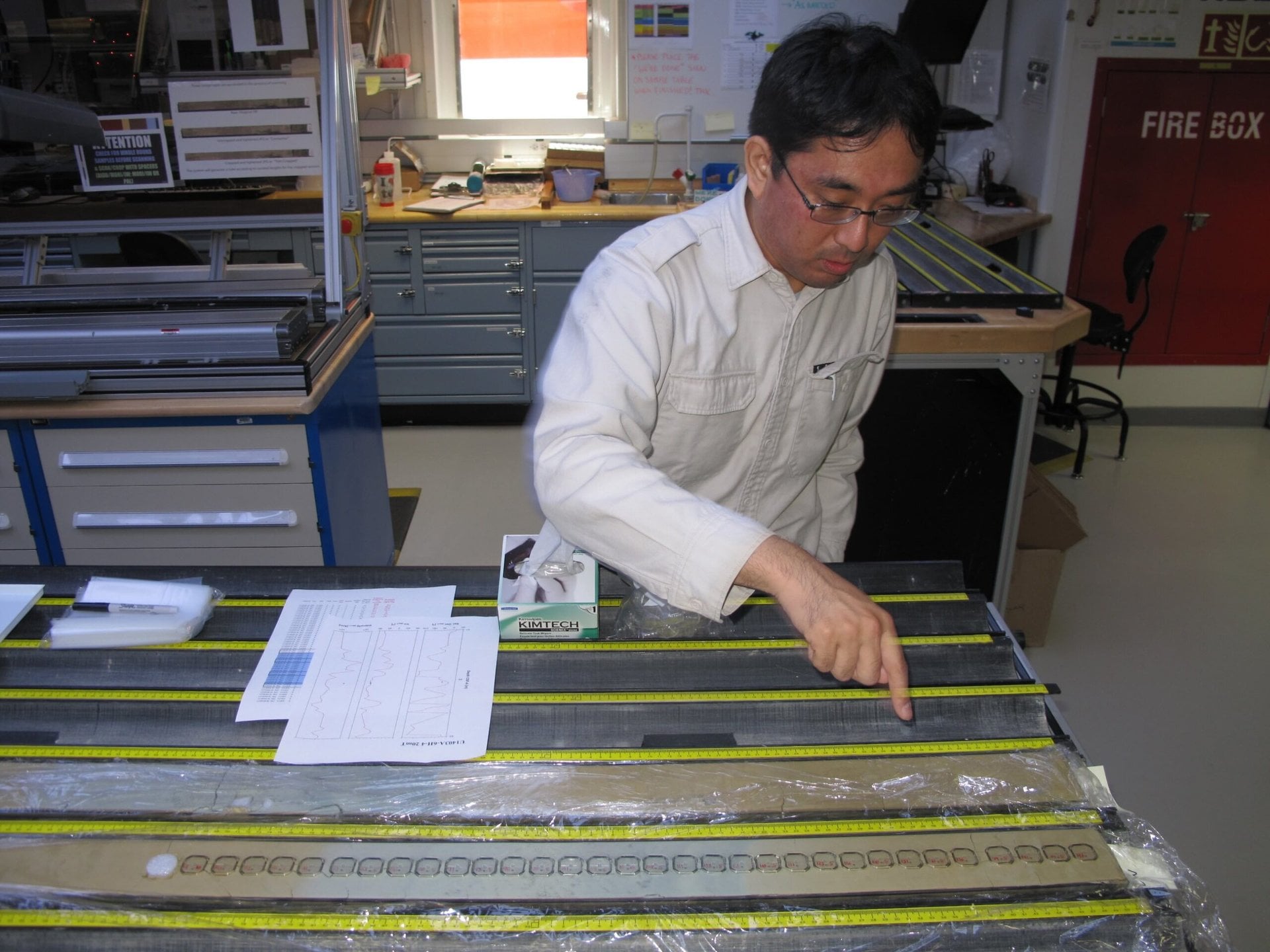
How does this work? The sediments carry a reliable magnetic signal locked in by tiny crystals of magnetite produced by ancient microorganisms and from dust and erosion from the continents. The crystals act like little compasses, pointing in the direction of Earth's magnetic field polarity at the time the sediments were deposited. Essentially, they trace the history of geomagnetic reversals over deep time.
As paleomagnetists, Yamamoto and Lipperts’ job was to measure the direction and the intensity of the magnetization that’s preserved in those cores. According to Lippert, the mechanism for the reversals isn't obvious from the magnetic fields. “We don’t know what triggers a reversal," he said. "Individual reversals don’t last the same amount of time, so that creates this unique barcode. We can use the magnetic directions preserved in the sediments and correlate them to the geologic timescale.”
Tracking Earth's Dynamo
One 8-meter-thick layer in the drilled cores offered some strange evidence. The section appears to show prolonged geomagnetic reversals. “Yuhji noticed, while looking at some of the data when he was on shift, this one part of the Eocene had really stable polarity in one direction and really stable polarity in another direction,” Lippert said. “But the interval between them, of unstable polarity when it went to the other direction, was spread out over many, many centimeters.”
Those changes were evidence of magnetic reversals and encoded the time frame between them with good accuracy. The question then was, were these anomalous reversals due to something about the magnetic field or something else in the sediment cores? Further examinations showed that the anomalies recorded actual changes Earth's magnetic field. In subsequent analysis of these cores the team confirmed that the cores were showing actual changes in the magnetic field. That's how they found an 18,000-year reversal and a 70,000-year one.
Core Implications
What could be happening to create these distinct shifts between reversals? The anomalous findings actually tell scientists something about the dynamo that generates Earth's magnetic field. It's only been recently that planetary scientists have been able to model the core, its evolution, and ability to generate the magnetic field. Our planet's inner core is a swirling, chugging dynamo of a molten iron-nickel mixture. Its motions generate the electrical currents that create the magnetic field. As far as scientists can tell, the reversals in the field are an intrinsic part of the core's activity, and they probably began about 3.5 billion years ago. Recent reversals (in the last 1.78 million years) took anywhere from 1 to 12 thousand years to complete, depending on latitude. These events occur in three steps: a precursor phase that can take up to 2.5 thousand years, a main transition phase that can last about a thousand years, and rebound phase that goes on for about another 2.5 thousand years, with the complete flip extending up to 10,000 years. These figures are derived from studies of both seafloor cores and lava flows and represent a general model of the flips.
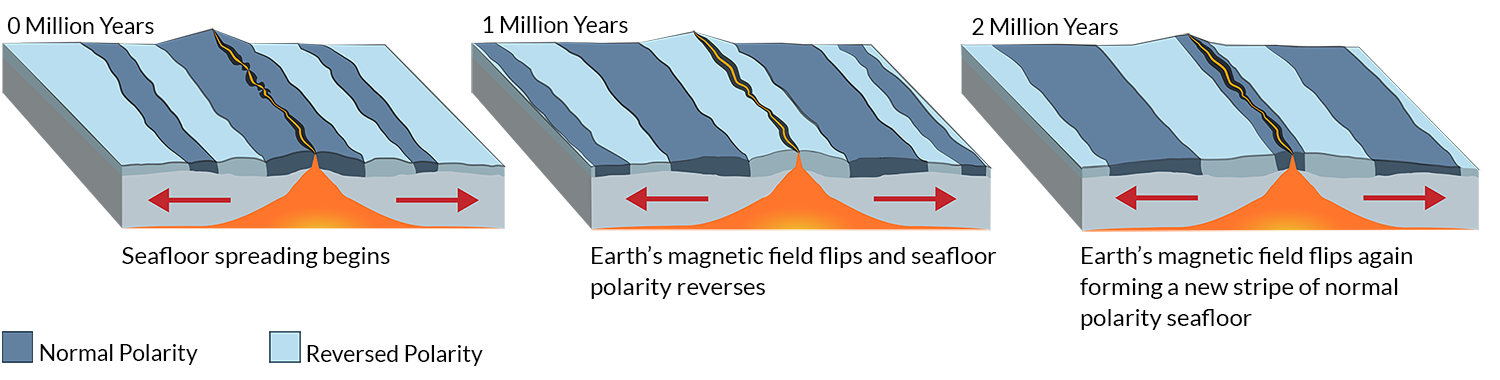
Prior models of core activity and magnetic field flips seemed to lock in an interval of about 10,000 years between flips. Those models depended on data from 540 magnetic field reversals that took place over the last 170 million years. The huge gaps between the Eocene flows that Yamamoto and Lippert studied may indicate that activities in the core that cause these flips may not be as regular as scientists once thought. Newer computer models of Earth’s geodynamo, taking place in the swirling outer core that generates the electrical currents supporting the magnetic field, indicated reversals’ durations vary. There were many short ones, but also occasional long, drawn-out transitions, some lasting up to 130,000 years. “This finding unveiled an extraordinarily prolonged reversal process, challenging conventional understanding and leaving us genuinely astonished,” Yamamoto wrote.
The occurrence of longer than expected reversals has implications for changing conditions on Earth's surface due to weakening of the magnetic field over long periods, according to Lippert. That's because our magnetic field plays a special role for the planet. “The amazing thing about the magnetic field is that it provides the safety net against radiation from outer space, and that radiation is observed and hypothesized to do all sorts of things. If you are getting more solar radiation coming into the planet, it’ll change organisms’ ability to navigate,” he said. “It’s basically saying we are exposing higher latitudes in particular, but also the entire planet, to greater rates and greater durations of this cosmic radiation and therefore it’s logical to expect that there would be higher rates of genetic mutation. There could be atmospheric erosion.”
More studies of reversal records should lock in what these new findings suggest: that Earth's geomagnetic activity may have always been more erratic than scientists thought. The evidence is in the rock record for all to study.
For More Information
When Earth's Magnetic Field Took Its Time Flipping
Extraordinarily Long Duration of Eocene Geomagnetic Polarity Reversals