How do galaxies evolve? When did they start forming? Those are questions astronomers and cosmologists are working to answer. The standard evolutionary path includes early bright star-forming activity, a middle age, and then a quiescent old age where they stop making stars. That changes if the galaxy happens to collide with another one, because that spurs new bouts of starbirth. It's been this way since stars and galaxies first began forming, hundreds of millions of years after the Big Bang.
A team of astronomers from around the world has found a collection of dusty, star-forming galaxies in that very earliest epoch of cosmic history. The team leader, Dr. Jorge Zavala, specializes in such galaxies. “My research involves trying to identify and understand a population of rare, dusty star-forming galaxies that were only discovered at the end of the 1990s,” said Zavala. He points out that it's not an easy task. Part of what has made these galaxies so difficult to study is their dust. It obscures the view and also absorbs UV and visible light from hot young stars. The absorbed light heats up the dust, and that heat gets re-radiated as infrared light.
Tuning in To Distant Early Galaxies
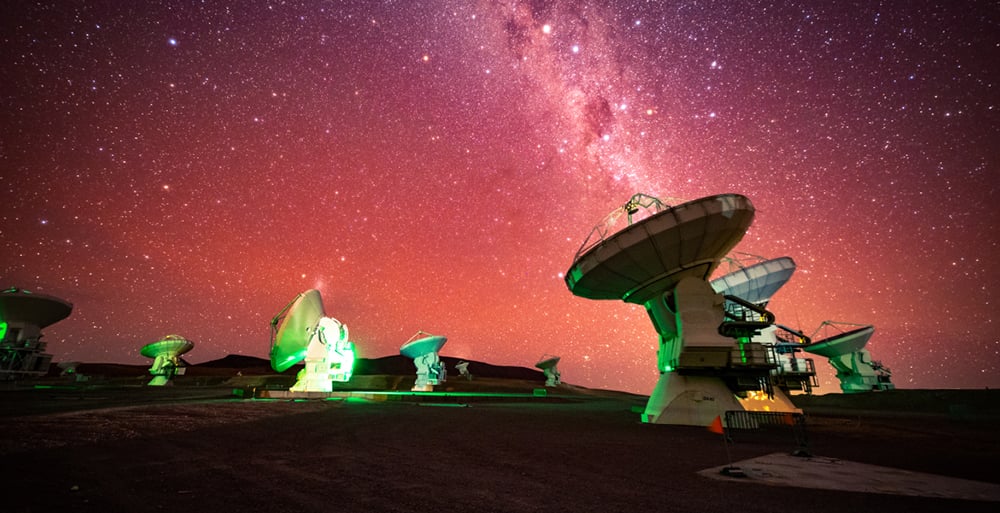
To study such hidden objects, Zavala and the team turned to radio astronomy, specifically the Atacama Large Millimeter Array (ALMA) in Chile, which is perfectly tuned to detect infrared radiation at certain wavelengths. ALMA revealed some 400 bright, dusty galaxies in the very early Universe. The next step was to focus the James Webb Space Telescope (JWST) on about 70 such galaxies and figure out their distances and ages. It turns out they began forming at least 13 billion years ago, some 700,000 years after the Big Bang. That makes them links in the long chain of galaxy formation and evolution. “Dusty galaxies are massive galaxies with large amounts of metals and cosmic dust,” Zavala said. “And these galaxies are very old, which means stars were being formed in the early Universe, earlier than our current models predict.”
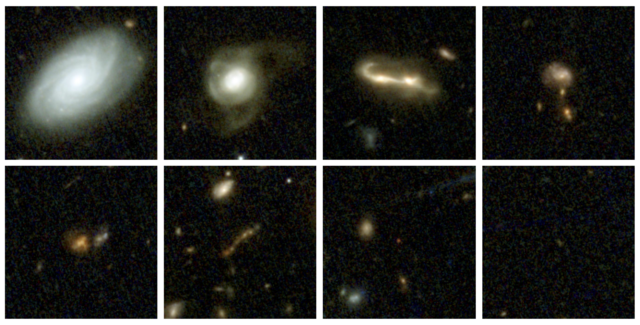
The galaxies that ALMA studied have extremely high numbers of stars, some as high as 1010 solar masses. Their star-formation rates are prodigious, cranking out some 100 solar masses per year. The galaxies that Zavala and colleagues studied also have another unique characteristic; they seem to be related to other rare types of early galaxies. One set is the ultrabright star-forming galaxies that cranked up production very shortly after the Big Bang. The other set is made up of older, quiescent galaxies that aren't producing stars at any great rate.
The Research Project
The 400 dusty galaxies studied by Zavala's team came from a program called the ALMA CHAMPS Large Program. This is a multi-band survey effort in the submillimeter range to look at galaxies through cosmic time, all the way back to the Epoch of Reionization. It's primarily aimed at studying bright, dusty sources in early epochs to tr ace the evolution of galaxies, starting with the earliest ones to form. It now appears that, thanks to such observations and also studies made by JWSTa in the COSMOS field, the "start date" for galaxy formation is getting pushed back closer to the Big Bang than ever before. However, there are still gaps in the record, so studies such as these are important in uncovering significant populations of early stars and galaxies.
Zavala and the team also want to probe the link between the early dusty galaxies and the more distant ultraviolet-bright galaxies discovered by JWST. It's quite possible that the dusty ones, the bright ones, and a population of massive quiescent galaxies at slightly closer distances (z=3-5). The team is exploring the idea that all of these are potentially linked as progenitor-descendant populations based on their abundance, redshifts, and stellar masses. Of course, more observations with ALMA, JWST, and other facilities are needed to get a significant population of galaxies for study to prove the relationships.
Figuring out the timeframe for the first stars and galaxies, plus their evolutionary process, is one of the hottest areas of galaxy studies. Each set of observations peers farther back in time, toward that magic moment when the Universe began. Unfortunately, the period of the Dark Ages right after the Big Bang obscures our view of the cosmic birth process. But, as the Universe expanded, light could travel freely, starting the Epoch of Reionization. That period, beginning some hundred million years or so after the Big Bang, is our first coherent view of the early Universe and the infant stars and galaxies that were beginning to form.
For More Information
ALMA and JWST Identification of Faint Dusty Star-Forming Galaxies up to z~8