Even a modest telescope reveals the breathtaking Saturnian ring system that has captivated astronomers for four centuries, a world so alien in its beauty that first time observers often struggle to believe what they are seeing is real. But Saturn's rings are just the beginning. Beneath that iconic silhouette lies a planet of extraordinary extremes, a gas giant eleven times wider than Earth, spinning so fast that a single day lasts barely ten hours, and wrapped in a magnetic field so powerful it dominates a region of space millions of kilometres in every direction.
All planets have magnetic fields and every magnetic field carries it an invisible shield around it. A vast, bubble like structure called a magnetosphere, generated by the planet's own magnetic field, acts as a barrier against the constant stream of charged particles blasting out from the Sun. Without it, those particles would strip away the atmosphere, bombard the surface, and make life on Earth essentially impossible. Much of what we know about earth planetary magnetic fields has been driven by the assumption that they all work the same way as Earth’s but a new study suggests that may be wrong.
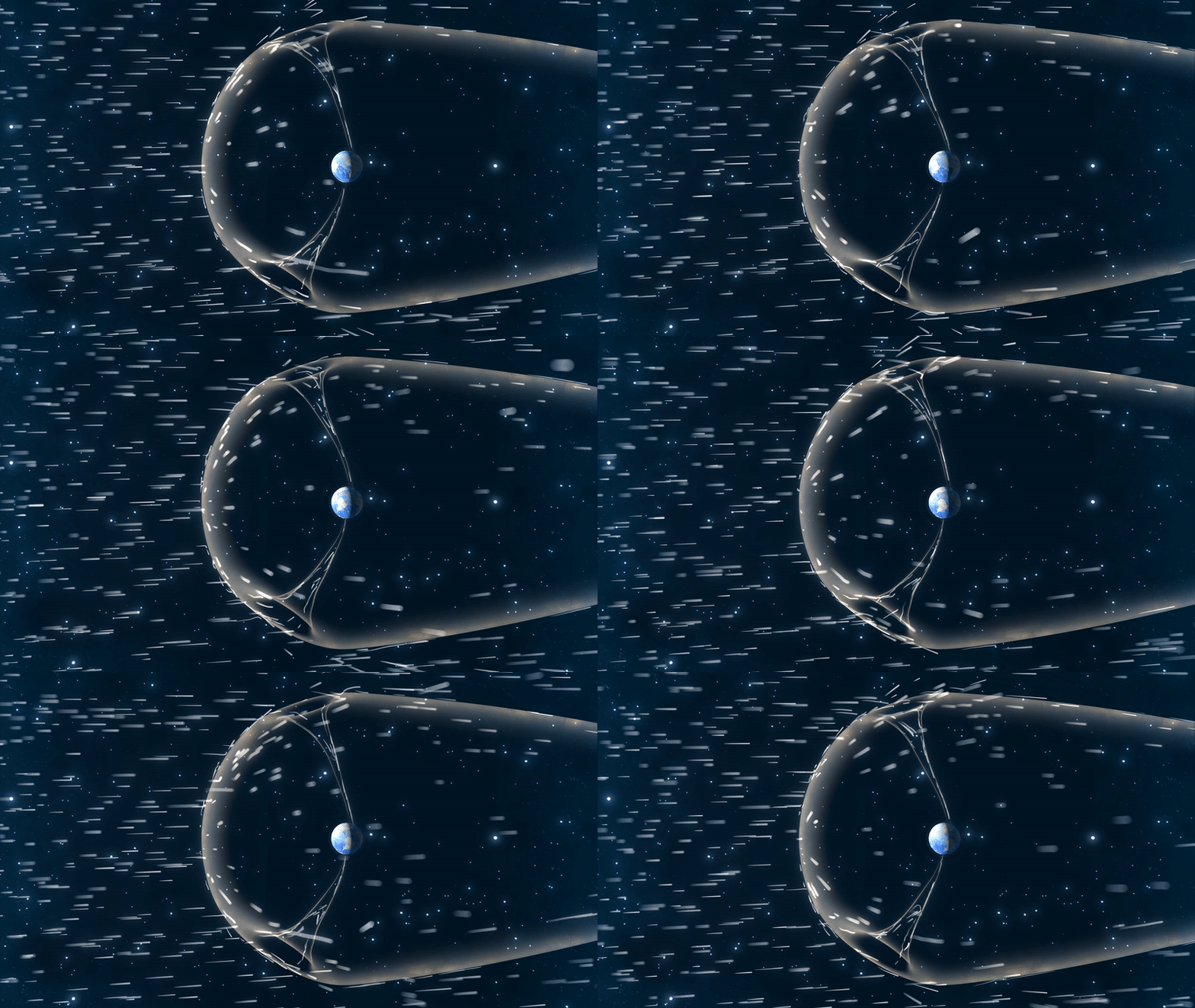
Researchers from Lancaster University, analysing data from the Cassini spacecraft, have uncovered a striking structural surprise in Saturn's magnetosphere. Their findings, published in Nature Communications, reveal that a key feature of Saturn's magnetic environment sits in a completely different place to where anyone expected and the reason why changes how we think about giant planets entirely.
Near the poles of any magnetised planet, the protective bubble has a weak spot. Funnel shaped openings called magnetospheric cusps sit at high magnetic latitudes, in the polar regions but crucially on the sunward facing side, where the magnetosphere is most directly exposed to the solar wind. It is through these openings that charged particles from the Sun can leak directly into the upper atmosphere. On Earth, the cusp sits predictably near local noon (the point on the polar region directly facing the Sun at any given moment) because the main competition here is between solar wind pressure and Earth's own magnetic field pressure. They balance neatly, and the cusp settles on the sunward side. Not so at Saturn, it is a different beast altogether.
The team used Cassini data collected between 2004 and 2010 to pin down the precise location of Saturn's cusp. They found that, rather than sitting near noon, Saturn's cusp is dragged significantly toward the afternoon side of the planet, sitting on average between 13:00 and 15:00 local time, and sometimes pushing it all the way toward 20:00.
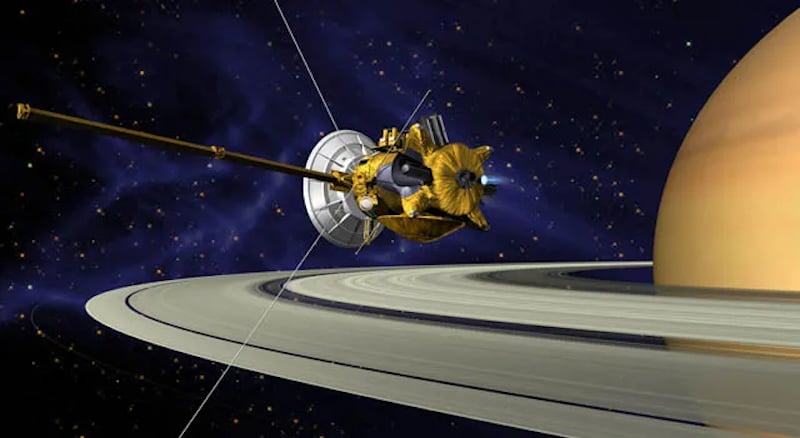
The culprit is Saturn's rotation. A Saturnian day lasts just 10.7 hours, less than half an Earth day. That furious spin, combined with a magnetosphere packed with ionised material erupting from the moon Enceladus, means that rotational forces dominate over solar wind pressure in a way that simply does not happen here on Earth. The cusp gets dragged along with the spinning magnetic field, pulled away from noon and skewed dramatically toward dusk.
The position of the cusp directly influences where magnetic reconnection occurs. Reconnection is the explosive process that accelerates particles to enormous energies, driving auroral displays and on Saturn it alters where these spectacular displays light up its polar skies.
It also confirms something theorists have long suspected; that rapidly rotating giant planets operate in a fundamentally different magnetospheric regime to slower, smaller worlds like our own. Cassini may have ended its mission in 2017, but its data is clearly not done revealing secrets.
Source : Spacecraft data reveals surprising detail about Saturn's magnetic ‘shield'