
Space News & Blog Articles
Rocket Lab Electron rocket aborts liftoff at engine ignition
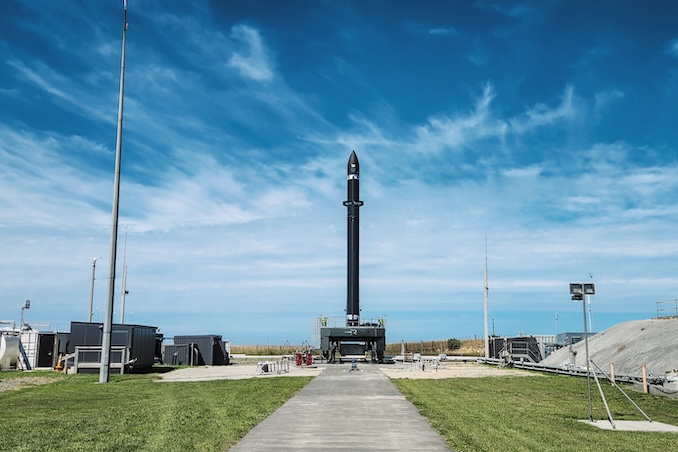 A Rocket Lab Electron rocket stands at Launch Complex 1 ahead of the flight of the ‘Bridging the Swarm’ mission for the Korea Advanced Institute of Science and Technology (KAIST). Image: Rocket Lab
Update Dec. 16, 1:26 am EST (0626 UTC): Rocket Lab said they aborted the mission on Dec. 15/16 after “one of Electron’s thousands of sensors noticed out-of-family data and called time on lift-off, exactly as it was designed to do. Team is working the straightforward fix now and will select a new launch date shortly.
Original story:
Rocket Lab is poised to close out 2025 with a trio of Electron rocket launches across its three pads in New Zealand and the United States. If all three launch, this would represent the most rapid sequence of Electron missions to date.
The company launched the ‘RASISE and Shine’ mission for the Japan Aerospace Exploration Agency (JAXA) at 0309 UTC on Dec. 14. Next up, less than 48-hours later, is a mission from South Korea, which was originally set to fly on Dec. 11.
That mission, dubbed ‘Bridging the Swarm,’ is scheduled to launch no earlier than 1:55 p.m. NZDT / 0055 UTC on Dec. 16 (7:45 p.m. EST on Dec. 15). Rocket Lab will have live coverage of the mission beginning about 20 minutes prior to liftoff.
This launch is for the Satellite Technology Research Center (SaTReC) located within the Korea Advanced Institute of Science and Technology (KAIST).
Onboard the Electron rocket is the Neonsat-1A satellite, which is described by Rocket Lab as being “an advanced Earth observation satellite equipped with a high-resolution optical camera to monitor natural disasters along the Korean Peninsula.”
“The first of the Neonsat satellites, Neonsat-1, was launched and deployed by Rocket Lab during the April 2024 mission ‘Beginning Of The Swarm’, and has been successfully carrying out its Earth-monitoring objective,” the company said.
“The new Neonsat-1A satellite will be deployed to validate KAIST’s advanced satellite’s capability, boost operational utility, and pave the way for the single Neonsat satellite to become a constellation – thus fulfilling the mission’s name, ‘Bridging the Swarm.’ More Neonsat satellites are scheduled for launch in 2026 and 2027.”
The NeonSat-1A satellite will launch into a 540 km (336 mi) low Earth orbit at an inclination of 97.4 degrees. Deployment from the rocket’s Curie kick stage is anticipated roughly 54 minutes after liftoff.
On Friday, Dec. 19, Rocket Lab is also scheduled to launch a mission from Launch Complex 2 at NASA’s Wallops Flight Facility on Wallops Island, Virginia. The mission is referred to as ‘Avalanche’ and is set to fly during a window that opens at 12 a.m. EST (0500 UTC).
Rocket Lab hasn’t officially commented on this mission publicly, but it’s believed to be a mission booked by the U.S. Space Force’s Space Systems Command. This would make it the Space Test Program-30 (STP-S-30), which will launch a satellite called DiskSat.
Rocket Lab previously said that DiskSat “will demonstrate sustained very low earth orbit (VLEO) flight and test a unique, 1-meter diameter, disk-shaped satellite bus that is designed to increase on-orbit persistence.”
“When we get down to VLEO — this is below 350 kilometers — it’s a lot of drag and other elements that you have to overcome. Because of the shape of DiskSat, we can change its orientation so that it has a very low drag profile,” said Catherine Venturini, the principal investigator for DiskSat from the Aerospace Corporation, in a Dec. 9 press release.
“The goal being that, with electric propulsion, we can sustain a VLEO for a certain amount of time, which would be very compelling for a lot of our customers and their mission interests.”
Record-breaking year
The successful launch of the ‘RAISE and Shine’ mission to begin the week marked the 19th launch of an Electron rocket this year. Among those, there were three, suborbital launches from Virginia as part of Rocket Lab’s Hypersonic Accelerator Suborbital Test Electron (HASTE) program.
The company has been in record territory since Nov. 18 when it launched its 17th Electron rocket on a mission called ‘Prometheus Run’ for the Missile Defense Agency.
Here’s how Electron’s annual launch tally stands:
2025 – 16 orbital, 3 suborbital 2024 – 14 orbital, 2 suborbital 2023 – 9 orbital, 1 suborbital 2022 – 9 orbital 2021 – 6 orbital 2020 – 7 orbital 2019 – 6 orbital 2018 – 3 orbital 2017 – 1 orbital“This pace is only possible because we are very intentional about designing Electrons at scale,” said Sir Peter Beck during a third quarter earnings call on Nov. 10. “This extends beyond the vehicle itself to all the supporting infrastructure, like manufacturing, processing and operating a high-volume launch range infrastructure as well.
“It’s an important approach that we’re deploying the Neutron to, ensuring that we’re thinking well beyond first flight.”
The debut launch of its larger Neutron rocket was delayed from 2025 and is currently targeting its first launch sometime in the first quarter of 2026 or shortly thereafter.
We’ve completed qualification & acceptance testing of the Hungry Hippo fairing for Neutron  With the design, structure, and operations of Neutron’s fixed reusable fairing and upper module now proven out, Hungry Hippo is ready for launch. pic.twitter.com/8I0DKE4Ugt
— Rocket Lab (@RocketLab) December 8, 2025
“We’ve set high expectations for Neutron’s first flight. Our aim is to make it to orbit on the first try,” Beck said. “You won’t see us minimizing some qualifier about us just learning the pad and claiming success and whatnot. And that means that we don’t want to learn something during Neutron’s first flight that could be learned on the ground during the testing phase.”
That first flight of Neutron won’t carry a customer payload, but rather is designed to prove out the vehicle and its supporting infrastructure.
As for the year ahead for Electron, Beck said their factory is designed with the goal of building 52 rockets per year, but didn’t speculate on the number of launches it anticipated completing with that rocket in 2026.
One of the missions on the manifest set to fly in the first quarter is NASA’s Aspera mission. The agency’s Launch Services Program awarded the mission to Rocket Lab as part of its Venture-Class Aquisition of Dedicated and Rideshare (VADR) contract back in May.
“Through the observation of ultraviolet light, Aspera will examine hot gas in the space between galaxies, called the intergalactic medium,” NASA said. “The mission will study the inflow and outflow of gas from galaxies, a process thought to contribute to star formation.”
When you subscribe to the SpaceZE News Feed, we will send you an e-mail when there are new updates on the site so you wouldn't miss them.
