
For years, when something happened on the far side of the Sun, it was invisible to us on Earth. Sunspots could form there, flares could lash out and the corona could send masses of material out to space. However, we didn't know about any of this until those active regions rotated around to our view. In the late 1900s, scientists came up with a technique called helioseismology to analyze sound waves influenced by such activity as they echoed through the Sun.
According to solar physicist Amr Hamada of the National Solar Observatory (NSO), it's a valuable technique. “Helioseismology has allowed us to detect where active regions exist on the far side of the Sun,” said Hamada. “However, until recently we could not determine one of their most important properties: the magnetic polarity.”
So, Hamada and an international team of researchers came up with a way to analyze magnetic polarities using NOAA's Global Oscillation Network helioseismic maps. In essence, they use physics to study phase shifts in the fields and assign magnetic polarities to far-side sunspots. That information is vastly improving space weather forecasting and our understanding of the solar magnetic field.
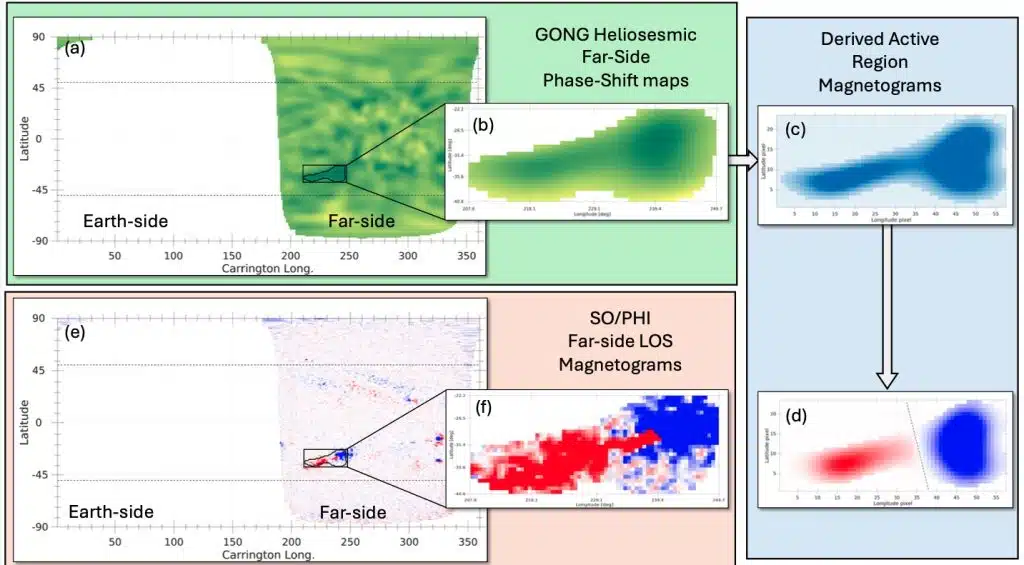 A reconstruction of polarity‑resolved magnetic fields in a helioseismically identified far‑side active region: (a) the green shading shows the helioseismic phase‑shift signal on the far side; (b) the extracted active‑region patch from the phase‑shift map; (c) phase‑shift amplitudes converted to unsigned magnetic‑field values; (d) polarity assignment applied to the unsigned field; and (e–f) the same region as observed by Solar Orbiter’s Polarimetric and Helioseismic Imager (SO/PHI). Blue and red colors in panels (d-f) represent negative and positive field values. Credit: Figure a-d: NSF/NSO/GONG; e and f: Data courtesy of the Solar Orbiter/PHI Team (ESA & NASA)
The Sun's Magnetism
The Sun's overall magnetic field gets generated somewhere inside our star, but it's not known for certain exactly where that happens. It might be near the surface or deep inside. All that we see is the active surface, dotted with sunspots (which have strong, localized fields of their own), and wracked by flares and outbursts generated by magnetic activity. So, to predict these actions more accurately, it helps to know about sunspots and the role their magnetic activities play in such things as flares and coronal mass ejections.
Magnetic polarity describes how magnetic fields are oriented, that is, are they positive or negative? Positive polarity of the field points away from the Sun, while negative polarity points inward. The polarity plays an important role in how magnetic fields interact with the surrounding areas of the Sun. In the most energetic interactions, we might get powerful solar storms that affect people and technology here on Earth.
Sunspots are one manifestation of solar magnetic fields. They form all over the Sun, and their magnetic activity allows outbursts from the Sun. However, when they manifest themselves on the far side, they're not visible to us. So, for a long time, astronomers knew next to nothing about the hidden ones. That all changed when the GONG network came online and allowed solar physicists to explore hitherto-unseen parts of the Sun before they come into view.
GONG Maps the Sun
GONG is a global network of solar telescopes that constantly monitors oscillations that move across the solar surface. The oscillations themselves are created by waves that travel through the Sun. They act like earthquake waves do here on Earth as they collide with structures inside the planet. In this case, the waves in the Sun slam into internal solar structures and magnetic features. Hamada points out that these waves are constant. “By measuring how those waves travel through the solar interior, we can learn about structures both inside the Sun, and on the far side of its surface," Hamada explained.
Hamada's team breakthrough uses a new analysis of helioseismic observations collected by GONG. “Although magnetic fields have been estimated before, the novelty here lies in the physics-driven determination of magnetic polarities and tilt angle within the helioseismically identified active regions," said Jain.
The science teams found very subtle evidence of phase shifts in the helioseismic maps created by the network. By applying physics to the information, the team could infer how magnetic fields are arranged inside the far-side active regions. That allowed them to figure out the magnetic polarity of those regions.
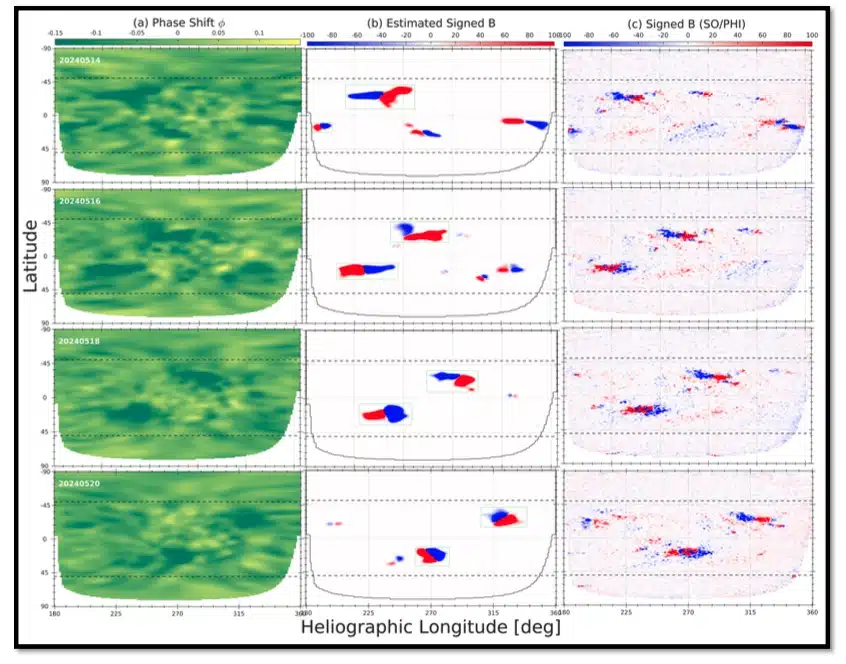 Transit of active regions 13663 and 13664 — responsible for a series of severe solar storms in May 2024 — as they first appeared on the far side of the Sun. The evolution is shown over four alternate days. Left: helioseismic phase‑shift maps. Middle: signed far‑side magnetograms constructed from helioseismically identified active regions. Right: co‑temporal SO/PHI magnetograms. Credit: Figure a-b: NSF/NSO/GONG; c: Data courtesy of the Solar Orbiter/PHI Team (ESA & NASA)
Changing the Way we View Solar Activity
Hamada pointed out that essentially, we're "seeing" the far side of the Sun by using sound waves. His team takes the GONG data one step further, using analysis techjniques that reveal the invisible architecture of magnetic fields shaping the Sun’s most powerful activities. Their method is continually being refined and should eventually give scientists a powerful and continuous magnetic map of the whole Sun. That will allow scientists to better predict solar activity from once-invisible regions long before they turn to face Earth during the Sun's 27-day rotation period. The ultimate goal is to create more accurate forecasts of such things as solar flares and coronal mass ejections, the kinds of activities that create space weather effects here at home.
The solar activity associated with strong magnetic regions has its good and bad sides. A strong storm often sparks beautiful dosplays of northern and souther lights. But, if it's really strong, such space weather can destroy satellites, harm astronauts in space, and disrupting navigation, communications and the energy transport. A more complete magnetic picture of the Sun could give forecasters earlier warnings of potentially disruptive events, while also providing solar physicists a more complete picture of what is happening all over the Sun, not just the side that faces us.
For More Information
NSF-NOAA GONG Maps hidden Magnetism on the Sun's Far Side
Polarity-resolved Far-side Magnetograms Based on Helioseismic Measurements
