We see stars as the main constituent of galaxies. They're the visible part, and they're what announce a galaxy's presence. But a galaxy's gas supply is its lifeblood, and tracing the gas as it flows in and through a galaxy reveals its inner workings.
A galaxy's main business is using this gas to form stars. But some galaxies are quiescent, meaning their star formation has slowed to a trickle. Scientists have proposed two broad types of mechanisms that can cause quenching: internal and environmental. High-mass quenched galaxies usually suffer from an internal mechanism, specifically AGN feedback. Lower-mass quenched galaxies usually suffer from environmental quenching.
The puzzling thing about quenched galaxies is that some of them appear to have plenty of star-forming gas, but for some reason star-formation has slowed to a crawl. Astronomers are working to understand this dichotomy. New research submitted to The Astrophysical Journal examines 'red geysers,' an unusual type of quenched galaxy that makes up abuot 8% of nearby quenched galaxies.
The research is "Galactic Rain: Cool Gas Inflows in Red Geyser Galaxies and Their Connection to AGN Activity and Interactions." The lead author is Arian Moghni, an astrophysics undergrad at the University of California, Santa Cruz.
In astronomy, red means old. Red geysers are dominated by old, red, evolved stars, and lack a population of young, hot, blue stars. Red geysers have plenty of gas, but don't form stars. They have a particular heating mechanism that prevents the gas from cooling and becoming stars. Their black holes are dimmer and less active than a typical AGN, yet they emit weak, steady winds that act like geysers. Scientists think these geysers heat up gas and prevent it from forming stars.
But to determine if that's the case, scientists need a clearer picture of how gas flows in and around red geysers.
"Red geysers are a recently identified population of massive, quiescent galaxies that exhibit large-scale but weak, bi-symmetric ionized gas outflows, interpreted as signatures of ongoing, low-level active galactic nucleus (AGN) feedback," Moghni and his co-authors write. "We investigate the kinematics and prevalence of cool (T ∼ 100–1000 K), neutral gas traced by Na I D absorption, and its connection to galaxy environment and AGN activity."
The researchers observed 140 red geyser galaxies from the Sloan Digital Sky Survey-IV Mapping Nearby Galaxies at Apache Point Observatory (MaNGA) in their work. MaNGA is a spectroscopic survey that examined the internal kinematic structure of gas in 10,000 nearby galaxies. This research focuses on the Na I D doublet, a pair of neutral sodium lines. These lines are important for observing galactic-scale gas flows.
AGN can suppress star formation if they inject enough energy into the surrounding gas. But for that to happen, the AGN needs a source of gas. The researchers used the Na I D feature to map the movement of gas in the 140 red geysers.
The research showed that red geysers have very faint but extended outflows of ionized gas that span tens of thousands of light years.
"These galaxy-scale winds are thought to be signatures of supermassive black hole activity in the center,” said lead author Moghni in a press release. "The puzzle is how these black holes get their fuel. Previous studies had shown signatures of inflowing gases, but the source of these gases and their connection to the supermassive black hole were not well understood."
Typically, gas falls in toward a galaxy's central black hole, where it finds its way into the disk. But in a red geyser, the gas falls in very slowly, only about 10% as fast as expected. If it were being drawn in by gravity like in other galaxies, it would be in-falling much more rapidly. The gas in red geysers also moves in a much more orderly way, suggesting that the black hole jets aren't disrupting it.
The picture gets more complex. Out of the 140 red geysers, 30 of them are detected in radio waves, meaning their AGN are active. This subset of red geysers has more cool gas flowing toward the galactic center than the others.
“It’s really exciting to see how closely the inflowing cool gas is linked to the supermassive black hole activity,” Moghni said. “This gas seems to be funneled in toward the galaxy’s center, where it can help feed and sustain the black hole’s activity.”
To dig deeper, the researchers divided their 140 red geysers into two broad categories: radio-detected and non-radio detected. They also divided them into four categories based on interactions with other galaxies, since this can change a galaxy's gas budget.
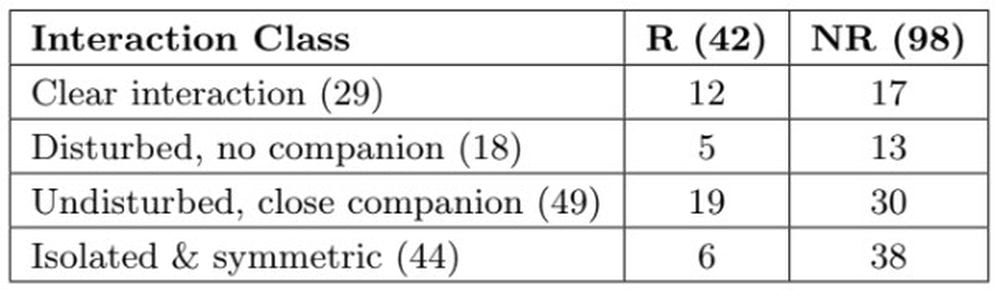
Red geysers that have interacted or merged with other galaxies have much larger reservoirs of gas than red geysers that are isolated. The research showed that in these interacting galaxies, cool in-falling gas covers a much larger area, about 2.5 times more area than in a non-interacting red geyser. All that gas feeds the red geyser's black holes, which makes them generate their winds.
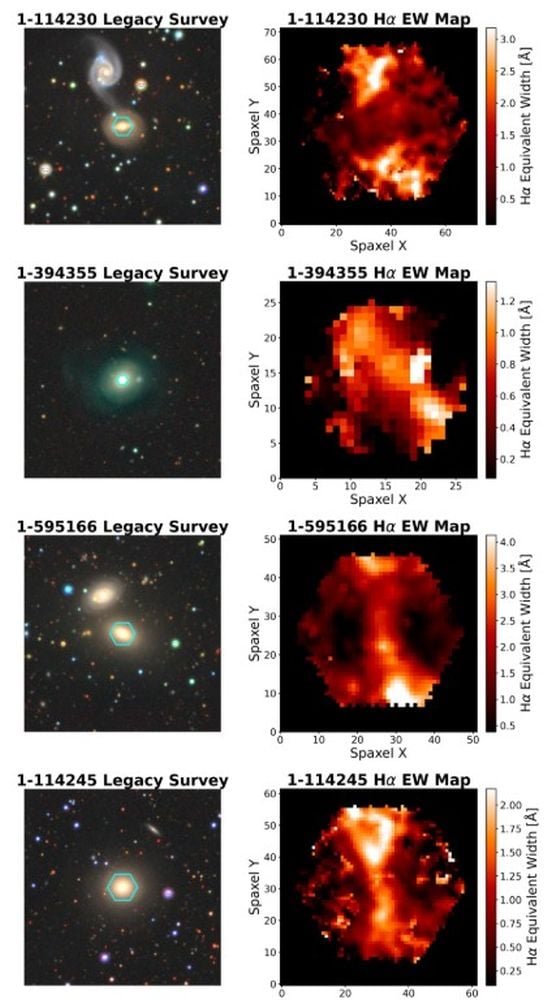
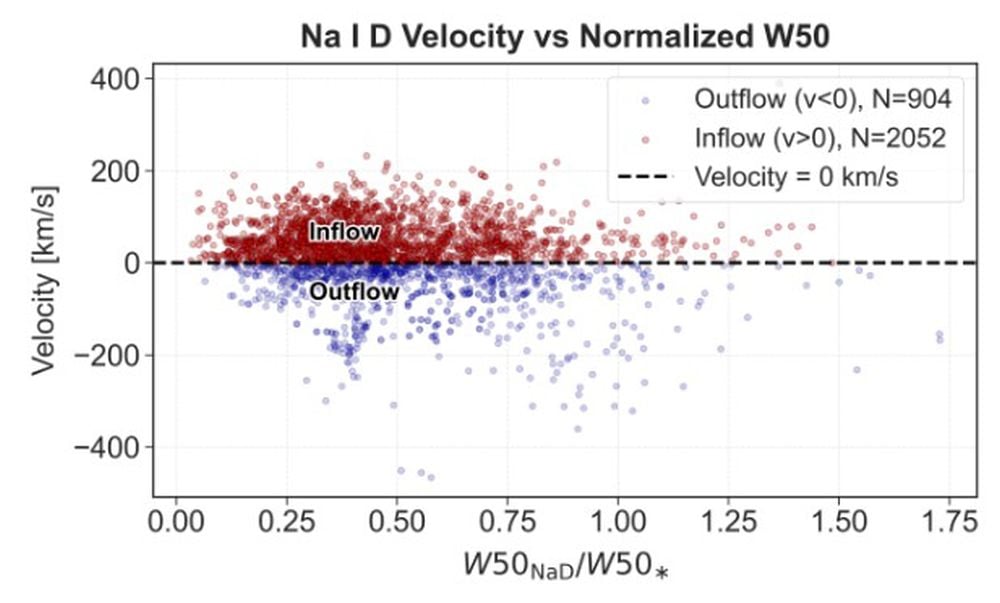
The researchers observations of the Na I D doublet revealed how much gas is flowing into the red geysers, and how much is flowing out.
These results paint a revealing picture of the puzzling, quiescent red geysers and explains how they stay quenched despite having plenty of gas.
In these galaxies, gas is driven inward by interactions with other galaxies and by internal processes. Enough gas finds its way to the black hole to trigger ongoing, low-level accretion and outgoing winds as black hole feedback. That feedback heats up the galaxy's gas, stifling star formation. Over long time periods, this lets massive galaxies stay dormant despite having lots of gas.
“Minor mergers and interactions are an efficient refueling process,” Moghni said. “They deliver cool gas that falls in and feeds the black hole, which can then allow them to continue to suppress star formation for long timescales.”
"We have studied the cool, neutral gases traced by the Na I D absorption lines in a sample of 140 red geyser galaxies, containing 42 radio-detected and 98 non-radio- detected galaxies," the authors write. About one third of them are interacting or have recently interacted. The other two-thirds are either undisturbed or isolated.
The results show that clouds of star-forming gas are flowing inward in 70% of the red geysers, and that the gas is mostly concentrated in their central regions. "The dominance of inflowing Na I D absorption deviates from the outflow-dominated picture that has emerged in most studies of cool gas absorption," the authors explain.
There are two sources for this cool gas. One is interactions, and the other is internal generation. "The relatively low inflow velocities, the lack of Na I D absorption at large radii, and the fact that roughly two-thirds of red geysers show no evidence of interactions indicates that the cool neutral gas is not always supplied through external accretion," the authors explain. Some of it likely originates from ionized gas cooling and condensing in a galaxy's central few kiloparsecs.
"Together, these findings indicate that interactions and minor mergers can efficiently replenish cool gas reservoirs in galaxies, feeding the central AGN, sustaining its activity, and regulating long-term quiescence. This supports a bigger picture in which quiescent galaxies remain dormant through cycles of inflow, feedback, and regulation," the authors conclude.