
"How did life begin?" That question has been pondered by philosophers, scholars, and scientists since time immemorial. In the modern age, it has been generally assumed that the building blocks of life as we know it - amino acids, DNA, and RNA - came together spontaneously to form the first proteins billions of years ago. However, all attempts to recreate this chemical reaction ("abiogenesis") in the laboratory have yielded null results. Nevertheless, it has been widely accepted that this event occurred on Earth, most likely in its early oceans.
In a recent study, an international team of researchers led by Aarhus University challenged this long-held assumption, demonstrating that proteins can readily form in outer space. At the Institute for Nuclear Research, part of the Hungary Academy of Sciences (HUN-REN Atomki), the team simulated the conditions found in giant dust clouds throughout space. The results, reported in Nature Astronomy, indicate that the building blocks of life may permeate space, significantly increasing the statistical likelihood that humanity will someday find extraterrestrial life.
Within a small chamber, the team recreated the environment of space by lowering the pressure to near zero and the temperature to -260 °C (-436 °F). They also continuously pumped gas particles out of the chamber to maintain an ultra-high vacuum. The team then placed glycine in the chamber and irradiated it with cosmic-ray analogs generated by an ion accelerator at the HUN-REN Atomki institute to assess its reaction. Specifically, the team investigated whether complex molecules such as peptides would form - short-chain amino acids that bond together to create proteins.
"We saw that the glycine molecules started reacting with each other to form peptides and water," said lead author Alfred Thomas Hopkinson, a researcher from the Center for Interstellar Catalysis (CIC) at Aarhus University. "This indicates that the same process occurs in interstellar space. This is a step toward proteins being created on dust particles, the same materials that later form rocky planets."
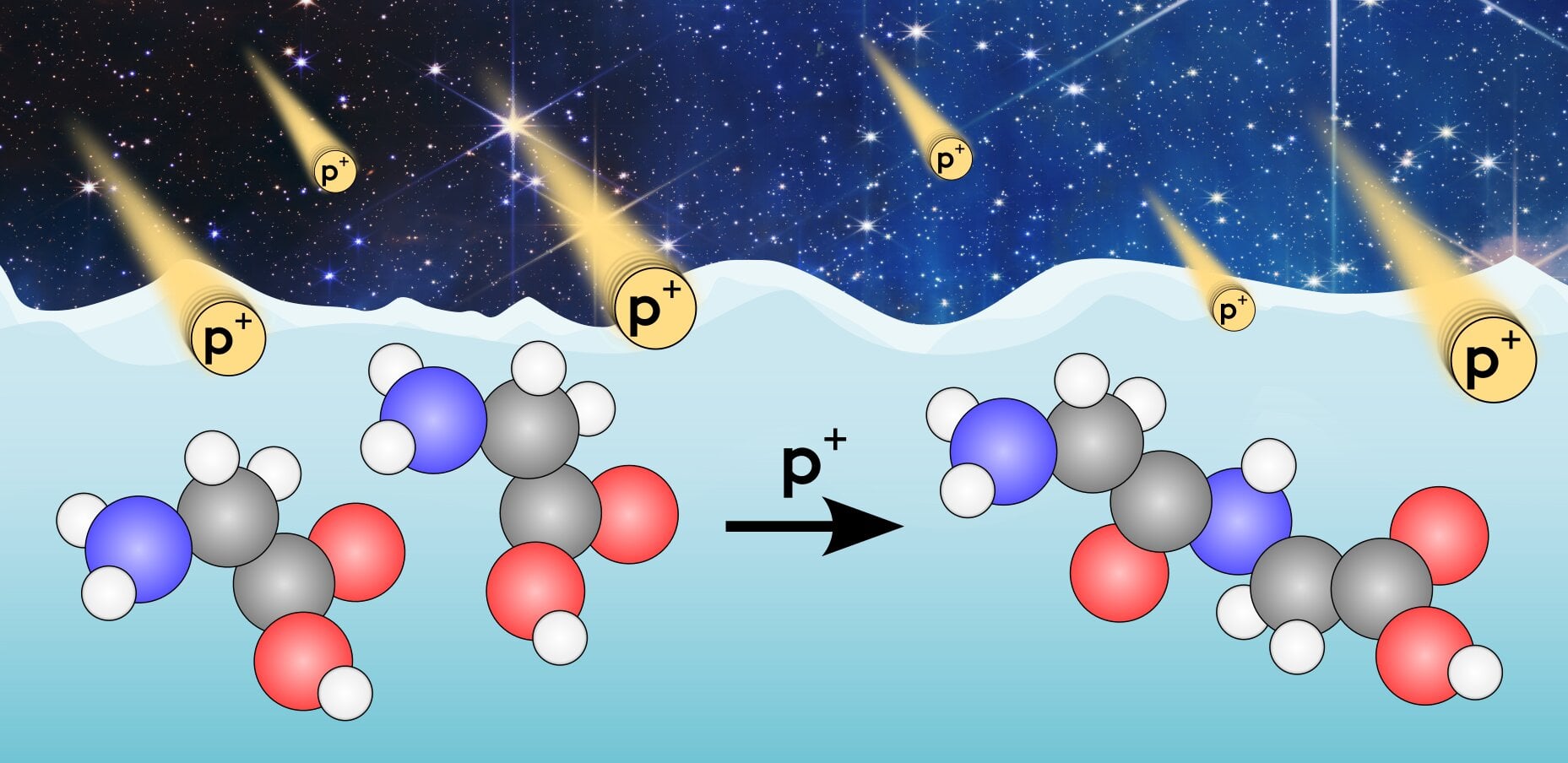 *A graphical representation of glycine on a surface in the interstellar medium bombarded by cosmic rays to produce peptides, the building block of proteins. Credit: Hopkinson et al. (2025)/NASA/ESA/CSA/STScI*
Since peptides are precursors to the ingredients for all life as we know it, studying where and how they form is vital to the search for the origins of life. The team's findings not only reinforce previous research demonstrating that complex organic molecules (COMs) are present in space, but also show that the chemical process by which amino acids bond is universal. This suggests that the same reaction might occur for other, more complex amino acids that are also essential to life. Said co-author Sergio Ioppolo, also a researcher from the CIC at Aarhus University:
[W]e were interested in discovering if more complex molecules, like peptides, form naturally on the surface of dust grains before those take part in the formation of stars and planets. We used to think that only very simple molecules could be created in these clouds. The understanding was that more complex molecules formed much later, once the gases had begun coalescing into a disk that eventually becomes a star. But we have shown that this is clearly not the case.
According to the predominantly accepted model of stellar formation, stars are created when dense clouds of interstellar gas and dust undergo gravitational collapse. What material is left falls into a disk around the new star, eventually accreting to form systems of planets. As such, these results suggest that the building blocks of life would be present during this process, "seeding" the new planets and enabling prebiotic chemistry. For those planets that are within the star's habitable zone, further chemical reactions could lead to the emergence of life.
This discovery is significant because it suggests that the essential molecules for life are far more abundant than previously thought and form much sooner than expected. This dramatically increases the likelihood of life existing in other star systems, with immense implications for astrobiology and the Search for Extraterrestrial Intelligence (SETI). Alas, as Hopkinson emphasized, this does not answer the fundamental question of how life began. In other words, the mystery of how and under what circumstances the essential ingredients came together to create life as we know it remains.
Nevertheless, their results provide crucial insight into how this process began billions of years ago. "All types of amino acids bond into peptides through the same reaction. It is therefore very likely that other peptides naturally form in interstellar space as well. We haven't looked into this yet, but we are likely to do so in the future," said Hopkinson. "There's still a lot to be discovered, but our research team is working on answering as many of these basic questions as possible," added Ioppolo. "We've already discovered that many of the building blocks of life are formed out there, and we'll likely find more in the future."
Further Reading: Aarhus University, Nature Astronomy
