We’re getting close to launch day for Dragonfly! Engineers at the Johns Hopkins Applied Physics Laboratory (APL) in Laurel, Maryland, have officially kicked off the integration and testing stage for the car-sized, nuclear-powered helicopter bound for Saturn’s largest moon, Titan. According to a press release for APL, after years of designing, tweaking, and testing individual components in laboratories and on computer simulations, various organizations have started testing actual hardware ahead of the mission’s planned 2028 launch.
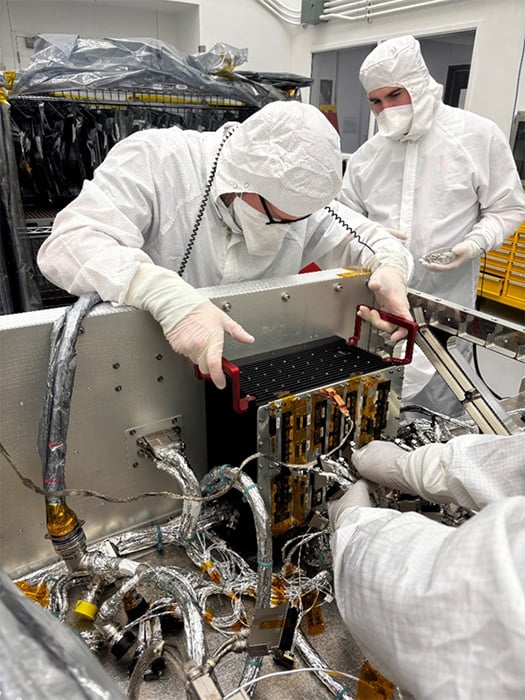
In Maryland specifically, two components have successfully been powered up for the first time. The Integrated Electronics Module (IEM) acts as the spacecraft’s “brain”. It contains Dragonfly’s avionics, including communications, guidance, navigation, and data handling system, all in one power-efficient box. Several Power Switching Units (PSUs) were also tested - these manage load switching and power distribution between the flight, communication, and scientific systems. Both the IEM and the PSUs were hooked up to the main wiring assembly of the system and successfully passed their test.
“This milestone essentially marks the birth of our flight system,” said Elizabeth Turtle, Dragonfly’s principal investigator at APL in the press release. “Building a first-of-its-kind vehicle to fly across another ocean world in our solar system pushes us to the edge of what’s possible, but that’s exactly why it’s so exciting. The team is doing an outstanding job, and every component we install and every test we run brings us one step closer to launching Dragonfly to Titan.”
Video showcasing the power and electronics integration and testing NASA is doing. Credit - NASA Science YouTube ChannelWhile APL was testing the flight system, engineers at Lockheed Martin Space in Littleton, Colorado were putting the aeroshell and cruise-stage assemblies that will protect the vehicle during its six year long transit to Saturn as well as the dangerous atmospheric entry once it arrives at the nitrogen-rich moon through their paces. Another group of engineers finished a series of aerodynamic tests at the wind tunnel at NASA’s Langley Research Center in Virginia.
One of the most critical features of Dragonfly will be its ability to survive the extreme cold on Titan itself. At APL, another team is testing the specialized foam coating designed to insulate the spacecraft in the “Titan Chamber”. This environmental testing chamber is designed to mimic Titan’s brutally cold surface temperatures, which hover around -179℃.
Testing isn’t fully complete yet though - plenty of the scientific payload, which is being developed by organizations around the world, is yet to be delivered. As it comes in, APL plans to continue integration and testing into early 2027. At that point, Lockheed Martin will take over for system-level testing, before returning the completed mission back to APL for final space-environment checks late next year.
Assuming everything goes to plan, which, if we’re being honest, is an optimistic assumption, Dragonfly will be headed to the Kennedy Space Center in Florida in the summer 2028 for launch aboard a SpaceX Falcon Heavy rocket. After spending six years in transit to Titan, it will eventually land on the one of the only other worlds in our solar system with liquid on its surface. There it will study the moon’s chemistry, geology, and weather, allowing scientists to unlock some of the secrets of how Titan came to be the way it is, but also potentially to shed a light on the chemical origins of life itself.
“We’ve spent years designing and refining this amazing rotorcraft,” said Annette Dolbow, Dragonfly’s integration and test lead at APL. “Now we get to bring all those elements together and transform Dragonfly into an actual flight system.” When successful, it will mark another milestone in the history of humanity’s expansion out into our solar system, with a robotic helicopter leading the way.
Learn More:
APL - Dragonfly Mission Begins Rotorcraft Integration, Testing Stage
UT - Dragonfly is Going to Titan on a Falcon Heavy
UT - NASA is Continuing to Build the Titan Dragonfly Helicopter. Here are its Rotors