NASA's MSL Curiosity rover has found some more pieces of the puzzle that is Mars' ancient habitability. Evidence that the planet was once warm, wet, and habitable is growing, and now Curiosity has detected some new organic molecules. The rover found 21 organic compounds in rocks in Gale Crater with its Sample Analysis at Mars (SAM) instrument. Seven of them were detected for the first time.
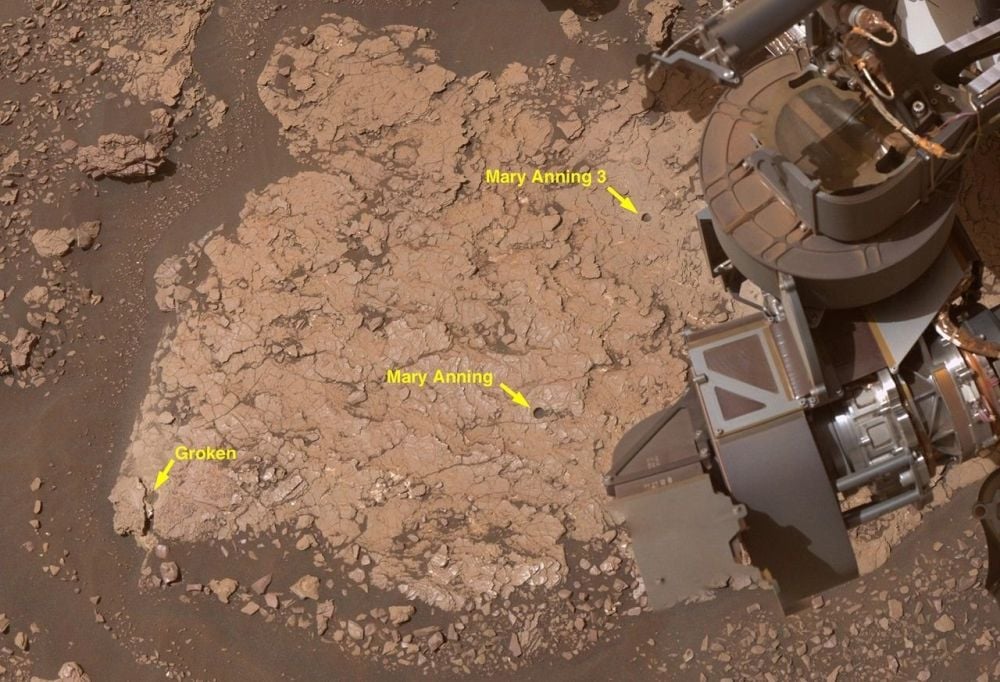
These results stem from Curiosity's work back in 2020, when it drilled into a clay-bearing sandstone rock named Mary Anning 3. Now, after thorough onboard laboratory work, the rover has identified the most diverse collection of organic molecules ever found on Mars. As it stands now, there's no way of knowing if these organic molecules have a biological or geological origin, but the findings are still intriguing. Despite not being proof of ancient life, they're still important. They show that the planet is capable of preserving ancient biosignatures.
The discovery is presented in new research in Nature Communications titled "Diverse organic molecules on Mars revealed by the first SAM TMAH experiment." The lead author is Amy Williams from the Department of Geological Sciences at the University of Florida in Gainesville.
"The search for organic matter on Mars has rapidly evolved in the past decade with simple aromatic, S-heterocycles, and aliphatic organic molecules detected in Gale crater," the authors write. "We report the in situ detection of >20 organic molecules from clay-bearing sandstones in the ~3.5-billion-year-old Knockfarrill Hill member of Glen Torridon, Gale crater, by the Sample Analysis at Mars instrument suite onboard the Curiosity rover."
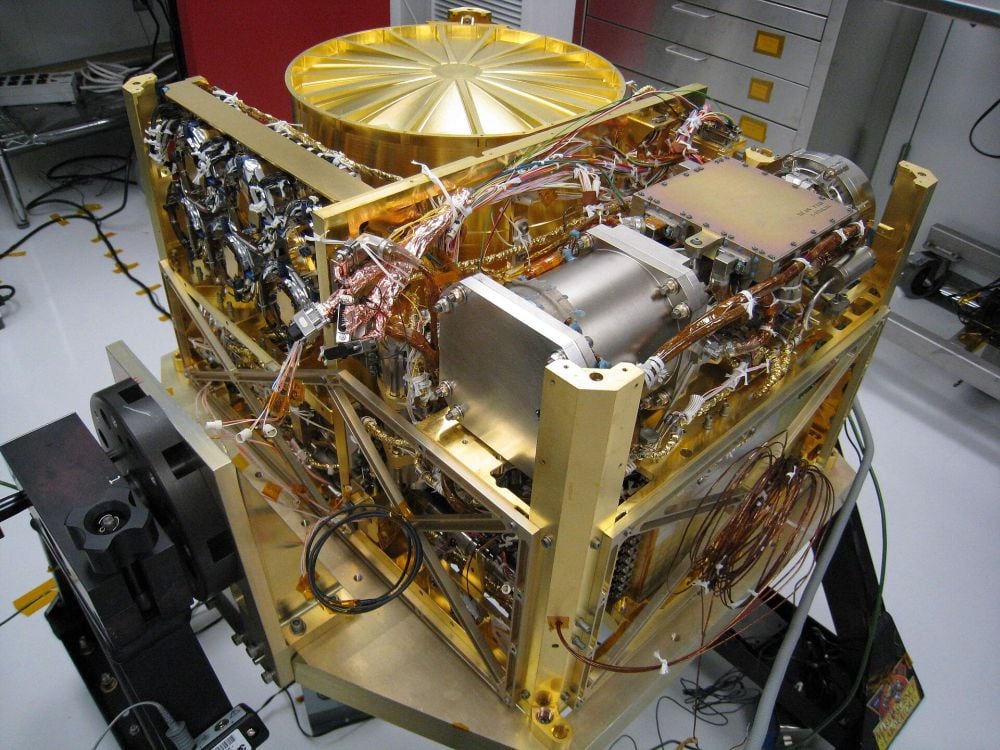
SAM is three instruments in one that can detect organics and gases in both rocky and atmospheric samples. It has 74 single-use sample cups at its disposal, and 9 of them are reserved for wet chemistry. It used one of those 9 in this work.
SAM has small amounts of chemicals onboard that it uses in wet chemistry. In this work, the onboard laboratory experiments "released molecules preserved in ancient macromolecular or free organic matter within Martian bedrock despite ~3.5 billion years of diagenesis and radiation exposure," according to the authors.
One of the new molecules is called a nitrogen heterocycle. They're rings of carbon atoms that contain nitrogen and are considered to be precursors to DNA and RNA.
“That detection is pretty profound because these structures can be chemical precursors to more complex nitrogen-bearing molecules,” said lead author Williams in a press release. “Nitrogen heterorcycles have never been found before on the Martian surface or confirmed in Martian meteorites.”
But nitrogen heterocycles aren't the only significant finding. Curiosity also found a chemical named methyl benzoate. Its detection is important in our understanding of Mars' chemistry. It's not a smoking gun in the search for past life, but it could be critical. Methyl benzoate is complex, and it has both an aromatic ring, or benzene ring, as well as an ester group. It has both a biotic and an abiotic source, but its presence shows that Mars has preserved more complex or "mature" organic chemicals than has been previously confirmed. It likely didn't form on its own. Instead, it was most likely snipped off a larger organic compound during the SAM experiment.
The fact that methyl benzoate survived for about 3.5 billion years on Mars' radiation-blasted surface is significant and shows that the planet can preserve complex organic molecules. It suggests that even more convincing organic molecules like amino acids could be preserved, too.
SAM also found benzothiophene, which can also have both biotic and abiotic sources. It's a sulphur bearing molecule, and the sulphur can act as a shield to the radiation that bombards the Martian surface, protecting other molecules from destruction. It's another indication that there's more complex organic molecules waiting to be found on Mars.
These types of discoveries were what MSL Curiosity was built for, and they show that all of the hard work is paying off.
“This is Curiosity and our team at their best. It took dozens of scientists and engineers to locate this site, drill the sample, and make these discoveries with our awesome robot,” said study co-author and the mission’s project scientist, Ashwin Vasavada of NASA’s Jet Propulsion Laboratory in Southern California. “This collection of organic molecules once again increases the prospect that Mars offered a home for life in the ancient past.”
"We propose that this suite of organics represents TMAH thermochemolysis breakdown products from ancient organic macromolecular material that has been preserved in billions-of-years-old sedimentary rocks in Gale crater," the researchers write.
The SAM analysis doesn't reveal the spatial distribution of these chemicals, so the authors say that they can't confirm their source. It's possible that they were delivered to Mars by ancient meteorites. They could also have other abiotic sources. But regardless of the source, their discovery confirms that Mars can preserve ancient biosignatures.
"These results expand the library of confirmed and suggested organic molecules preserved over deep geologic time in the Martian near-surface and confirm the presence of macromolecular carbon on Mars," the authors conclude.
Curiosity has used up all of its wet chemistry cups. It used its last one when it explored the boxlike ridges in Gale Crater. These features were formed by ancient groundwater, and those results will be presented in a future paper.