
Space News & Blog Articles
Live coverage: SpaceX to launch 1st ‘Twilight’ rideshare mission
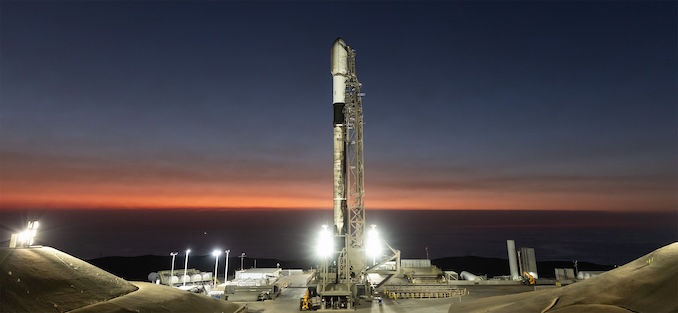 File: A SpaceX Falcon 9 rocket is vertical at Space Launch Complex 4 East (SLC-4E) at Vandenberg Space Force Base ahead of the launch of the Starlink 9-10 mission on Nov. 8, 2024. Image: SpaceX
SpaceX will debut a new class of rideshare mission on Sunday with the launch of its first Twilight flight. The mission is described by the company as flying to a “dawn-dusk Sun-synchronous orbit” after departing from Vandenberg Space Force Base.
As of Saturday afternoon, SpaceX hasn’t announced the total number of payloads flying onboard, but it did list 40 deployment events on its launch timeline. Spacecraft will be jettisoned from the Falcon 9 rocket’s upper stage starting roughly an hour after liftoff and concluding more than 2.5 hours into the mission.
Liftoff from Space Launch Complex 4 East is scheduled for 5:20 a.m. PST (8:20 a.m. EST / 1320 UTC). The rocket will fly on a southerly trajectory after takeoff.
Spaceflight Now will have live coverage beginning about 30 minutes prior to liftoff.
It will be the fifth flight for one of SpaceX’s newer Falcon boosters, designated 1097. It previously launched three batches of Starlink V2 Mini Optimized satellites and the Sentinel-6B spacecraft.
Roughly 7.5 minutes after liftoff, B1097 will touchdown at Landing Zone 4 (LZ-4), adjacent to the launch pad. If successful, this will be the 32nd landing at this site and the 557th booster landing for SpaceX to date.
Pandora, BlackCat, and SPARCS
The Twilight mission will carry a trio of NASA spacecraft, including a spacecraft designed to study exoplanets called Pandora.
This mission is spearheaded by NASA’s Goddard Space Flight Center in Greenbelt, Maryland. It uses a 17-inch-wide (45 cm) telescope jointly developed by Corning Incorporated and Lawrence Livermore National Laboratory to observe the atmosphere of exoplanets as they pass in front of their respective stars.
Observations will be taken in both visible and infrared light. NASA said Pandora will look at each planet and its start 10 times “with each observation lasting a total of 24 hours.”
“The Pandora mission is a bold new chapter in exoplanet exploration,” said Daniel Apai, an astronomy and planetary science professor at the University of Arizona in Tucson where the mission’s operations center resides. “It is the first space telescope built specifically to study, in detail, starlight filtered through exoplanet atmospheres. Pandora’s data will help scientists interpret observations from past and current missions like NASA’s Kepler and Webb space telescopes. And it will guide future projects in their search for habitable worlds.”
The observatory was one of four astrophysics missions tapped for further development under NASA’s new Pioneers program and will study 20 stars and 39 exoplanets over a five-year timeline. The Pandora mission has a budget cap of $20 million, according to a statement from NASA in 2021.
The two other NASA-backed payloads, BlackCat and SPARCS (Star-Planet Activity Research CubeSat) come from the agency’s CubeSat Launch Initiative. Each CubeSat measures 11.8 by 7.8 by 3.9 inches (30 by 20 by 10 cm).
BlackCAT is set to launch!
This @NASA-funded mission led by @PSUScience, with contributions from @LosAlamosNatLab, will launch at 13:19 UTC this Sunday to hunt for some of the brightest, furthest, and oldest explosions in our Universe:
BlackCAT (the Black Hole Coded Aperture… pic.twitter.com/2XZvhDi6CJ
— Kongsberg NanoAvionics (@NanoAvionics) January 9, 2026
BlackCat is funded through NASA’s Astrophysics Research and Analysis Program to the tune of $5.8 million for its five-year mission. It is a wide-field x-ray telescope built and managed by Pennsylvania State University with support from Los Alamos National Laboratory and built on a satellite bus from Kongsberg NanoAvionics US.
Per a September 2021 press release from Penn State, BlackCat was expected to launch in March 2024. The telescope will be used “to study powerful cosmic explosions like gamma-ray bursts, particularly those from the early universe, and other fleeting cosmic events,” NASA said.
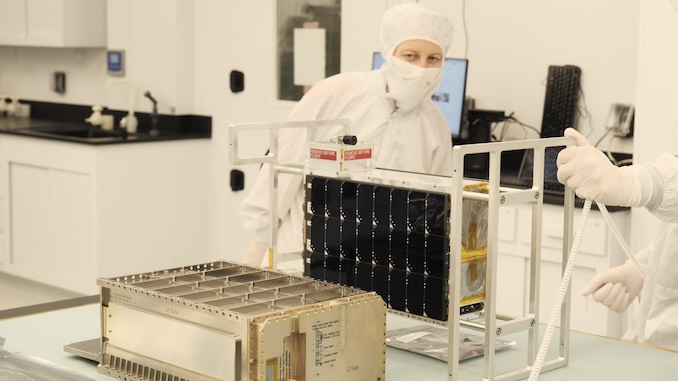 Arizona State University Professor Evgenya Shkolnik, principal investigator for the Star Planet Activity Research CubeSat mission, inspects the space instrument as it’s being built in a clean room. Image: Arizona State University
Meanwhile SPARCS is designed to study solar flares and sunspots of stars with low mass in the far- and near-ultraviolet. The data gathered from these observations will help determine the likelihood that these starts can support life in nearby exoplanets.
“We will be sensitive for the first time to the rarest and the strongest of these stellar flares,” says ASU Professor Evgenya Shkolnik, the mission’s principal investigator. “And once we understand how strong flares can get, which we really don’t know, we will finally understand how much energy is hitting a potentially habitable planet. Then we can use those data to calculate what that impact really is.”
In a January 2020 Astrophysics presentation, NASA shows SPARCS as intending to launch in Fall 2021.
What else is onboard?
A little more than half of the 40 deployments will be managed by Exolaunch, which has a presence in both Germany and the United States. The first deployment of the Twilight mission will be the first of four Connecta Internet of Things CubeSats from Türkiye-based Plan-S Satellite and Space Technologies.
This will bring Plan-S up to a total of 16 IOT satellites in low Earth orbit, assuming a successful deployment and commissioning.
“The Twilight mission builds directly on a record-breaking year for Exolaunch,” said Jeanne Allarie, Chief Investor Relations Officer at Exolaunch, in a statement. “In 2025 alone, we completed 11 launches and deployed 196 satellites, the highest annual launch cadence in our history, bringing our total to 653 satellites flown across 41 missions.
“This level of execution positions Exolaunch as the launch integrator of choice for satellite deployment at global scale. We are grateful to SpaceX for the outstanding collaboration and for enabling the most reliable access to space.”
Twilight is when the day doesn’t end, it simply shifts gears.  That’s exactly what’s coming next: four new Connecta IoT Network satellites, designed, manufactured and engineered by Plan-S, and integrated via launch partner @Exolaunch are set to lift off on @SpaceX Falcon 9… pic.twitter.com/jyJK8ElmIE
— Plan-S (@WeArePlanS) January 9, 2026
Another notable payload manifested under Exolaunch’s purview is the Araqys-D1/Dcubed-1 satellite from Germany-based Dcubed. The CubeSat aims to manufacture a 60-cm boom in space.
“If successful, it will mark a global first: the manufacturing of a structure directly in the vacuum of space,” Dcubed said on social media. “Achieving this breakthrough—known as In-Space Manufacturing (ISM)—opens the door to a radically new future: one where large solar arrays, antennas, and entire space infrastructures aren’t launched from Earth… they are made in space.”
The CubeSat is backed by the European Innovation Council (EIC).
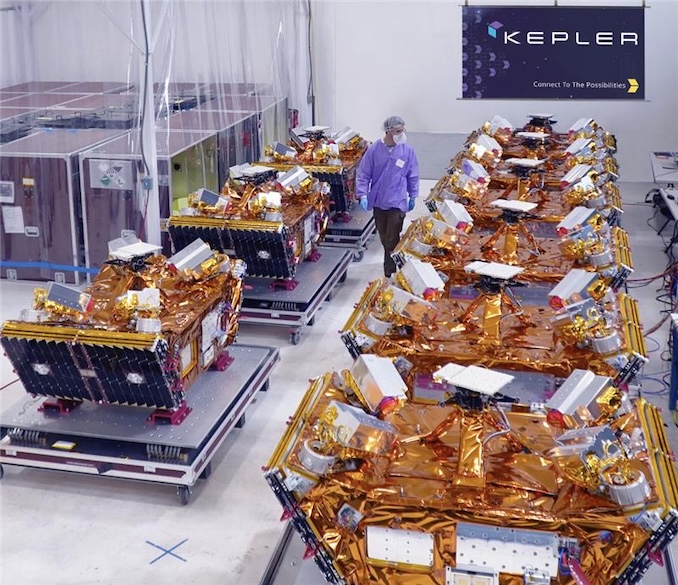 et for Jan. 2026, the mission will deploy Kepler’s optical data relay ring with SDA-compatible communications, hosted payloads, and on-orbit compute for real-time connectivity across space. Image: Kepler Communications
Canada-based Kepler Communications is also set to deploy ten of its 300-kilogram-class communications satellites called Aether. The company said the satellites, which feature four optical terminals for “high-throughput, low-latency laser links,” are designed to be compatible with the U.S. Space Development Agency’s (SDA) communications standards.
“Optical data relay is redefining how space systems communicate, operate, and deliver value,” said Mina Mitry, chief executive officer and co-founder of Kepler Communications. “It removes the high latency and bottlenecks of traditional RF links and allows our customers to move data continuously, securely, and at the speed of light.
“With real-time connectivity and advanced computing in orbit, operators can unlock new possibilities for defence and intelligence, real-time situational awareness, commercial innovation, and sustained human operations in space. Together, these advancements are creating the foundation for a truly connected space economy.”
When you subscribe to the SpaceZE News Feed, we will send you an e-mail when there are new updates on the site so you wouldn't miss them.
