Laser sail propulsion is an idea that won't go away. By aiming powerful Earth-based lasers at tiny spacecraft with light sails, tiny spacecraft can be accelerated to near-relativistic speeds without carrying fuel or an energy source, and without carrying any kind of propulsion system at all. There are clear advantages to this idea, if it can be implemented.
Two spacecraft have partly implemented the idea. JAXA's IKAROS spacecraft and the Planetary Society's Lightsail-2 used sails, but they were powered by photons from the Sun, not from a laser. They showed that the concept can work, at least partly.
The Breakthrough Starshot program, now defunct, aimed to build a fleet of 1,000 miniature spacecraft with photon sails and send them on a 20-year journey to Alpha Centauri, the star system closest to us. The fleet of nanocraft, each with a tiny camera, would've been powered by Earth-based lasers and would've performed a flyby of Proxima Centauri, giving humanity its first close-up look at another star, and at the two confirmed exoplanets that orbit it.
While Breakthrough Starshot seems to have succumbed to its own private-funding related problems, the overall idea has endured. The proposal to send a swarm of laser sail spacecraft to check out our closest neighbour is getting a breath of fresh air in a new paper. It's titled "Science from the In Situ Exploration of the Proxima Centauri System," and it's available on the pre-print server arxiv.org. The lead author is T. Marshall Eubanks, Chief Scientist at Space Initiatives Inc. (Watch Fraser Cain's interview with Eubanks at the bottom of this article.)
"In the future interstellar exploration at near-relativistic speeds will be possible using beamed energy laser propulsion," the authors write. "With this, spacecraft as small as gm mass picospacecraft become candidates for the exploration of deep space, with a trade space of velocity and mission duration versus mass."
There's an acknowledged trade-off between traditional single spacecraft missions loaded with technology, and tiny spacecraft. A single tiny spacecraft would be extremely limited in terms of scientific results. But as a swarm, some of that limitation can be overcome.
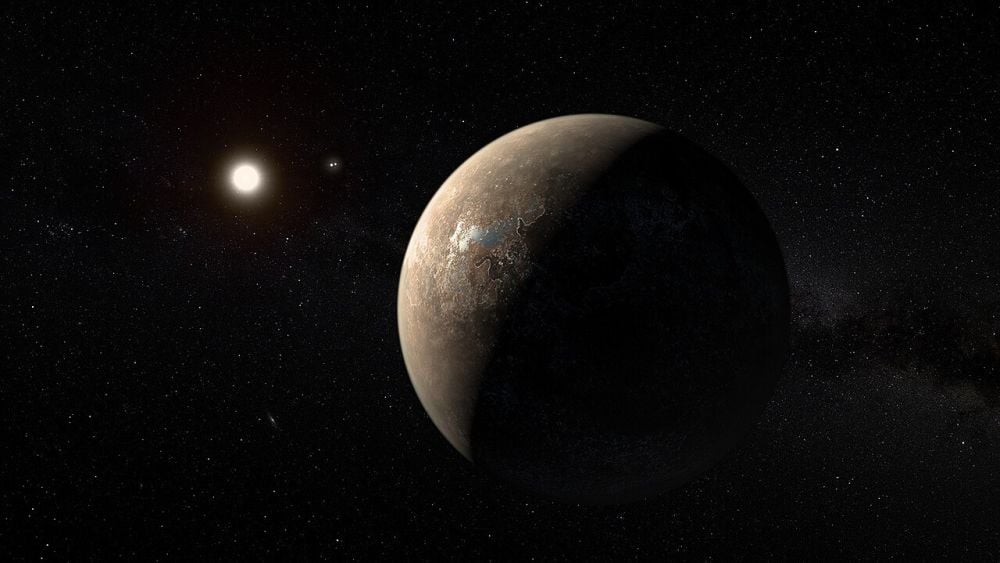
This idea would see swarms of picospacecraft, called Coracles, perform fast flybys of the Proxima Centauri system. Outfitted with a single instrument each, a small digital camera, "a picospacecraft swarm could deliver gigapixel resolution of the target exoplanets," the authors write. "Our mission target is the planet Proxima b in the habitable zone (HZ) of the red dwarf Proxima Centauri, the tertiary (and nearest) component of the nearest star system, Alpha Centauri."
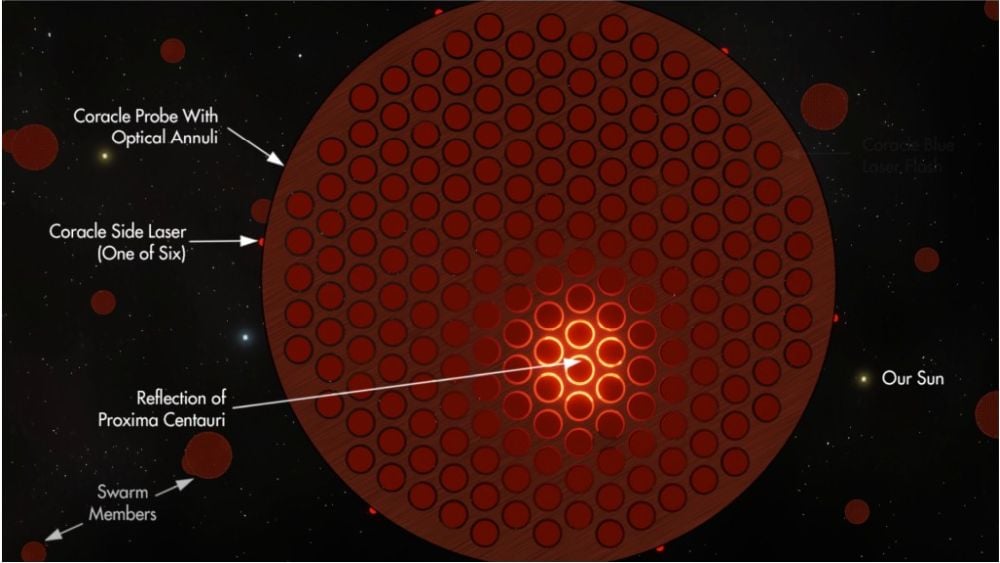
While the mission would be intriguing for many reasons, including proving a long-pondered technology, the natural question that occurs regards scientific results. What would the science returns be?
First of all, the technological limitations place constraints on the type of observations the swarm can perform, and the amount of data it can return.
Navigation is a problem. Since there's no "mothership" in the swarm to herd the members along to their destination, the mission would have to rely on something like pulsar navigation to reach its target. It's likely that not all of the spacecraft will reach the target, or be close enough to it to be effective. The authors point out a couple of solutions to this problem.
One is to send the tiny spacecraft as a series of individual probes. In this scenario, the probes don't have to be sent as a swarm and don't need to be grouped coherently. "This relaxes constraints on when the probes are sent, but will greatly limit any multi-probe studies, and may result in the transmission of less data, and also of redundant data back to Earth," the authors write.
Another is to send the swarm as a time coherent swarm. The members would have to be organized so that they know where each other are and where Earth is. Then, when data is transmitted back to Earth, it arrives as a coherent "wall of light." This requires inter-prone synchronization and exquisite timing which is a complex problem to solve while keeping probe size small.
A third solution is a "Sparse Phased Array," but the authors don't spend much time on it due to its complexity. "We do not consider this last sparse phased array approach further in this paper due to the extreme difficulty of phase coordination across the swarm," they write.
The swarm idea has some clear advantages, and one of them is redundancy. Not all of the members need to reach the target for the mission to be fulfilled. This gives the mission some built-in leeway to achieve its science results. Only a small subset of the probes need to approach the targets closely.
"The close flyby of Proxima b will last less than a minute, with the highest image resolution will come from the small subset of probes that happen to pass closest to targets of interest," the authors explain.
Once the successful probes have captured their data, there's still another hurdle to clear.
"In addition, with HDR recordings acquiring up to one million images per second per aperture there will be terabytes of data acquired by the swarm during the flyby," the researchers write. Downloading all of this data is simply impossible. Even if the swarm spent years downloading its data, there's still orders of magnitude more data than can be returned.
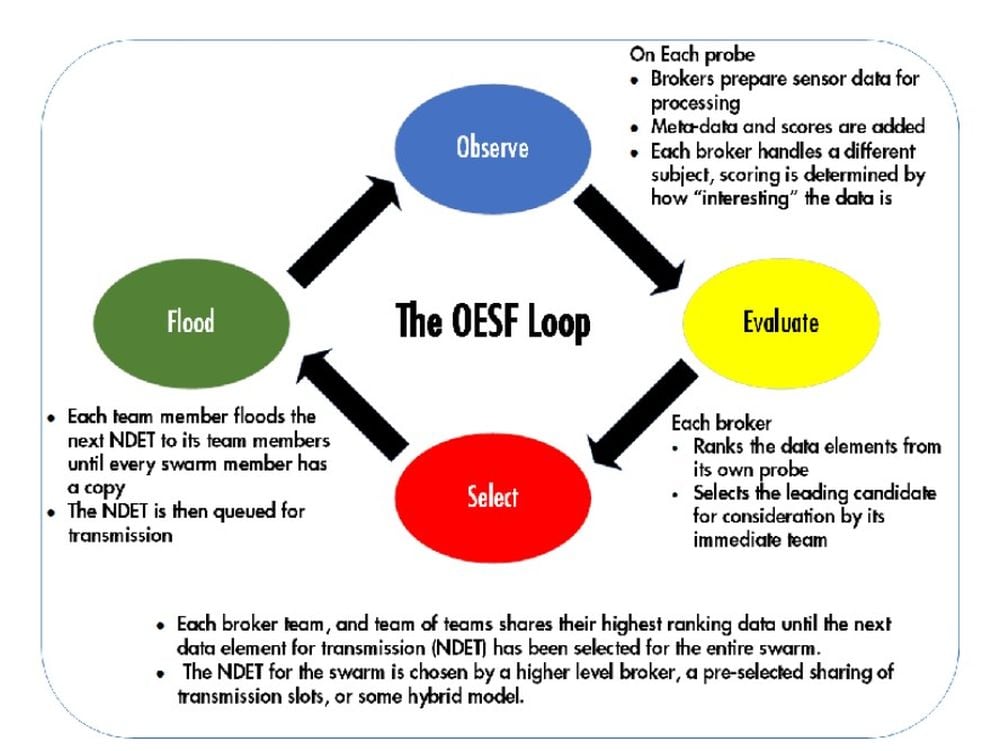
The swarm will need some way to select what data is important to return to Earth, all without help from Earth-bound mission personnel who are more than four light-years away. One proposal is called "lookahead" observations. Members of the swarm would capture images as it approached the primary target, and AI would make decisions about which subjects, asteroids or exomoons for example, should be prioritized for observations and return data. A system like this is necessary because unlike many other missions, there will be a single flyby and no repeat orbits.
With these strengths and obstacles in mind, the authors say that multiple science objectives could be achieved. The swarm could capture approach videos of the star from hours before its closest approach, and map its flaring. It could also capture approach videos of Proxima Centauri b days before its flyby and detect any exomoons. These approach videos can also serve as Lookahead data to select targets for more observations.
The authors point out that the swarm could revolutionize our understanding of Proxima Centauri b, even if only some of the swarm members get close to it. "A swarm with a few hundred surviving members and a total extent of 105 km should have some members passing within ∼104 km of the target planet (roughly its diameter), providing a potential Proxima b resolution of ∼20 meters," they explain. The swarm can potentially image the night-side of the tidally-locked planet, too.
Beyond imaging, the swarm could also perform transmission spectroscopy of Proxima Centauri b's atmosphere. "Transmission spectroscopy can be done at Proxima b using natural and artificial sources, and will, through the search for spectral lines of biomarkers and technosignatures, likely provide the best means of establishing the existence of a biology or even a technological society on Proxima b," the researchers write.
The swarm could also observe Proxima Centauri's frequent flaring to learn more about it and other M-dwarfs. These stars are prone to flaring which can strip away planetary atmospheres and truncate habitability. A closer look at one would be a huge boon for astrophysicists.
There's also the potential for impact spectroscopy. "The distance between probes at the fleet’s center could be as little as a few thousand kilometers, and it is possible that one or more Coracle probes would enter the Proxima-b atmosphere, if it exists, or impact the surface, if it does not," the authors write. The swarm could monitor the flashes from the impacts to learn more about the exoplanet's composition.
There's also the potential for more science as the swarm moves beyond Proxima Centauri. "Roughly 1 year after the Proxima encounter the swarm will have a distant encounter with the α Cen AB system, with a closest approach of ∼10,000 au.," the authors write.
Other stars are so far away that it will take bold inititatives to ever reach them. While other advanced propulsion technologies are always being pondered, we never know when they'll come to fruition. That's why the laser sail idea never goes away.
"Gram-scale interstellar probes pushed by laser light are likely to be the only technology capable of reaching another star this century," the authors write in their conclusion. "A near-relativistic swarm mission could provide a strong initial survey of Proxima b as an exoplanet and should be able to detect Proxima b biosignatures and technosignatures, should these be present."