
One of the most intriguing puzzles in cosmology is the existence of supermassive black holes that seem to appear very early in the history of the Universe. Astronomers keep finding them at times when, by all that they understand about the infant Universe, they shouldn't be there. The standard theory of black hole formation suggests that they hadn't enough time to grow as massive as they appear to be. Yet, there they are, monster black holes with the mass of at least a billion suns. The James Webb Space Telescope (JWST) has found a large population of them in early epochs, and they've been observed in very early quasars as well by such missions as the Chandra X-Ray Observatory.
Scientists at the University of California Riverside studied the role of dark matter in the infant cosmos as a way to explain this mystery. Their work shows that the decay of dark matter might have influenced the birth and growth of the earliest supermassive black holes. That still leaves the question: what is dark matter made of?
According to team leader and grad student Yash Aggarwal, dark matter particles could send very small amounts of energy into a gas cloud. It seems like a small amount, but given enough dark matter decay and time, it could kick-start the black hole formation process. “Our study suggests that decaying dark matter could profoundly reshape the evolution of the first stars and galaxies, with widespread effects across the Universe,” Aggarwal said. “With the James Webb Space Telescope now revealing more supermassive black holes in the early Universe, this mechanism may help bridge the gap between theory and observation.”
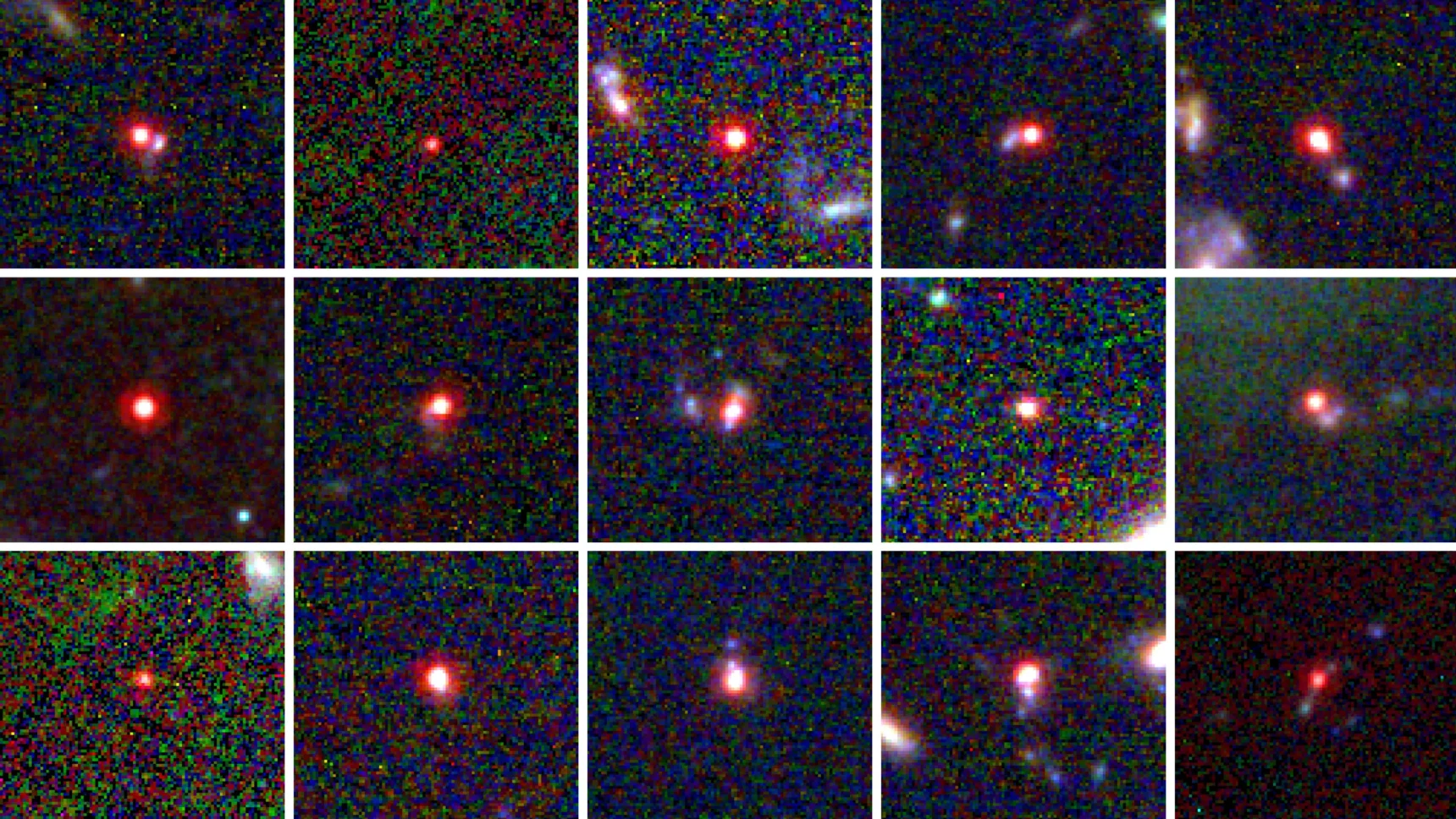 The early Universe contains large numbers of supermassive black holes at the hearts of the earliest galaxies. The black holes likely formed from seeds that collapsed inside hydrogen gas clouds. Courtesy Jorryt Matthee, EIGER/FRESCO surveys.
How the Early Universe Could Create Supermassive Black Holes
The early Universe was an intriguing place, according to Flip Tanedo, a UCR professor and Aggarwal's advisor. “The first galaxies are essentially balls of pristine hydrogen gas whose chemistry is incredibly sensitive to atomic-scale energy injection,” he said. “These are the properties that we want for a dark matter detector — the signature of these "detectors" might be the supermassive black holes that we see today.”
To figure out the role of dark matter in those early times, the research team came up with computer models of the temperature and chemical changes of the hydrogen gas that existed at early epochs. They modeled its behavior in the presence of decaying axions. These subatomic particles are considered a viable dark matter candidate. Some research suggests that they can play other roles as well. If they are dark matter, then as it decays, it can leak a small amount of its energy into the gas and supercharge the direct collapse rate. Each decaying dark matter particle would only need to inject an amount of energy that is a billion trillionth the energy of a single AA battery.
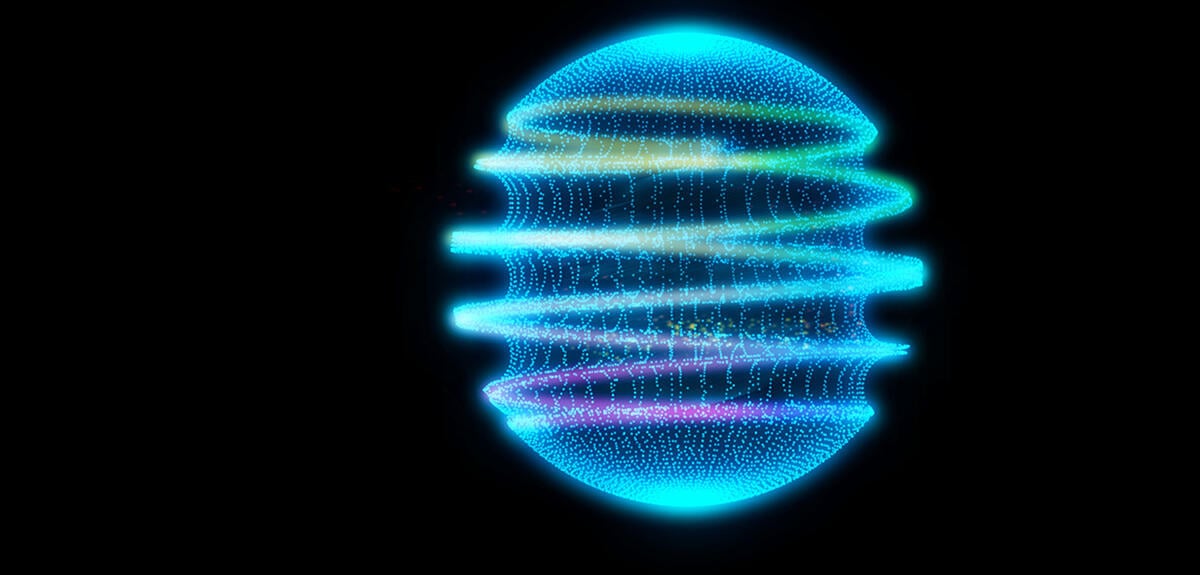 *This is an artist's impression of an axion, a leading candidate to explain dark matter. Axions have been used to explain dark matter for at least 40 years, and may well be the culprit in the formation of the earliest supermassive black holes. Courtesy: Collaboration XENON/CNRS*
Big Black Holes from Little Seeds
The research team, which included James Dent of Sam Houston State University in Texas and Tao Xu of the University of Oklahoma, modeled the thermo-chemical dynamics of the gas in the presence of decaying axions. The result is a supposed window of dark matter masses between 24 and 27 electronvolts. These could influence the conditions that create what are known as seed direct collapse black holes. These begin with smaller "seed" black holes that formed via the collapse of a lot of material (hydrogen gas). These are thought to have begun shaping up sometime in the first few hundred million years of the Universe. That's very early, while the first stars were still forming. So, these seed black holes couldn't have gone through the usual process of massive star formation, death, and collapse of the remainder into a stellar-mass black hole. This material went straight to black hole territory and kept on accreting to get the early supermassive black holes astronomers continue to find.
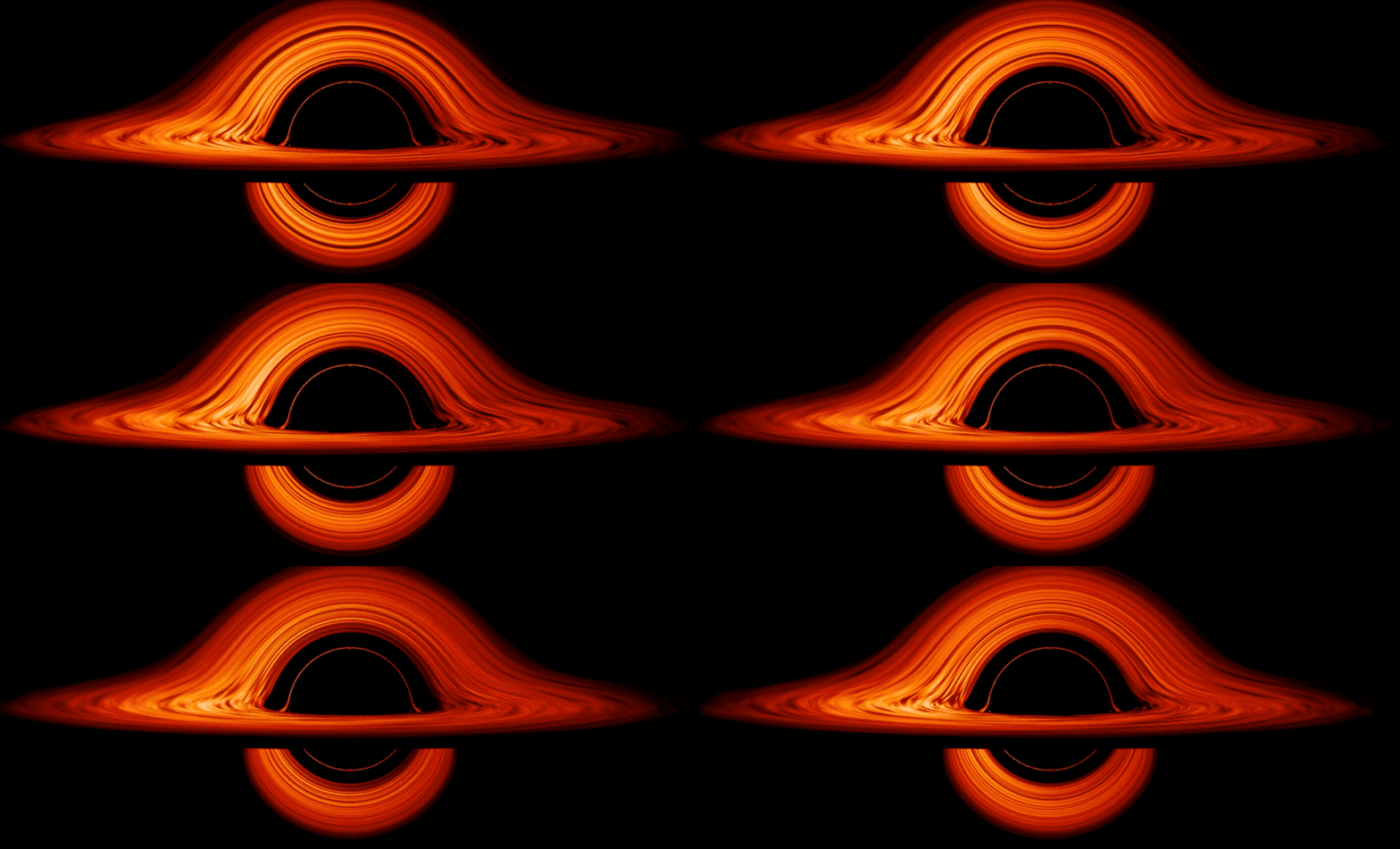 A visualization of an actively accreting black hole. View full video here: https://svs.gsfc.nasa.gov/13326. Courtesy: NASA Goddard Space Flight Center/Jeremy Schnittman.
This line of inquiry into the earliest supermassive black holes began as a series of workshops that discussed the big questions in cosmology and astrophysics, according to Tancredo. The meetings included particle physicists and astrophysicists, taking a fresh look at those questions. “We showed that the right dark matter environment can help make the ‘coincidence’ of direct collapse black holes much more likely,” he said. “In the same way, the support for interdisciplinary work helped make the ‘coincidence’ leading to this work possible.”
While this is an important step toward understanding these early black hole monsters, many questions remain. Future observations using JWST and other telescopes could uncover more of these objects, perhaps even at earlier times than the currently observed ones. Ultimately, this work could help determine what dark matter actually is, while at the same time characterizing conditions in the very earliest history of the Universe.
For More Information
Dark Matter Could Explain Earliest Supermassive Black Holes
Direct Collapse Black Hole Candidates from Decaying Dark Matter
Direct Collapse Black Hole Candidates from Decaying Dark Matter (ArXiv)
