
A thousand light years from Earth, something enormous is happening. The Hubble Space Telescope has captured images of the largest protoplanetary disk ever observed, a swirling mass of gas and dust that spans nearly 640 billion km. To put that in perspective, it’s 40 times wider than our entire Solar System, from the Sun to the outer edge of the Kuiper Belt where comets drift in the darkness.
But size isn’t what has astronomers puzzled. This disk, playfully nicknamed “Dracula’s Chivito” by its researchers, is behaving in ways planetary nurseries aren’t supposed to.
For decades, it was thought that protoplanetary disks are relatively calm, orderly structures where planets gradually coalesce from dust and gas over millions of years. IRAS 23077+6707 shatters that image. Hubble’s observations reveal a chaotic environment with bright, finger like wisps of material shooting vertically above and below the disk’s central plane, stretching much farther than anything previously seen in similar systems.
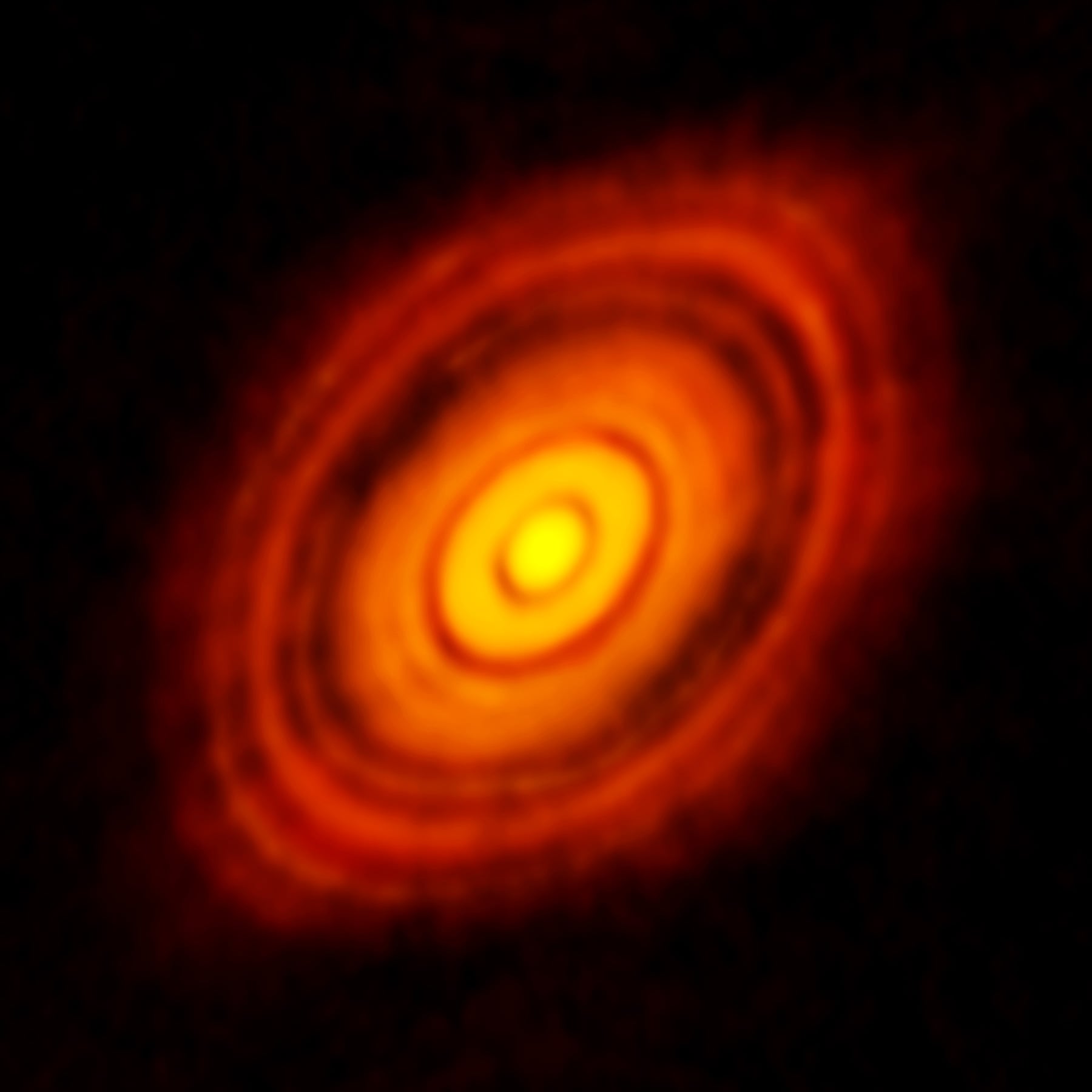 Protoplanetary disk HL Taurus {Credit : ALMA ESO/NAOJ/NRAO)
Even stranger, these dramatic features appear only on one side of the disk. The other side cuts off sharply with no visible filaments at all. This bizarre asymmetry suggests something violent happened recently, perhaps a sudden influx of gas and dust falling onto the disk, or interactions with its surrounding environment that are still reshaping its structure.
“We were stunned to see how asymmetric this disk is, The lopsided nature of the disk challenges existing models of how these systems evolve.” - Joshua Bennett Lovell of the Centre for Astrophysics.
The disk obscures whatever star or stars lie at its centre. Scientists believe it might harbour either a single massive hot star or a binary pair. With a mass estimated at 10 to 30 times that of Jupiter, there’s more than enough material here to build multiple gas giant planets, making it a scaled up version of what our own Solar System might have looked like 4.6 billion years ago.
Hubble’s visible liight imaging provides exceptional detail that complements observations from NASA’s James Webb Space Telescope, which sees in infrared. Together, these observatories are revealing that planet formation can be far more turbulent and dynamic than previously thought.
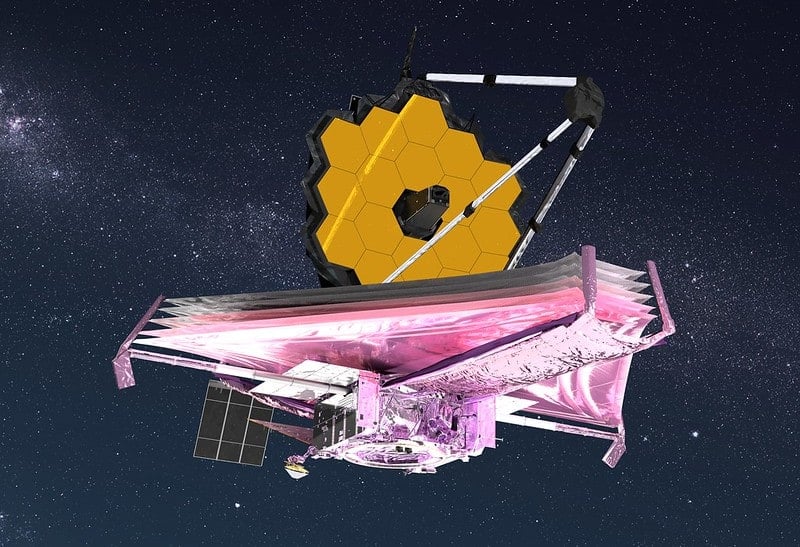 Artist impression of the James Webb Space Telescope (Credit : NASA GSFC/CIL/Adriana Manrique Gutierrez)
This discovery transforms IRAS 23077+6707 into a unique laboratory for studying how planets form under extreme conditions. Right now however, astronomers have more questions than answers about what’s driving the chaos in this distant stellar nursery.
Source : NASA’s Hubble Reveals Largest Found Chaotic Birthplace of Planets
