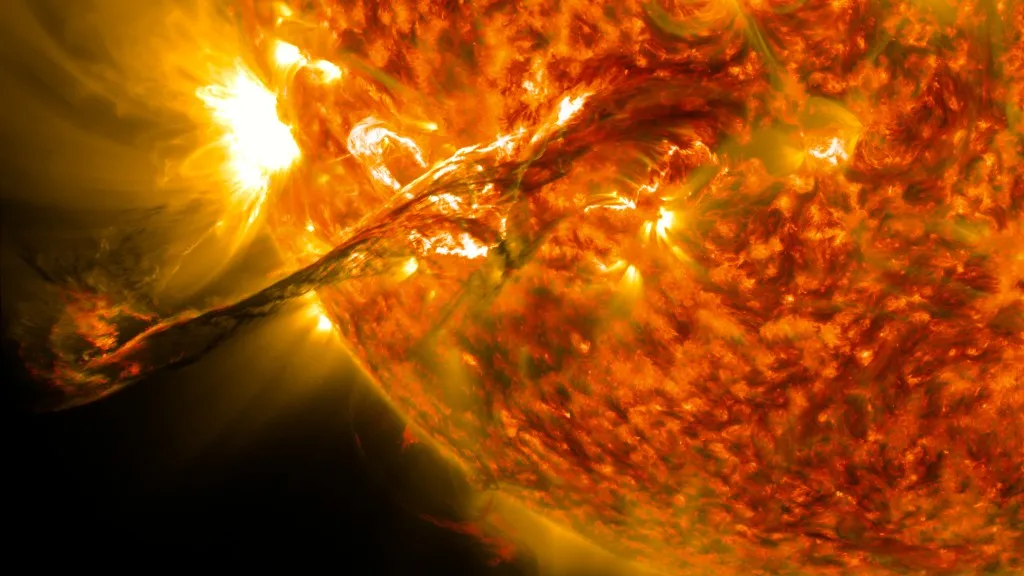
Somewhere around the year 774 CE, the Sun erupted with extraordinary violence. High energy particles slammed into Earth’s atmosphere, triggering nuclear reactions that produced radioactive carbon-14. Trees across the planet absorbed this carbon and locked it into their wood, preserving a record of that ancient solar storm that scientists can still read today.
These extreme events, called Miyake events, represent space weather far more powerful than anything measured in the modern era. They dwarf even the 1859 Carrington Event, which created auroras near the equator.
Understanding these ancient storms matters because similar events could devastate our technology dependent civilisation, knocking out satellites, disrupting GPS and damaging power grids.
Tree rings have become invaluable for studying these storms. When cosmic rays hit Earth’s atmosphere, they create carbon-14 that trees incorporate into their wood. During a Miyake event, radioactive carbon production spikes dramatically, leaving signatures in tree rings that persist for millennia.
But there’s a problem. Scientists have noticed frustrating inconsistencies when comparing trees from the same event. Some show sharp carbon-14 spikes while others show gradual increases. The timing varies between species and locations, making it difficult to pinpoint exactly when storms occurred or determine their true intensity.
A comprehensive new study co-authored by Northern Arizona University scientists including lead author Amy Hessl, Mariah Carbone and Andrew Richardson, reveals that trees don’t instantly convert atmospheric carbon into wood. Instead, they store it for months or even years before using it.
“Although tree rings are one of our best tools for reading Earth’s history, they’re not perfect instruments” - West Virginia University scientist Amy Hessl, lead author.
Different species follow different strategies. Some grow rapidly in spring using recently absorbed carbon. Others, particularly conifers, rely on carbohydrates stored from previous seasons. A pine tree forming wood in May might be using carbon absorbed the previous July, smearing the atmospheric signal across multiple rings.
It seems that climate matters too. Trees in harsh environments store more reserves to survive droughts or winters, potentially diluting the spike from a Miyake event. Growing season timing also affects the signal for example trees that grow mainly in spring record different atmospheric carbon than those growing steadily through summer.
“Understanding how trees acquire carbon from the atmosphere, store it for future use and then use it to grow new wood is critical. The biology determines how faithfully the atmospheric signal is preserved” - Mariah Carbone.
For solar storm research, accounting for tree biology allows scientists to determine more accurately when Miyake events occurred and how intense they were. The stakes are considerable with satellites, power grids and astronauts all vulnerable to extreme solar particle events.
The geological record suggests Miyake events occur roughly once every thousand years. The most recent confirmed event happened around 993 CE. By understanding how tree biology shapes these records, scientists can read Earth’s history of extreme space weather with greater clarity and perhaps gain the insight needed to protect our technological civilisation when the Sun next unleashes its fury.
Source : How tree rings help scientists understand disruptive extreme solar storms