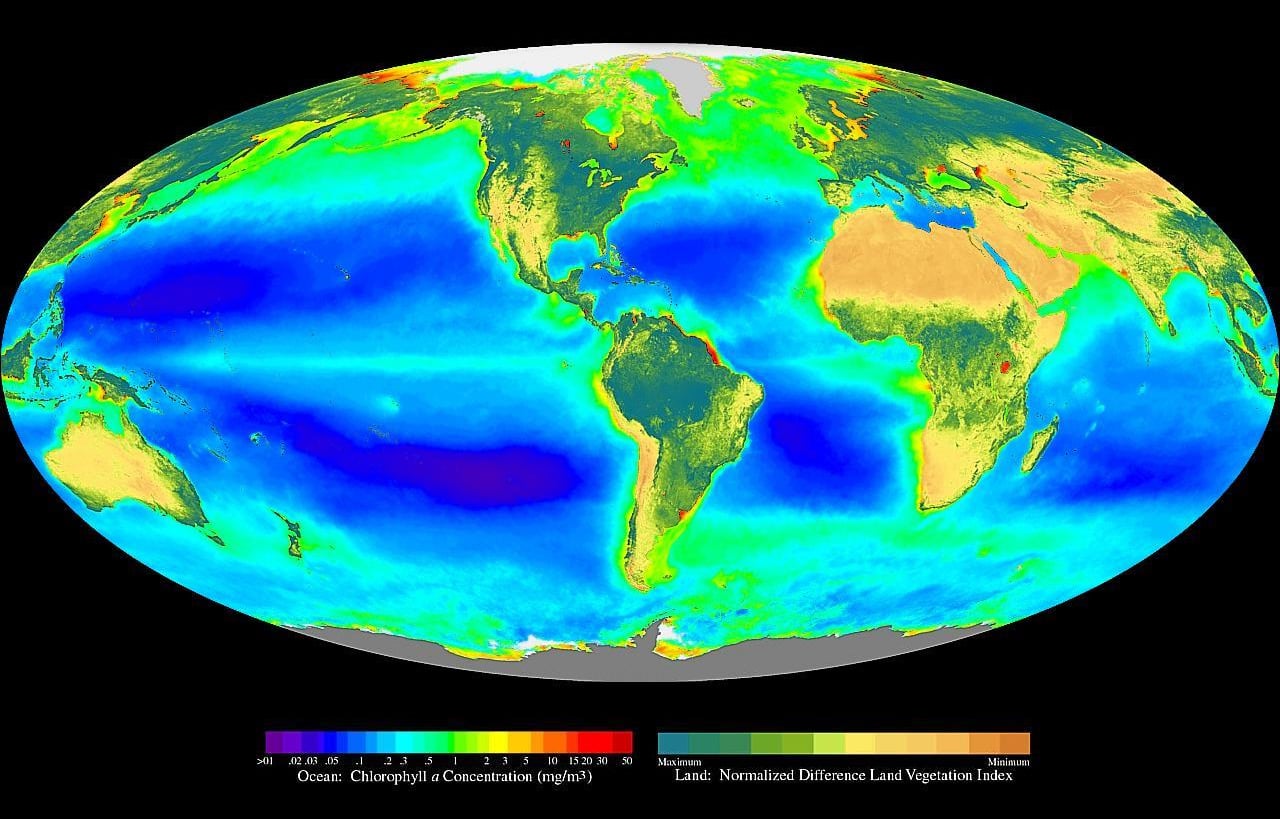
Here's a thought experiment. Imagine looking at Earth from a distant star system, armed with a powerful telescope capable of capturing its reflected light. Could you tell the planet was alive? The answer, remarkably, might be yes and the clue would come from the colour of the plants.
Vegetation does something peculiar with light. Chlorophyll, the pigment that makes plants green, absorbs visible light to power photosynthesis. But in doing so it draws a sharp line at the boundary between red and near-infrared wavelengths (around 700 nanometres) and reflects near-infrared strongly back into space rather than absorbing it. The result is an abrupt jump in reflectivity at that wavelength called the vegetation red edge. It's a spectral fingerprint of photosynthetic life, and it's written into Earth's light profile for anyone with the instruments to read it.
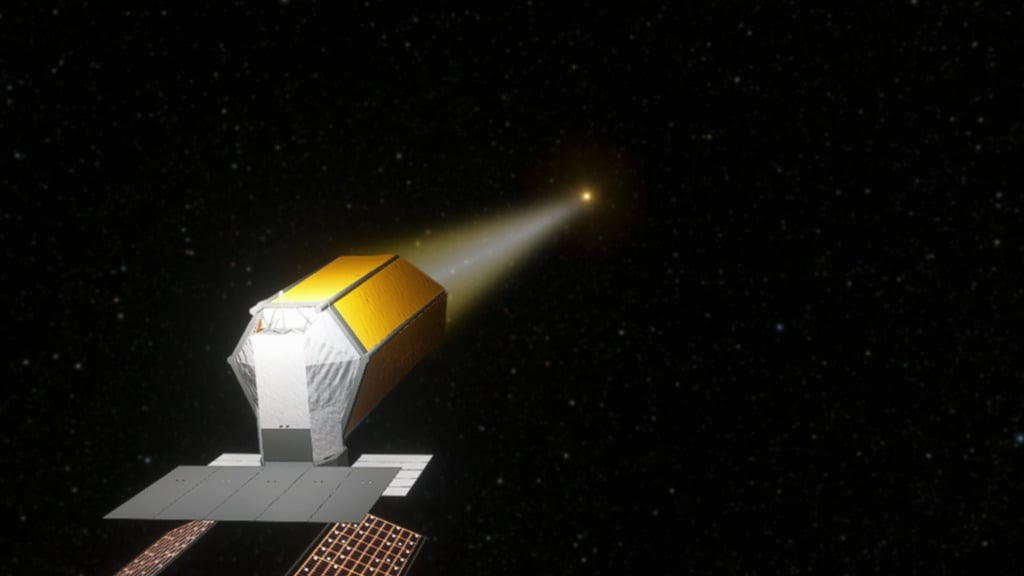
Future observatories, particularly NASA's planned Habitable Worlds Observatory, are being designed with exactly that goal in mind. But detecting the red edge on a distant exoplanet is far more complicated than it sounds, and a new study by researchers at JPL and NASA Goddard Space Flight Center has tackled one of the thorniest problems in doing so.
The difficulty is that real planets are complicated. Previous models of Earth like exoplanets tended to treat their surfaces and atmospheres as uniform with a single type of terrain and a consistent cloud layer. The real Earth is nothing like that. At any given moment, part of it is ocean, part forest, part desert, part ice cap. Some regions are blanketed by thick cloud, others are clear. This patchwork of different surfaces reflects light in different ways depending on what's in view and at what wavelength, and clouds can muddy the signal considerably.
The team, led by Zachary Burr, used realistic three-dimensional models of Earth itself to simulate the planet at nine different times of day to capture different surface features rotating into view. They ran these through a sophisticated retrieval framework called ExoReL, extended to account for surfaces whose reflectivity varies with wavelength rather than assuming a flat, uniform response.
The results revealed that, even in the presence of cloud cover, and even when the spectra were averaged to mimic the longer observation times a real telescope would need, the red edge signal remained detectable, as long as more than half the visible surface was land rather than ocean. The team could pinpoint the jump in reflectivity to within about 70 nanometres, robust enough to distinguish biological from non-biological causes.
This work is going to help tremendously in the search for habitable worlds. An exoplanet isn't going to helpfully keep the same face pointed towards us, and its clouds won't clear on request. Knowing the red edge survives these real world complications through patchy clouds, mixed terrain and rotation means the Habitable Worlds Observatory has a genuine target worth hunting for.
Source : Retrieving the Red Edge on Earth-like Planets with Heterogeneous Clouds and Surfaces