
Stars are the basic units of a galaxy. But they form from gas, which is even more elemental. How star-forming gas moves around in a galaxy shapes star formation, and also shapes the galaxy and how it evolves.
Stars form when massive clouds of molecular hydrogen cool and collapse. Densities form, and they gather more gas around them, forming protostars. The protostars continue to accrete gas until eventually, they become so massive that temperature and pressure are great enough to trigger fusion. As multiple young stars form in a cluster, their UV radiation creates stellar feedback, which affects the remaining gas.
That's a snapshot of how stars form, and though there are many more details waiting to be understood, it's a helpful overview. But astronomers want to to know more than just how stars form in their clusters. They want to know how quickly these clusters can disperse their natal gas with their stellar feedback, and how quickly their feedback can then affect other nearby gas. In new work, a team of researchers used the JWST and the Hubble to study star clusters and how quickly they emerge from their cloaks of natal gas.
Their research is "The emerging timescale of young star clusters regulated by cluster stellar mass," and it's published in Nature Astronomy. The lead author is Alex Pedrini, from Stockholm University and the Oskar Klein Centre in Sweden.
As infrared astronomy has improved, astronomers have gotten better looks at young star clusters still obscured by gas. The JWST has more power than any other telescope when it comes to these types of observations, and its observations have helped astronomers understand the timescale involved in star cluster formation. In fact, one of the telescope's four main science themes is the Birth of Stars.
Astronomers hoped that when launched, the JWST could answer an important question: how long does it take for a young star cluster to disperse the cloud of gas it was born in? An answer to that question will help astronomers understand how soon a star cluster's feedback can then reach gas outside of its birth cloud.
"Quantifying the timescales of star cluster emergence from their natal clouds remains one of the main challenges in understanding the star formation process," the authors write. "These timescales are fundamental measurements of the star formation cycle within galaxies, yet are difficult to constrain due to the complex interplay between stellar feedback and star formation across multiple physical scales."
The researchers used the dynamic duo of the JWST and the Hubble to examine almost 9,000 star clusters in four different galaxies: the Whirlpool Galaxy (M51), the Southern Pinwheel Galaxy (M83), the Phantom Galaxy (NGC 628), and NGC 4449. The JWST's infrared observations are from the now completed FEAST (Feedback in Emerging extrAgalactic Star clusTers) observing program, and the Hubble provided visible light images of clusters that were no longer obscured by gas. "In this work, we take advantage of extensive JWST and HST multiwavelength campaigns to constrain the emerging timescales of star clusters from a deeply embedded phase to a optically exposed state," the authors write.
The observations showed that massive clusters played a dominant role and their stellar feedback had a powerful effect on further star formation in their galaxies.
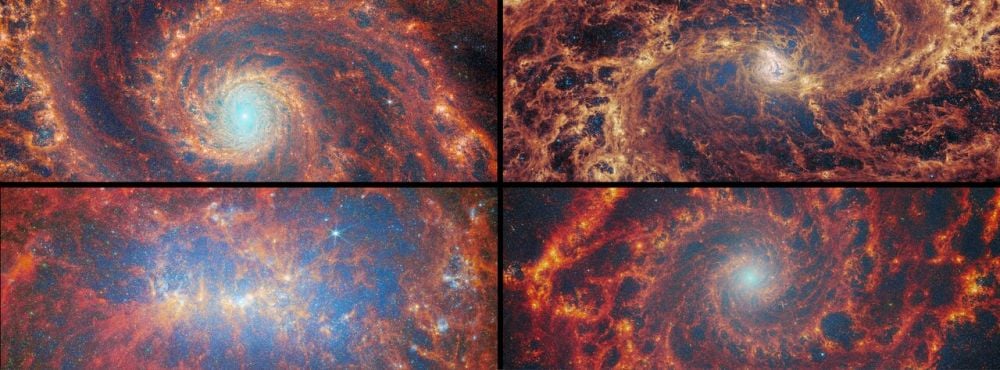 *The four galaxies in the study, clockwise from top left: Messier 51, Messier 83, NGC 4449, and NGC 628. Blue is infrared light that shows where bright stars are. Orange and yellow shows ionized gas, and red shows dust grains and complex molecules like polycyclic aromatic hydrocarbons. Image Credit: ESA/Webb, NASA & CSA, A. Pedrini, A. Adamo (Stockholm University) and the FEAST JWST team*
The 9,000 star clusters span different evolutionary stages. Some were very young and just beginning to emerge from their natal gas clouds. Others were further along and had partially dispersed their gas. Others were completely unobstructed, and the Hubble imaged these ones in visible light.
"Because the number of massive stars and the mass of the most massive star scale with cluster mass , it is expected that massive clusters dominate the production of ionizing photons in galaxies," the authors explain in their paper. "The key question we address here is how long it takes for clusters to emerge from their birth clouds."
With its ability to see inside star clusters, the JWST determined the age and mass of each cluster. Its observations found something that, though not necessarily surprising, is important and can improve simulations of stellar feedback and star formation: Massive clusters emerge from their clouds quicker than less massive clusters.
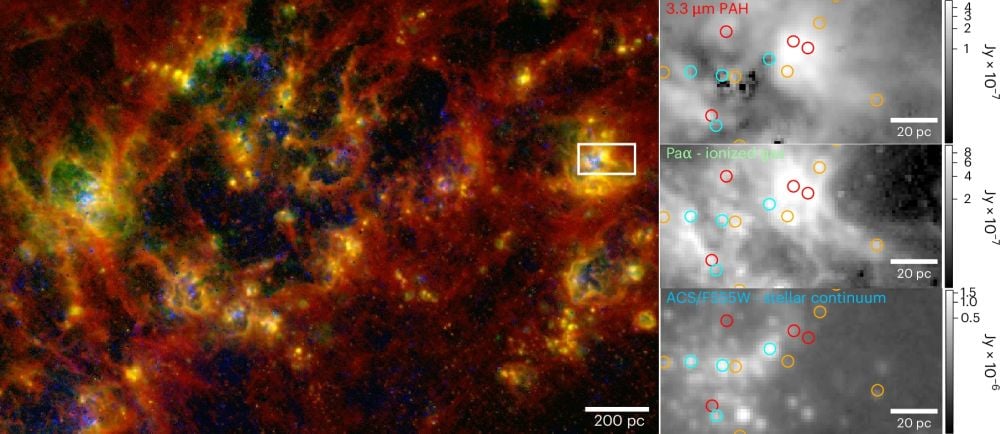 *These images from the research show a star forming complex in M51. It's an RGB composite image of the complex observed with HST and JWST. The panels on the right show different emissions detected with different filters, and each circle is a star cluster. "Positions of eYSCs and optically detected YSCs are marked with red, orange and cyan circles for eYSCI, eYSCII and oYSCs, respectively," the authors explain. eYSCI and eYSCII are embedded clusters, and oYSCs are optically visible clusters. Image Credit: Pedrini et al. 2026. NatAstr*
"We find a strong correlation between dispersal timescale and cluster stellar mass, with massive clusters emerging faster than their lower-mass counterparts," the authors explain. "This is a critical constraint on star formation and stellar feedback simulations, which struggle to fully reproduce star clusters formation and emergence."
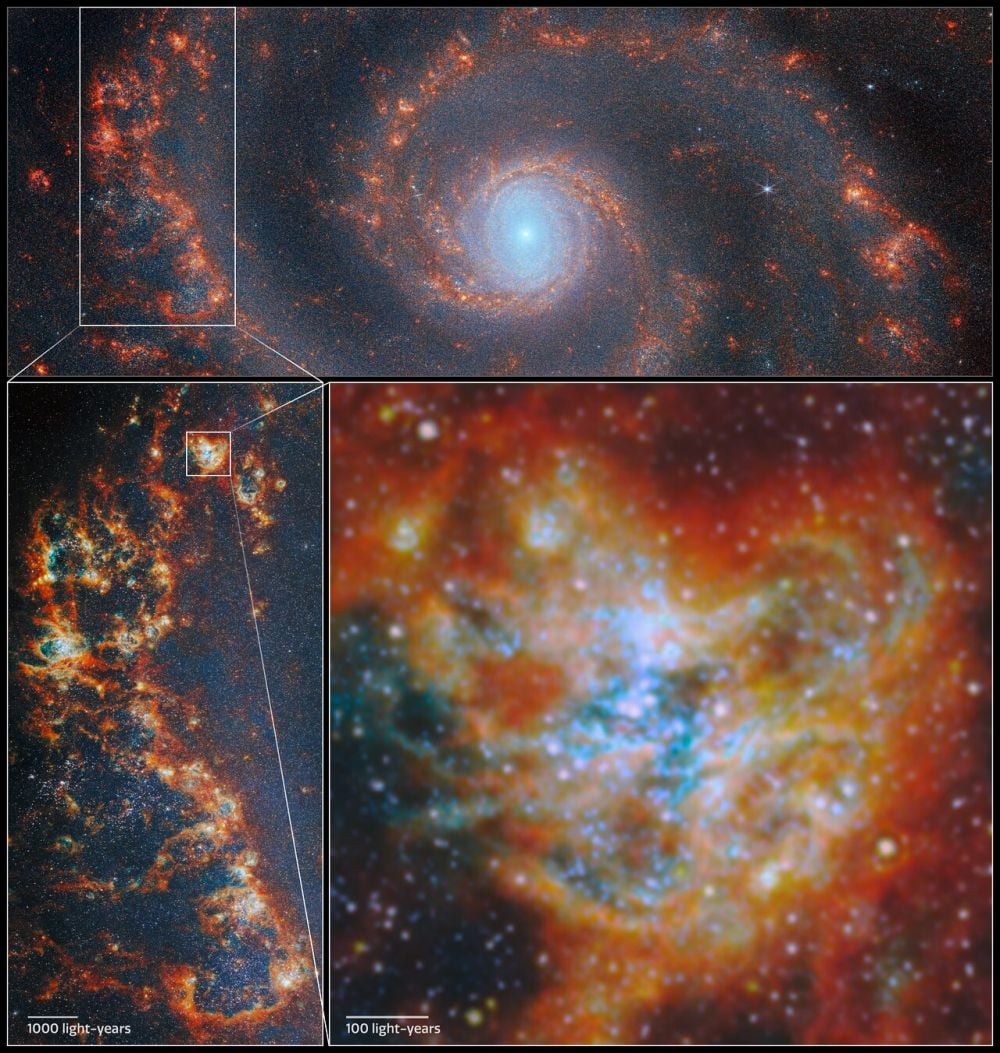 *These images show the location of one of the star clusters in M51, the Whirlpool Galaxy. "The thick cloud of star-forming gas, in which clumps collapsed to form each of the individual star clusters, is shown here in red and orange colours that represent infrared light emitted by ionised gas, dust grains, and complex molecules such as polycyclic aromatic hydrocarbons (PAHs)" a press release states. Many of the bright dots are not individual stars, but clusters of stars. The cyan regions are caused by powerful UV radiation from hot young stars in the clusters. Eventually, stellar feedback and supernovae explosions will drive gas away, ending star formation. Image Credit: ESA/Webb, NASA & CSA, A. Pedrini, A. Adamo (Stockholm University) and the FEAST JWST team*
Massive hot, young stars are responsible for most of the UV radiation in a galaxy, so the sooner they emerge from their clusters, the sooner their feedback starts to affect their galaxy. Now, thanks to this work, we know that more massive clusters disperse their gas sooner than less massive clusters, showing that massive clusters start shaping their galaxies with their feedback sooner than less massive clusters.
Astronomers can use these results to simulate how star-forming gas is moved around in a galaxy, driving its evolution. But there's more to these results, too, because of the intimate connection between stars and planets.
Since a massive cluster strips away gas, and dust, faster than smaller clusters, this affects planet formation. And it's not just stellar feedback that strips away gas, supernovae explosions also play a role. Protoplanetary disks around stars will struggle to form when exposed to the UV radiation from more massive stars that have cleared out their gas. Those stars can now dissipate protoplanetary disks, making planet formation more challenging.
"Our results emphasize the central role of massive clusters in driving the escape of ionizing radiation into the galactic medium," the authors write. "Finally, they impose time limitations for planet formation in massive cluster environments where disks get exposed to ultraviolet irradiation and further gas infall is halted."
“This work brings together researchers simulating star formation and those working with observations, as well as groups researching planet formation,” said lead author Pedrini in a press release. “Using Webb, we can look into the cradles of star clusters and connect planet formation to the cycle of star formation and stellar feedback.”
