Mercury is one of the four rocky planets of the Solar System, yet its chemistry is very different from Earth, Venus, and Mars. Missions to the planet show that it has an iron-poor, but sulfur- and magnesium-rich crust, which has implications for its interior makeup. Furthermore, it's known to planetary scientists as the most reduced planet in the Solar system. That means the chemicals it contains are dominated by sulfides, carbides, and silicides, as opposed to oxides like we see here on Earth.
A team of Rice scientists has figured out a way to model Mercury's reduced state. They didn't have any rocks from Mercury, so they improvised. “Mercury’s surface looks completely different than Earth’s,” said Rajdeep Dasgupta, the Maurice Ewing Professor in Earth Systems Science and director of the Rice Space Institute Center for Planetary Origins to Habitability. “We couldn’t study its magmatic evolution using assumptions built off our understanding of Earth, and missions data are difficult to interpret. We had to find ways to bring the planet closer to our lab — specifically, through the meteorite Indarch.”
All About Indarch
Indarch fell to Earth in Azerbaijan in 1891. It's classified as an EH4 enstatite chondrite, a type that is very rare. They're known to have formed near the Sun in the early solar nebula and, along with a high iron content, also have rare types of sulfides (sulfur-rich compounds). Indarch likely went through some thermal heating during its formation and subsequent evolution.
Scientific studies of Indarch show that it has a chemical makeup very similar to Mercury's. That made it a prime candidate to help the science team understand how Mercury got to be the way it is. “Indarch chemically is as reduced as rocks on Mercury,” said Yishen Zhang, a postdoctoral researcher and first author on a paper about Mercury's makeup. “It is believed to be a possible building block of the planet.”
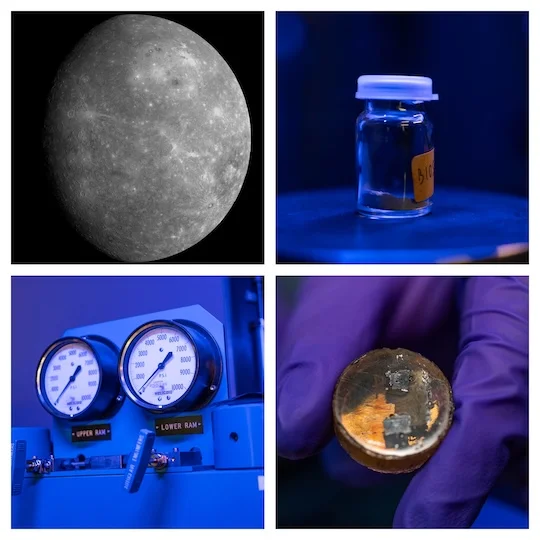
To study the rock and see how much it matches Mercury, the team "cooked up" some of their own Mercury rocks in the lab. Zhang made a model melt composition of Indarch, placed it in a vial and subjected the mixture to a high-temperature cooker to match the conditions that existed on Mercury during formation and evolution. The result was that sulfur present in a rock lowers the temperature at which magmas similar to Mercury's start to crystallize. “This process of cooking a rock can show us what happened chemically inside of Mercury,” Zhang said. “By using the temperature, pressure and chemical constraints derived from spacecraft observations and models, we recreate Mercurylike conditions to understand how magmas form and evolve there — even without direct samples from the planet.”
What This Means for Mercury
The presence of sulfur in a low-iron environment such as Mercury's means that the existing sulfur had to find other rocks to bind to. In this case, it seems to have found magnesium and calcium. On Earth, these rock-forming elements would typically bind to oxygen. That would create what we see on Earth today -- a silicate network made up of silicon, oxygen and rock-forming elements. When sulfur replaces oxygen, however, that network becomes weaker and crystalizes at a lower temperature. “As Indarch may represent Mercury’s proto-planet state,” Zhang said, “these experiments show that Mercury likely formed with sulfur occupying a structural position that on Earth belongs to oxygen. This fundamentally changes how the planet’s mantle solidified.”
Sulfur lowers the temperature at which reduced melted rocks begin to crystallize. The sulfur-rich magmas on Mercury very likely stay molten at lower temperatures. That's in contrast to similar types of Earth magmas, which means that Mercury has a unique chemical composition: low iron, high sulfur and its chemically reduced state.
As Mercury Evolved It Reduced
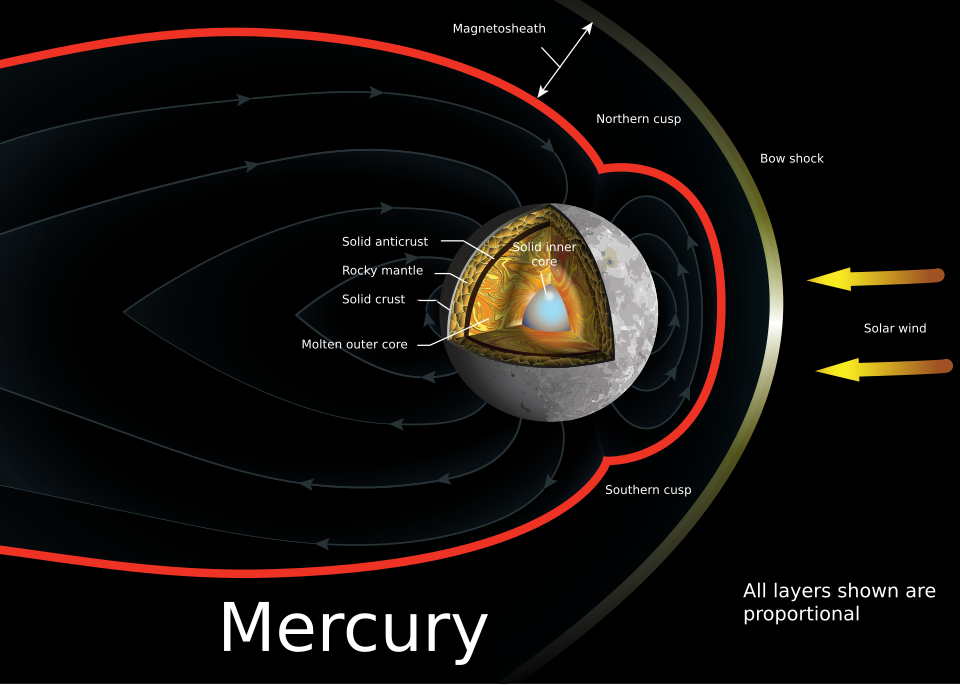
Mercury began as the other rocky planets did, in a molten-rock state after planetesimals accreted to form it. It began forming some 4.5 billion years ago and its early evolution is not yet well-understood. It has a mantle, and likely had a magma ocean very early in its history. Inside, it may have a solid outer core covering a deeper liquid core, and finally a very small solid core.
Its evolution to a reduced planet status gives new insights into how all rocky planets form and change based on their chemical makeup. In particular, it can shed some light on the process of differentiation, which creates distinct layers on and within rocky worlds. Understanding how and when it begins during a planet's formation is a big step in knowing the full history of rocky worlds and the behavior of their magmas.
Since we often compare other rocky planets to what we know about Earth, the chemistry of Mercury gives planetary scientists a chance to compare chemical evolution of the inner worlds. What Zhang found is that sulfur lowers the temperature at which these reduced melted rocks begin to crystallize. That means sulfur-rich magmas on Mercury may stay molten at lower temperatures than similar magmas on Earth. The reason for this significantly decreased crystallization temperature, Zhang found, is because of Mercury’s unique chemical composition: low iron, high sulfur and the chemically reduced state.
“This is a fascinating glimpse of how Mercury may have evolved as a planet to its unique current-day surface chemistry,” Dasgupta said. “More importantly, it provides a way for us to think about planets not based on how Earth was formed, but based on their own unique chemistry and magmatic processes under vastly different conditions. What water or carbon does to magmatic evolution of Earth, sulfur does on Mercury.”
For More Information
Rice Researchers Find Sulfur-rich Mercury Magmas Behave Differently than Earth's