
Planets form inside swirling discs of gas and dust surrounding newborn stars, hidden that make them extraordinarily difficult to detect. Astronomers know these protoplanetary discs contain the raw ingredients for planetary systems because our own Solar System condensed from such a disc 4.6 billion years ago, but actually spotting planets while they’re still forming has remained one of astronomy’s great challenges. Until now, very few planets have been confirmed around stars that are still in their infancy.
ESA’s Gaia space telescope has changed that equation. A team led by Miguel Vioque at the European Southern Observatory used Gaia to study 98 young stellar systems, and found evidence for unseen companions in 31 of them. The breakthrough came from Gaia’s extraordinary precision in measuring stellar positions and motions. Even planets too small and faint to see directly exert gravitational tugs on their host stars, causing them to wobble slightly. Gaia detects these wobbles by tracking how stars move against the background sky with unprecedented accuracy.
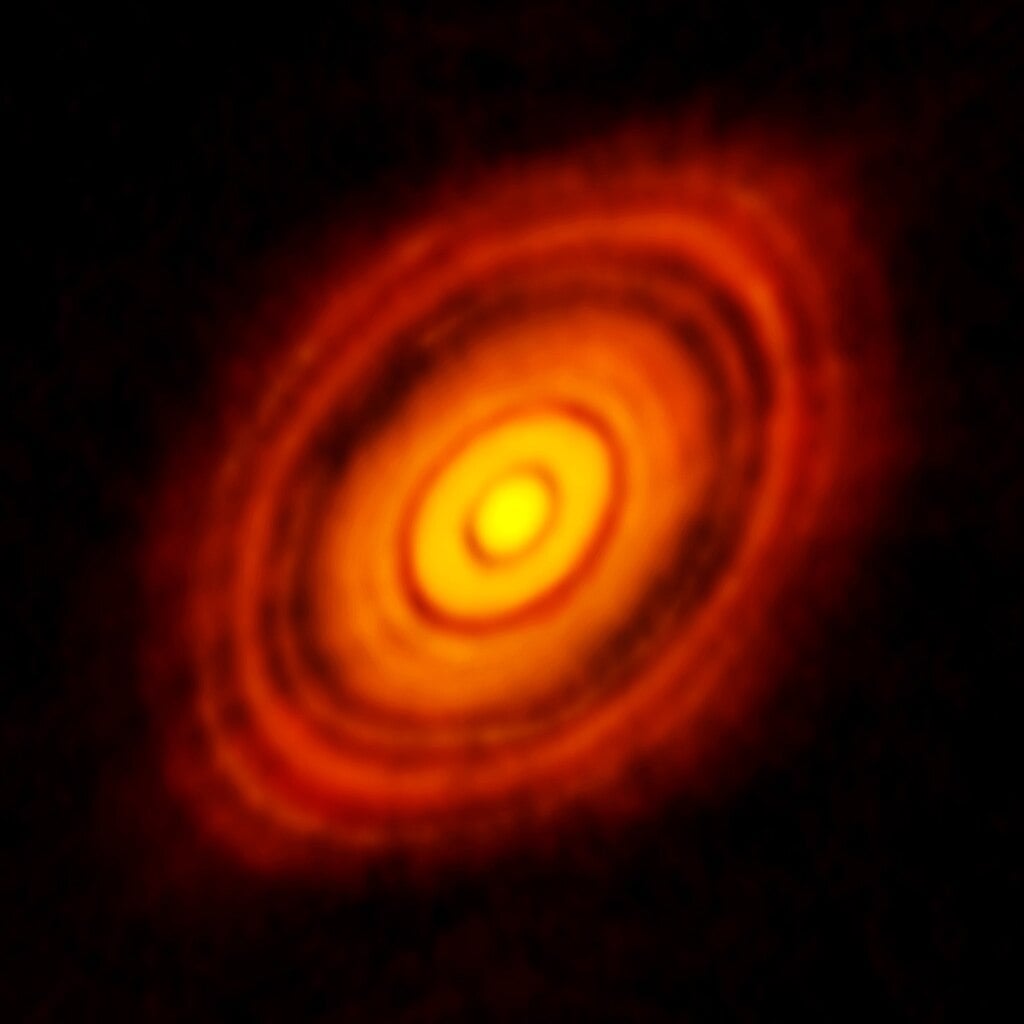 Protoplanetary disk around HL Tauri (Credit : ALMA)
The technique isn’t new, astronomers have used it for decades to find planets around older, stable stars, but applying it to stars that are still forming represents a significant advance. Young stars are inherently unstable, pulsating and varying as they settle into their main sequence lives, which makes detecting the subtle gravitational signature of a planet far more difficult. That Gaia succeeded demonstrates both the telescope’s remarkable sensitivity and the power of its all sky survey approach.
Out of the 31 systems showing evidence of companions, seven display motions consistent with objects of planetary mass. Eight systems likely host brown dwarfs, objects larger than planets but smaller than stars, while the remaining sixteen probably contain additional stars orbiting the primary. The stunning collage released by ESA shows these systems as glowing orange and purple discs captured by the Atacama Large Millimetre Array, with Gaia’s predicted companion locations marked in cyan. For comparison, the collage includes a reconstruction of what our own Solar System likely looked like at one million years old, with Jupiter’s predicted orbit also shown in cyan.
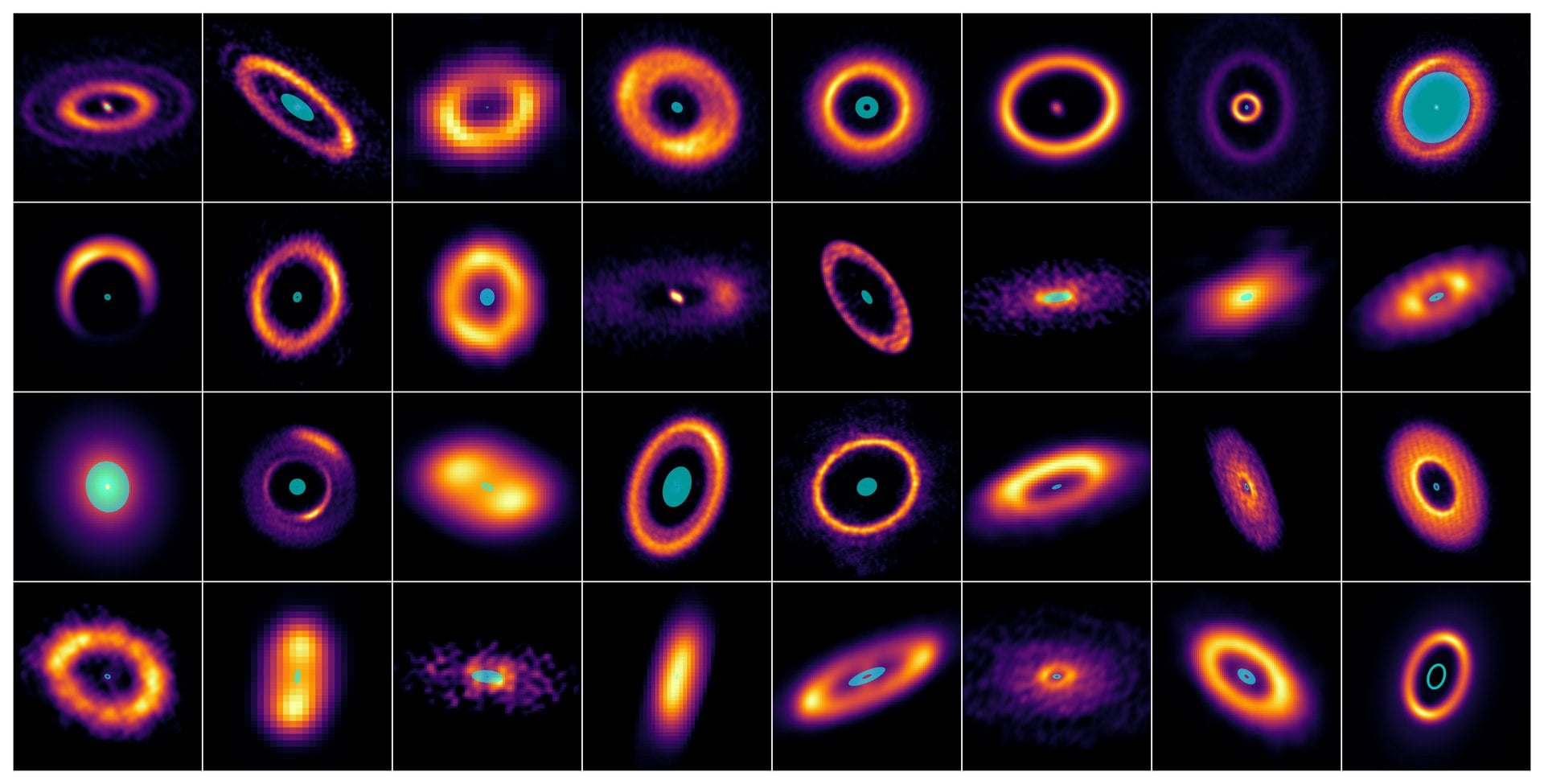 A collage of 32 glowing discs on a black background. Each disc shows concentric rings in vivid colours: purple, orange, and yellow, with bright cyan centres. The discs vary in size and orientation, creating a striking pattern of circular and elliptical shapes (Credit : ESO, ESA/Gaia/DPAC, M. Vioque et al.)
What makes Gaia’s approach revolutionary is its scale. Ground based searches for forming planets are expensive and can only target a few systems at a time. Gaia surveys the entire sky, enabling astronomers to study hundreds of forming stars and identify companions across large samples for the first time. Understanding how common planets are at different stages of formation and in different environments helps astronomers build comprehensive models of how planetary systems evolve.
The companions Gaia has identified can now be followed up with other telescopes. The James Webb Space Telescope, with its infrared vision that penetrates dust, can study the inner regions of these protoplanetary discs in unprecedented detail, potentially imaging the planets themselves or detecting the gaps they carve in the surrounding material.
