
An ultra-hot Jupiter exoplanet orbiting a young A-type star gave scientists using the Gemini South telescope a look at how both a star and its hot planet can have similar chemical compositions. The team, led by Arizona State University graduate student Jorge Antonio Sanchez, took spectra of the planet, called WASP-189b, using the Immersion Grating Infrared Spectrograph instrument on loan from McDonald Observatory in Texas. The observations measured the abundance of magnesium compared to silicon in the hot planet's atmosphere and allowed the team to compare it to the makeup of its parent star.
This is the first time these elements have been measured simultaneously in an ultra-hot Jupiter in abundances similar to its host star. According to Sanchez, the discovery of magnesium and silicon in the star reinforces an assumption made about exoplanetary systems. “WASP-189b gives us a much-needed observational anchor in our understanding of terrestrial planet formation since it offers a measurable quantity that validates the presumed resemblance of stellar composition and the proportion of rocky material around host stars used to form planets,” said Sanchez.
WASP-189b was discovered in 2018 and then further studied by the Characterizing Exoplanets Satellite (CHEOPS) in 2020. It's roughly twice the mass of our own Jupiter and moves in a close-in 2.7-day orbit polar orbit around the young host star HR 5599. Because it's such a hot world, WASP-189b contains a lot of vaporized metals and volatile elements in its atmosphere. That rich mix makes it an attractive candidate for further spectroscopic studies, and scientists could start using other such stars to refine their models.
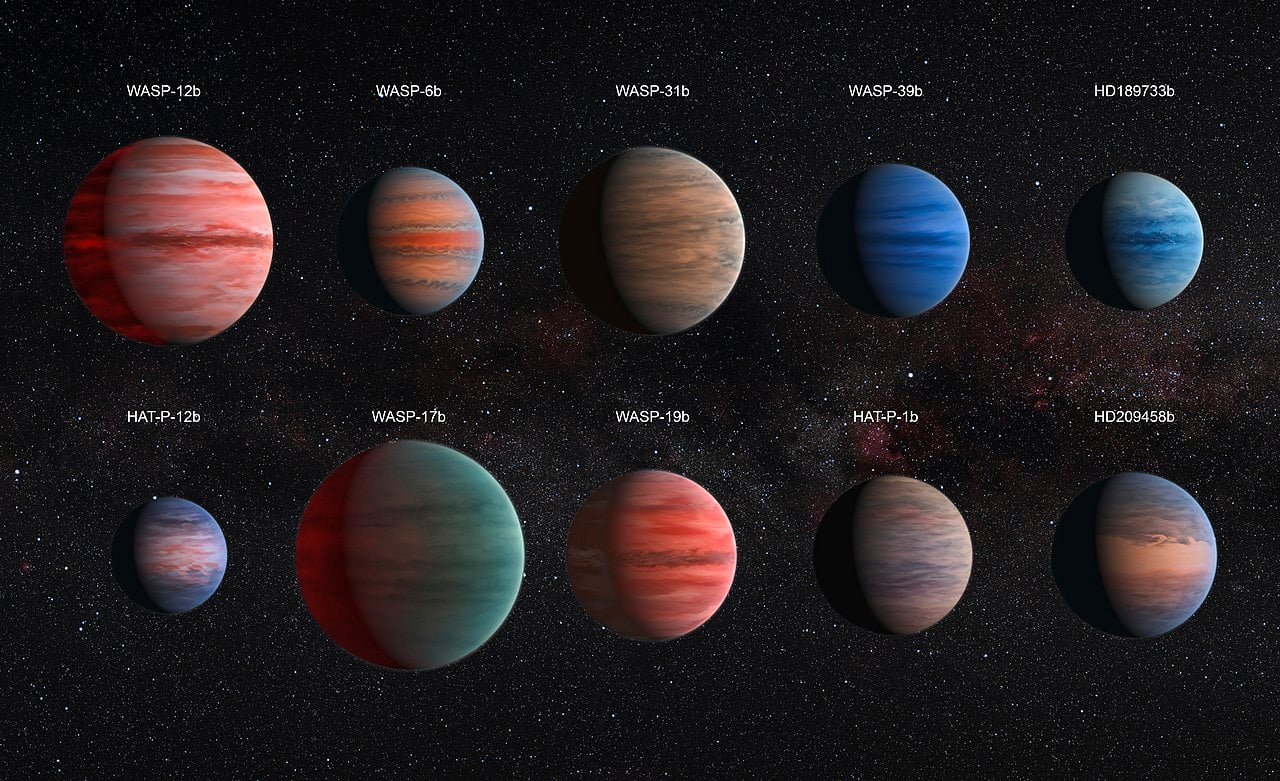 An array of hot Jupiter exoplanets. They come in a range of sizes, densities, and temperatures. Most orbit close to their host stars and give insight into the evolution of such planets. Courtesy ESA/Hubble & NASA.
Upholding Planet-forming Theory
Stars and their planets start out in clouds of gas and dust. Over time, such a cloud begins to contract, with a protostellar object forming at the center of a protoplanetary disk. The star is "born" when it begins its its hydrogen fusion stage and is not making anything heavier than helium in its core. If it has any other abundances of materials such as carbon, oxygen, magnesium, silicon, and iron in its outer layers, those came from the disk in which the star formed. That seems to be true of HR 5599. Our own Sun is a hydrogen-fusing furnace, yet it also has traces of metals in its atmospherre, indicating its birthplace in a cloud rich in heavier elements.
In the process of planetary formation, worlds begin to accrete in the disk and it makes sense that the abundances of their heavier chemical elements will be similar to the those found in the host star. Rocky planets (like Earth) accumulate from heavier elements, while the gas and ice giants form from accretions of hydrogen gas and ices. All of these materials came from the same primordial cloud that birthed the star. Scientists would like to assume that similar formation scenarios existed for other stars and their planets. This is why the ASU team used Gemini to take spectra of the star and its planet.
Obviously, rocky planets will show higher ratios of the heavier elements. But, hot planets, like WASP-189b (which has a temperature close to that of the Sun's surface), more than 3354 K (3080 C, 5577 F)) are hot enough to keep magnesium, silicon, and iron in a vaporous phase. The fact that the "rocky material" is found in such a state in WASP-189b's intensely hot atmosphere, illustrates the chemical link between a star and its planets via its birth cloud. It won't matter whether they evolve into rocky or hot gaseous worlds. This finding also opens a new route to understand how exoplanets form and evolve.
Implications for Astrobiology
The science of astrobiology is intimately connected to the search for life and the conditions for life both inside and outside of our own Solar System. It looks for habitable environments on such places as Enceladus and Europa, as well as Mars. Beyond our Sun and planets, astrobiologists search out worlds around other stars that might be habitable by looking for similar places. Astrobiologists assume that certain conditions have to be present for a world to be hospitable to life. Those include its position in the "habitable zone" of its star (where liquid water can exist on a world's surface). In addition to having water, the world should have a chemical makeup that is also tied into the evolution of life.
By measuring the chemical composition of a star, scientists can infer the abundances of rock-forming elements present in the primordial disk in which it and its exoplanets formed. That birthplace actually influences the conditions (temperature, climate, geochemistry) that can make a planet habitable for life. Take Earth, for example. Its rocky composition influence our magnetic field, take part in plate tectonics, and provides the right chemicals to encourage and sustain life on and above the planet. In addition, measurements of such elemental abundances and their persistence in the atmospheres of ultra-hot Jupiters can reveal how rocks and ices get mixed into planetary atmospheres of all types.
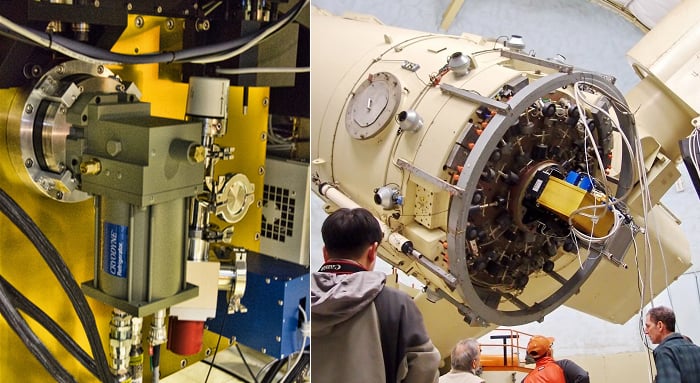 The Immersion GRating INfrared Spectrograph (IGRINS) instrument used to study HR 5599 and WASP-189b shown mounted at the McDonald Observatory in Texas. It was on loan to Gemini South when the observations were taken. Courtesy McDonald Observatory.
Searching Out More Links Between Stars and Exoplanets
As exoplanetary scientists and astrobiologists continue to study distant worlds, observations such as the Gemini South spectroscopic work should uncover more evidence of links between stars and their families of planets. Future multi-wavelength, high-resolution observations to study exoplanet atmospheres like that of WASP-189b will help reveal the larger chemical inventory that exists within distant worlds.
Such studies will enable deeper insights into the conditions that govern planetary origins, evolution, and potential habitability. “Our study demonstrates the capability of ground-based, high-resolution spectrographs to constrain critical species like magnesium and silicon, which are two elemental building blocks from which rocky planets form,” says study co-author Michael Line, Associate Professor at Arizona State University. “This advancing capability opens an entirely new dimension in our study of exoplanet atmospheres.”
For More Information
Gemini South Confirms Long-suspected Link Between the Composition of Exoplanets and their Host Stars
A Stellar Magnesium to Silicon Ratio in the Atmosphere of an Exoplanet
